
6 reactions
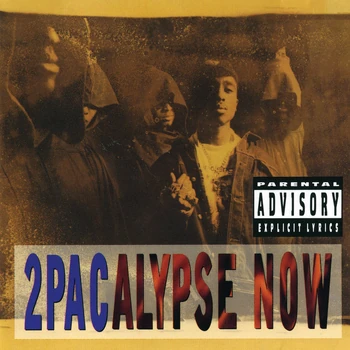
2Pacalypse Now
2Pacalypse Now is the debut studio album by 2Pac , released on November 12, 1991, by Interscope and Jive Records. The LP examines subjects of drug addiction, child negligence, sexual assault, teenage pregnancy, police brutality, and systemic oppression. It peaked at number 64 on the US Billboard 100 and number 13 on the Top R&B/Hip-Hop Albums charts. It was certified Gold by the RIAA on April 19, 1995, and sold over 920,000 copies as of 2011. In commemoration of its twenty-fifth anniversary, it was released on vinyl and cassette on November 11, 2016.In the 1991 press 2Pacalypse Now Biography , he wrote, " 2Pacalypse Now is a battle cry, a no-bullshit record about how we really live, really feel. Hip hop's a mirror reflection of our culture today. Everything put on wax will be remembered and 'Pray' is not how we're living in the '90s. It's up to the rap audience to decide the future of rap music. If you want it to be that bubblegum 'Ice, Ice, Baby' bullshit, that's what it's gonna be. But if you want it to be real, you have to stick with the real N***As. If not, they're going to take this industry away from us. It's gonna be a white thing, just like they did with rock 'n' roll. I'm speaking truth. We've got to stand strong."
Controversy
The album gained notoriety in the press when teenage Ronald Ray Howard murdered police officer Bill Davidson. At the time, Howard was listening to the 2Pacalypse Now tape and was stopped by Davidson, as his vehicle had a broken headlight. The wife of Bill, Linda, said, "There isn't a doubt in my mind that my husband would still be alive if Tupac hadn't written these violent, anti-police songs and the companies involved hadn't published and put them out on the street. I'm sure Tupac has no feeling for me or what happened to my husband. He obviously has a great anger toward law enforcement. All he cares about is singing his songs and making his money, no matter who he hurts." She filed a multimillion dollar civil suit against the rapper and the distribution companies. John Burris, the attorney who represented Shakur, defended, "Tupac is an artist who is acutely aware of the urban problems that confront young black males and police brutality is something he feels very strongly about. Through his music, he seeks to dramatize the plight of people living in the ghetto and to let his audience know they don't have to buy into the scenario that there is no future. He has a free speech right to express himself."
Followed by this, then-U.S. vice-president, Dan Quayle, denounced it for its supposed cause of violent acts. He called Time Warner Inc. to remove the album from stores, and blamed the album for the cause of Davidson's death. He reported, "Once again we're faced with an irresponsible corporate act. There is absolutely no reason for a record like this to be published by a responsible corporation. Today I am suggesting that the Time Warner subsidiary Interscope Records withdraw this record. It has no place in our society."
Critical reception and legacy
In 2016, Vibe called it the album that "marked the birth of a rap revolutionary". CR Fashion Book praised in June 2020, "Arguably his most political—and controversial—musical feat throughout his all-too-brief career, the album cemented 2Pac's legacy as a revolutionary and a brilliant lyricist who was far ahead of his time in his commentary of the trials and tribulations of the Black experience in America." HipHopDX similarly called it 2Pac's "most overtly political" work in his career, which tackles sociopolitical issues in the world. When ranking five of the rapper's albums, Far Out Magazine placed it at number five, writing, "2Pac's flow and voice is not yet established and he's more than a little garbled on some songs. But lyrically, Shakur is already sitting deep in the pocket and throwing bombs."
AllMusic's Marisa Brown wrote, "he also has cleanly carved out an image for himself: articulate and smart, not overtly boastful, and concerned about societal problems, both small and large [...] Yes, the edges of 2Pacalypse Now can be a bit rough, yes the beats aren't always outstanding, and yes, the MC's flow can be a little choppy, even for him, but it's still a great look at what 2Pac could offer, and a must-have for any fan of his, or hip-hop in general." Emilee Woods of RapReviews noted, "Musically, the album has not aged particularly well. It sounds dated, as well it should given that it was released in 1991." She conceded, "Tupac has plenty to discuss. None of it strays too far from the established topic, but he continually finds new ways to address the central issue. [...] It's not an extraordinarily long album, but it is a dense and heavy listen that will take a lot out of you if you pay close attention to the persistent theme. The beats overall fail to make much of an impression, but perhaps that is as it should be, since nothing should be allowed to outshine this kind of lyrical performance. Tupac's vitriol is carried by his sincerity and charisma, both of which would emerge as key traits of the figure that blossomed in the years to come."
2Pacalypse Now is the debut studio album by 2Pac , released on November 12, 1991, by Interscope and Jive Records. The LP examines subjects of drug addiction, child negligence, sexual assault, teenage pregnancy, police brutality, and systemic oppression. It peaked at number 64 on the US Billboard 100 and number 13 on the Top R&B/Hip-Hop Albums charts. It was certified Gold by the RIAA on April 19, 1995, and sold over 920,000 copies as of 2011. In commemoration of its twenty-fifth anniversary, it was released on vinyl and cassette on November 11, 2016.In the 1991 press 2Pacalypse Now Biography , he wrote, " 2Pacalypse Now is a battle cry, a no-bullshit record about how we really live, really feel. Hip hop's a mirror reflection of our culture today. Everything put on wax will be remembered and 'Pray' is not how we're living in the '90s. It's up to the rap audience to decide the future of rap music. If you want it to be that bubblegum 'Ice, Ice, Baby' bullshit, that's what it's gonna be. But if you want it to be real, you have to stick with the real N***As. If not, they're going to take this industry away from us. It's gonna be a white thing, just like they did with rock 'n' roll. I'm speaking truth. We've got to stand strong."
Controversy
The album gained notoriety in the press when teenage Ronald Ray Howard murdered police officer Bill Davidson. At the time, Howard was listening to the 2Pacalypse Now tape and was stopped by Davidson, as his vehicle had a broken headlight. The wife of Bill, Linda, said, "There isn't a doubt in my mind that my husband would still be alive if Tupac hadn't written these violent, anti-police songs and the companies involved hadn't published and put them out on the street. I'm sure Tupac has no feeling for me or what happened to my husband. He obviously has a great anger toward law enforcement. All he cares about is singing his songs and making his money, no matter who he hurts." She filed a multimillion dollar civil suit against the rapper and the distribution companies. John Burris, the attorney who represented Shakur, defended, "Tupac is an artist who is acutely aware of the urban problems that confront young black males and police brutality is something he feels very strongly about. Through his music, he seeks to dramatize the plight of people living in the ghetto and to let his audience know they don't have to buy into the scenario that there is no future. He has a free speech right to express himself."
Followed by this, then-U.S. vice-president, Dan Quayle, denounced it for its supposed cause of violent acts. He called Time Warner Inc. to remove the album from stores, and blamed the album for the cause of Davidson's death. He reported, "Once again we're faced with an irresponsible corporate act. There is absolutely no reason for a record like this to be published by a responsible corporation. Today I am suggesting that the Time Warner subsidiary Interscope Records withdraw this record. It has no place in our society."
Critical reception and legacy
In 2016, Vibe called it the album that "marked the birth of a rap revolutionary". CR Fashion Book praised in June 2020, "Arguably his most political—and controversial—musical feat throughout his all-too-brief career, the album cemented 2Pac's legacy as a revolutionary and a brilliant lyricist who was far ahead of his time in his commentary of the trials and tribulations of the Black experience in America." HipHopDX similarly called it 2Pac's "most overtly political" work in his career, which tackles sociopolitical issues in the world. When ranking five of the rapper's albums, Far Out Magazine placed it at number five, writing, "2Pac's flow and voice is not yet established and he's more than a little garbled on some songs. But lyrically, Shakur is already sitting deep in the pocket and throwing bombs."
AllMusic's Marisa Brown wrote, "he also has cleanly carved out an image for himself: articulate and smart, not overtly boastful, and concerned about societal problems, both small and large [...] Yes, the edges of 2Pacalypse Now can be a bit rough, yes the beats aren't always outstanding, and yes, the MC's flow can be a little choppy, even for him, but it's still a great look at what 2Pac could offer, and a must-have for any fan of his, or hip-hop in general." Emilee Woods of RapReviews noted, "Musically, the album has not aged particularly well. It sounds dated, as well it should given that it was released in 1991." She conceded, "Tupac has plenty to discuss. None of it strays too far from the established topic, but he continually finds new ways to address the central issue. [...] It's not an extraordinarily long album, but it is a dense and heavy listen that will take a lot out of you if you pay close attention to the persistent theme. The beats overall fail to make much of an impression, but perhaps that is as it should be, since nothing should be allowed to outshine this kind of lyrical performance. Tupac's vitriol is carried by his sincerity and charisma, both of which would emerge as key traits of the figure that blossomed in the years to come."


| 39,000 mlx | |
| 30 | |
| 6 |