

18 reactions
The Natural History Museum in London is a museum that exhibits a vast range of specimens from various segments of natural history ...
The museum is home to life and earth science specimens comprising some 80 million items within five main collections: botany , entomology , mineralogy , palaeontology and zoology . The museum is a center of research specializing in taxonomy , identification and conservation. Given the age of the institution, many of the collections have great historical as well as scientific value, such as specimens collected by Charles Darwin . The museum is particularly famous for its exhibition of dinosaur skeletons and ornate architecture—sometimes dubbed a cathedral of nature —both exemplified by the large Diplodocus cast that dominated the vaulted central hall before it was replaced in 2017 with the skeleton of a blue whale hanging from the ceiling.
The Natural History Museum Library contains an extensive collection of books, journals, manuscripts and artwork linked to the work and research of the scientific departments; access to the library is by appointment only. The museum is recognized as the pre-eminent center of natural history and research of related fields in the world. - more at Wikipedia
Visitor information: https://www.nhm.ac.uk/
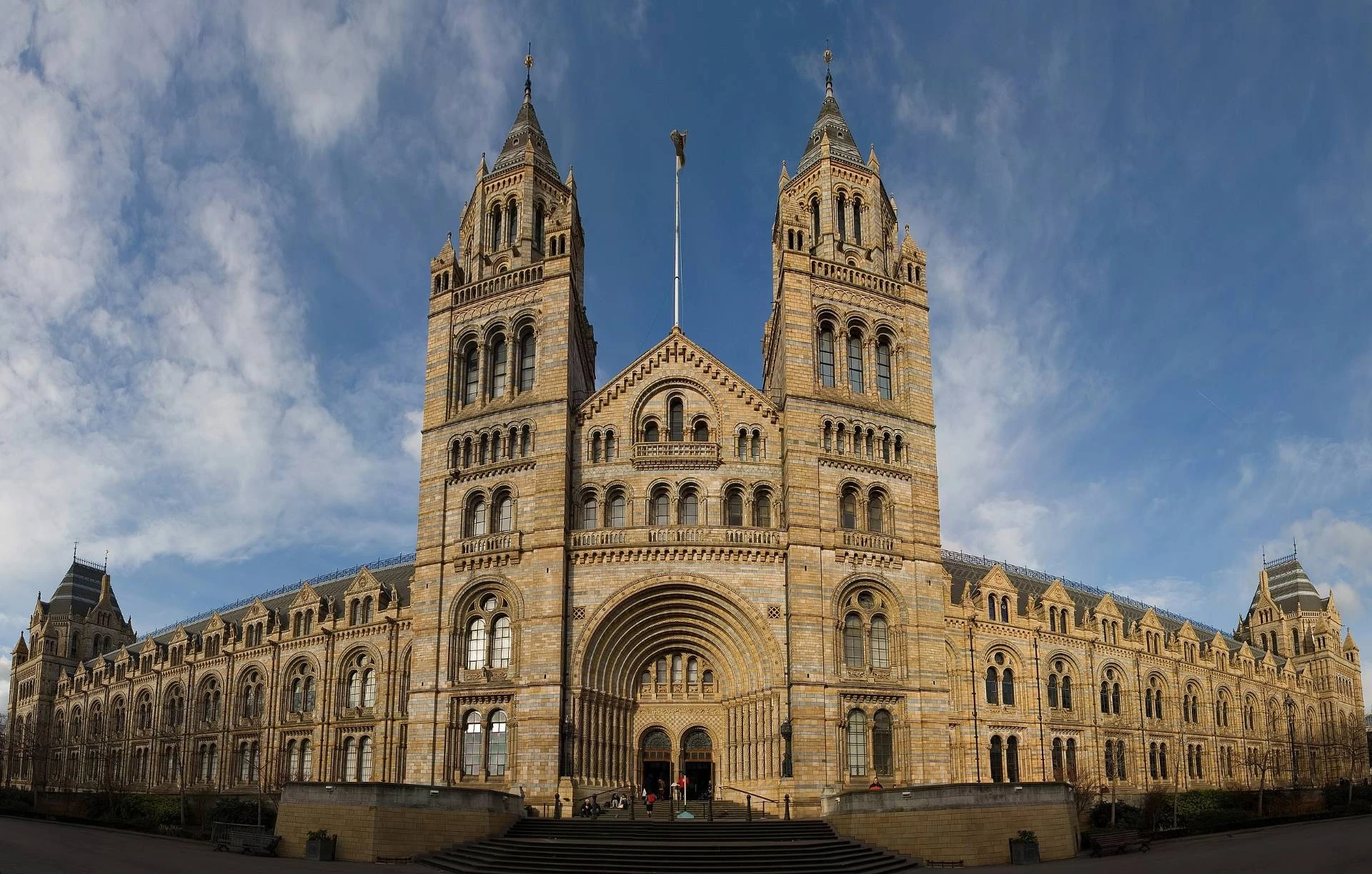
Image: Front façade of the museum in January 2006.
#iwasthere many times. My first visit, as a child with my parents, was my introduction to the true scale of dinosaurs and to the concepts of excavation and paleontology.
The museum is home to life and earth science specimens comprising some 80 million items within five main collections: botany , entomology , mineralogy , palaeontology and zoology . The museum is a center of research specializing in taxonomy , identification and conservation. Given the age of the institution, many of the collections have great historical as well as scientific value, such as specimens collected by Charles Darwin . The museum is particularly famous for its exhibition of dinosaur skeletons and ornate architecture—sometimes dubbed a cathedral of nature —both exemplified by the large Diplodocus cast that dominated the vaulted central hall before it was replaced in 2017 with the skeleton of a blue whale hanging from the ceiling.
The Natural History Museum Library contains an extensive collection of books, journals, manuscripts and artwork linked to the work and research of the scientific departments; access to the library is by appointment only. The museum is recognized as the pre-eminent center of natural history and research of related fields in the world. - more at Wikipedia
Visitor information: https://www.nhm.ac.uk/
Image: Front façade of the museum in January 2006.
#iwasthere many times. My first visit, as a child with my parents, was my introduction to the true scale of dinosaurs and to the concepts of excavation and paleontology.


| 53,000 mlx | |
| 110 | |
| 18 |