
4 reactions
July 5, 1996
Dolly The Sheep
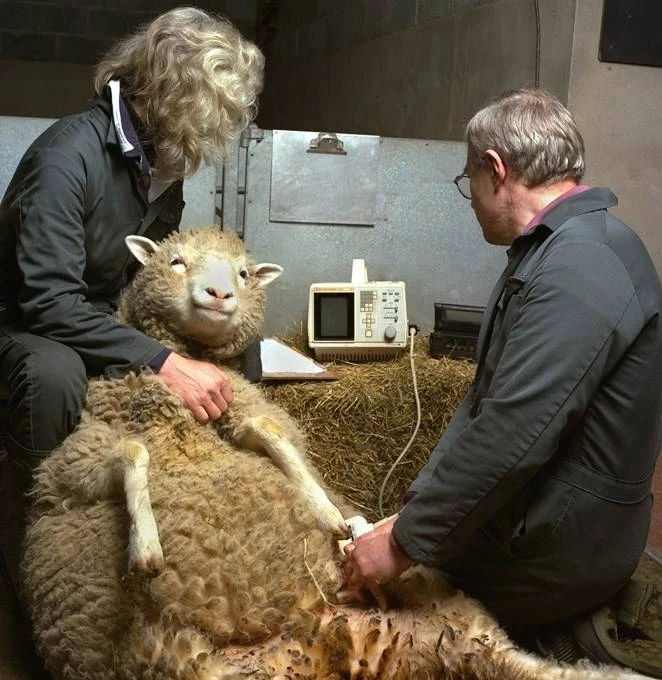
A historic scientific achievement unfolded at the Roslin Institute in Scotland when the world's first cloned mammal, a sheep named "Dolly," was brought into existence. Dolly's birth marked a groundbreaking moment in cloning technology, as she was not conceived through the typical process of reproduction.
Instead, Dolly was the result of a revolutionary method known as somatic cell nuclear transfer. In this process, the nucleus of a somatic cell (a non-reproductive cell) is transplanted into an egg cell that has had its nucleus removed. The modified egg, now containing the nucleus of a somatic cell, is coaxed into developing into an embryo, which is subsequently placed into a surrogate mother. Dolly's creation exemplified the successful application of this cloning technique in a mammal, heralding a significant advancement in the realms of reproductive biology and genetic engineering.
Dolly's emergence not only pushed the boundaries of scientific understanding but also ignited profound discussions about cloning, genetic manipulation, and the ethical considerations surrounding these transformative technologies. Her legacy endures as an emblematic figure in the annals of science, forever etched as the world's first cloned mammal.
Dolly The Sheep
A historic scientific achievement unfolded at the Roslin Institute in Scotland when the world's first cloned mammal, a sheep named "Dolly," was brought into existence. Dolly's birth marked a groundbreaking moment in cloning technology, as she was not conceived through the typical process of reproduction.
Instead, Dolly was the result of a revolutionary method known as somatic cell nuclear transfer. In this process, the nucleus of a somatic cell (a non-reproductive cell) is transplanted into an egg cell that has had its nucleus removed. The modified egg, now containing the nucleus of a somatic cell, is coaxed into developing into an embryo, which is subsequently placed into a surrogate mother. Dolly's creation exemplified the successful application of this cloning technique in a mammal, heralding a significant advancement in the realms of reproductive biology and genetic engineering.
Dolly's emergence not only pushed the boundaries of scientific understanding but also ignited profound discussions about cloning, genetic manipulation, and the ethical considerations surrounding these transformative technologies. Her legacy endures as an emblematic figure in the annals of science, forever etched as the world's first cloned mammal.


2
| 289,000 mlx | |
| 87 | |
| 4 |