
0 reactions
#News
Subscribe me for daily news updates
Why China can’t broker peace between Israel and Palestine
Beijing doesn’t have the tools that worked with Iran and Saudi Arabia. But a failed effort could still be a win for China.
Ahmadi Ali
Scholar of sanctions and economic statecraft
Ahmed Alqarout
Global political economy analyst
Published On 22 Jun 2023
22 Jun 2023
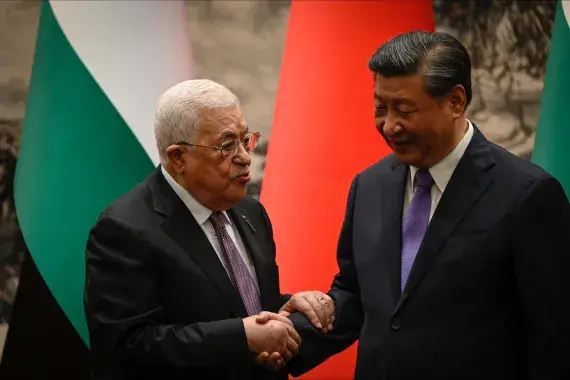
Palestinian President Mahmoud Abbas talks to China's President Xi Jinping after a signing ceremony at the Great Hall of the People in Beijing, China on June 14, 2023 [Jade Gao/Pool via Reuters]
Palestinian President Mahmoud Abbas visited Beijing last week, where he met Chinese President Xi Jinping. Abbas was the first Arab President to visit China since the China-Arab States Summit of Riyadh in December 2022 — signalling the importance that China appears to be placing on the Israel-Palestine issue.
The visit resulted in a leap forward in relations between China and Palestine. They agreed to a strategic partnership. Palestine will participate in Xi’s Belt and Road Initiative and a trio of new plans that Beijing has unveiled in recent months — the Global Security Initiative , Global Civilization Initiative and the Global Development Initiative — which collectively aim to present an alternative model of international relations to Western liberal norms. The two sides also activated a range of economic plans targeted at increasing trade between them.
KEEP READING
list of 4 items
list 1 of 4
Israeli settlers set up new illegal outpost on Palestinian land
list 2 of 4
‘He was my life’: The people killed by Israeli forces in Jenin
list 3 of 4
Israeli army uses force against Druze protests in occupied Golan
list 4 of 4
Israel drone attack kills 3 in occupied West Bank car attack
end of list
All of this stirred speculation about China’s new offer to mediate a peace process between Israel and Palestine, and whether it can succeed. So here’s the harsh reality: Beijing likely won’t be able to broker peace, yet could notch up a geopolitical win for itself by just trying.
China’s plan includes supporting full membership for Palestine in the United Nations as a sovereign and independent state with Jerusalem as the capital, the preservation of the status quo in Jerusalem’s religious holy sites and the resumption of peace talks with Israel on the basis of UN resolutions. The aim: a “two-state solution” to finally realise peaceful coexistence between Palestine and Israel which has been attempted for decades.
But what’s in it for Beijing?
Beijing’s goals
The growing Chinese interest in the Palestinian issue stems from several motives that are consistent with Beijing’s broader objectives in the region and internationally.
First, China is trying to build on its success in brokering a deal between Saudi Arabia and Iran to extend regional peace to the Palestinian-Israeli arena. China is interested in protecting its growing investments in the Middle East and helping end or curb conflict is to its advantage.
Second, China is trying to become a global leader in economic peacemaking. Any progress towards solving the Palestinian-Israeli conflict would solidify that image, one of the objectives of its Global Security Initiative.
Third, China is trying to disperse and counter Western pressure regarding the issues of Xinjiang, Hong Kong, Taiwan and Ukraine, by emphasising an issue of equal complexity and importance.
Importantly, the final two goals do not necessarily require that Chinese mediation succeeds in bringing a lasting end to the decades-long conflict and struggle for Palestinian statehood. It can secure some of its ambitions simply by positioning itself as a champion of diplomacy and mediation.
Sign up for Al Jazeera
Week in the Middle East
Catch up on our coverage of the region, all in one place.
Sign up
By signing up, you agree to our Privacy Policy
Will it work?
That’s vital to remember because, despite its growing enthusiasm, China’s ability to actually advance a peace process is questionable — despite the regional trend in the Middle East towards diplomacy.
Israel’s hardline government stands as the most decisive reason for this bleak outlook. For Israel, the occupation and the aggressive military and techno-authoritarian system of population control over the Palestinian people represent larger religious and ethno-nationalist goals that transcend basic state interests. It cannot be disabused of these aims with instruments of statecraft such as diplomatic arm-twisting or trade incentives.
This conflict, unlike the Saudi-Iran row, is also not a conflict between two states on somewhat equal standing. It is between the occupied and an occupier who feels unchallenged and emboldened. Israel is even moving towards the further annexation of Palestinian land. The rapid growth of Israeli settlements in the occupied West Bank has already rendered the two-state solution obsolete.
For Palestine, China’s growing interest still has clear advantages. By pushing forward the Abraham Accords with multiple Arab nations, the United States isolated Palestinians who cut ties with the US government in 2017 in protest and reduced their security coordination with Israel.
In a recent interview with CNN, Israeli Prime Minister Benjamin Netanyahu said negotiations with the Palestinians are no longer a priority and the US-led Abraham Accords and peace with Arab countries will come first.
As so, the Palestinians welcome Chinese leadership in negotiations to balance against perceived US bias in favour of Israel. Though the Palestinian Authority (PA) remains reliant on the US and its allies to sustain its economic survival, as Washington increases pressure on the Palestinians by cutting aid, Abbas and his administration need Chinese economic and development help.
Nonetheless, for the moment Chinese aid and investment in Palestine remain insignificant. Questions about the PA’s domestic legitimacy and internal divisions among the Palestinians also present potential obstacles to any efforts to kick-start negotiations.
Meanwhile, the trajectory of Sino-Israeli economic ties does not bode well for Chinese leverage and influence with the Israeli government, either.
China is Israel’s third-largest trading partner globally. Trade volume increased from $50m in 1992 to $15bn in 2021. But US pressure on Israel to downgrade ties with Beijing, as part of its global competition with China, has changed this trend.
In 2018-2022, Israel’s exports to China stagnated at about $4.5bn. Between 2018 and 2021, Israel’s imports from China also stagnated at $10.5bn. In 2020, Israel set up an advisory committee to inspect national security aspects of foreign investments — essentially to scan deals with China as potential national security threats, per the US’s request. Chinese investments in Israel have slowed as a result and will continue to do so, undermining Beijing’s ability to use trade to bargain for peace.
All of this, undergirded by the refusal of the current far-right Israeli government to talk with the Palestinians, means it is unlikely the Chinese efforts will be fruitful in achieving peace between Palestinians and Israelis.
Beijing is likely to continue to pursue mediation between Palestine and Israel as doing so is consistent with its own interests even if nothing is achieved.
Great diplomatic accomplishments tend to take place when expert diplomats are presented with an exceptional geopolitical opportunity. That was the case when China managed to broker a deal between Iran and Saudi Arabia. While a diplomatic coup for China, the Iran-Saudi detente was a product of both nations reevaluating how their long-simmering enmity was impacting their actual interests. Many rounds of painstaking talks in Baghdad had already created fertile soil for this achievement.
Such an opportunity does not seem evident on the Palestinian-Israeli issue. China can’t change that.
The views expressed in this article are the authors’ own and do not necessarily reflect Al Jazeera’s editorial stance.
Ahmadi Ali
Scholar of sanctions and economic statecraft
Ali Ahmadi is a scholar of sanctions and economic statecraft. He is an Executive Fellow at the Geneva Centre for Security Policy and an Analyst at Gulf State Analytics.
Ahmed Alqarout
Global political economy analyst
Ahmed Alqarout is a global political economy expert with a focus on great power competition and the political economy of conflicts in MENA.
LISTEN TO THESE PODCASTS
play
From: The Take
What will one joke cost China’s comedians?
Stand-up comedy only recently emerged in China, but one bad joke is threatening to wipe it out. Last month, the comedian L...
play
F rom: The Take
Q uestions remain after Greece boat disaster
I t may be the worst-ever shipwreck for refugees crossing the Mediterranean. Around 750 people seeking refuge in Europe wer...
play
Fr om: The Take
Ho w 4 Indigenous Colombian children survived in the Amazon
Ho w did four indigenous children survive the Amazon jungle for 40 days after a deadly plane crash? On May 1st, a propeller...
MORE FROM OPINION
O PINION
O PINION,
W eaponisation of anti-Semitism is bad for Palestinians – and Jews
O PINION
O PINION,
‘ Om-washing’: Why Modi’s yoga day pose is deceptive
O PINION
O PINION,
T o tackle racism in football Spain needs to face its history
O PINION
O PINION,
T itan and the trawler: Whose lives matter?
MOST READ
Search and rescue efforts for missing Titanic sub: All we know
Russia considering terror attack at Zaporizhzhia plant: Zelenskyy
Ukraine missiles damage bridge to Crimea: Russian officials
‘Ego trip’: African peace mission criticised in South Africa
AboutShow more
ConnectShow more
Our ChannelsShow more
Our NetworkShow more
Follow Al Jazeera English:
© 2023 Al Jazeera Media Network
You rely on Al Jazeera for truth and transparency
We understand that your online privacy is very important and consenting to our collection of some personal information takes great trust. We ask for this consent because it allows Al Jazeera to provide an experience that truly gives a voice to the voiceless.
You have the option to decline the cookies we automatically place on your browser but allowing Al Jazeera and our trusted partners to use cookies or similar technologies helps us improve our content and offerings to you. You can change your privacy preferences at any time by selecting ‘Cookie preferences’ at the bottom of your screen.
To learn more, please view our Cookie Policy.
Cookie Preferences
Allow All
Subscribe me for daily news updates
Why China can’t broker peace between Israel and Palestine
Beijing doesn’t have the tools that worked with Iran and Saudi Arabia. But a failed effort could still be a win for China.
Ahmadi Ali
Scholar of sanctions and economic statecraft
Ahmed Alqarout
Global political economy analyst
Published On 22 Jun 2023
22 Jun 2023
Palestinian President Mahmoud Abbas talks to China's President Xi Jinping after a signing ceremony at the Great Hall of the People in Beijing, China on June 14, 2023 [Jade Gao/Pool via Reuters]
Palestinian President Mahmoud Abbas visited Beijing last week, where he met Chinese President Xi Jinping. Abbas was the first Arab President to visit China since the China-Arab States Summit of Riyadh in December 2022 — signalling the importance that China appears to be placing on the Israel-Palestine issue.
The visit resulted in a leap forward in relations between China and Palestine. They agreed to a strategic partnership. Palestine will participate in Xi’s Belt and Road Initiative and a trio of new plans that Beijing has unveiled in recent months — the Global Security Initiative , Global Civilization Initiative and the Global Development Initiative — which collectively aim to present an alternative model of international relations to Western liberal norms. The two sides also activated a range of economic plans targeted at increasing trade between them.
KEEP READING
list of 4 items
list 1 of 4
Israeli settlers set up new illegal outpost on Palestinian land
list 2 of 4
‘He was my life’: The people killed by Israeli forces in Jenin
list 3 of 4
Israeli army uses force against Druze protests in occupied Golan
list 4 of 4
Israel drone attack kills 3 in occupied West Bank car attack
end of list
All of this stirred speculation about China’s new offer to mediate a peace process between Israel and Palestine, and whether it can succeed. So here’s the harsh reality: Beijing likely won’t be able to broker peace, yet could notch up a geopolitical win for itself by just trying.
China’s plan includes supporting full membership for Palestine in the United Nations as a sovereign and independent state with Jerusalem as the capital, the preservation of the status quo in Jerusalem’s religious holy sites and the resumption of peace talks with Israel on the basis of UN resolutions. The aim: a “two-state solution” to finally realise peaceful coexistence between Palestine and Israel which has been attempted for decades.
But what’s in it for Beijing?
Beijing’s goals
The growing Chinese interest in the Palestinian issue stems from several motives that are consistent with Beijing’s broader objectives in the region and internationally.
First, China is trying to build on its success in brokering a deal between Saudi Arabia and Iran to extend regional peace to the Palestinian-Israeli arena. China is interested in protecting its growing investments in the Middle East and helping end or curb conflict is to its advantage.
Second, China is trying to become a global leader in economic peacemaking. Any progress towards solving the Palestinian-Israeli conflict would solidify that image, one of the objectives of its Global Security Initiative.
Third, China is trying to disperse and counter Western pressure regarding the issues of Xinjiang, Hong Kong, Taiwan and Ukraine, by emphasising an issue of equal complexity and importance.
Importantly, the final two goals do not necessarily require that Chinese mediation succeeds in bringing a lasting end to the decades-long conflict and struggle for Palestinian statehood. It can secure some of its ambitions simply by positioning itself as a champion of diplomacy and mediation.
Sign up for Al Jazeera
Week in the Middle East
Catch up on our coverage of the region, all in one place.
Sign up
By signing up, you agree to our Privacy Policy
Will it work?
That’s vital to remember because, despite its growing enthusiasm, China’s ability to actually advance a peace process is questionable — despite the regional trend in the Middle East towards diplomacy.
Israel’s hardline government stands as the most decisive reason for this bleak outlook. For Israel, the occupation and the aggressive military and techno-authoritarian system of population control over the Palestinian people represent larger religious and ethno-nationalist goals that transcend basic state interests. It cannot be disabused of these aims with instruments of statecraft such as diplomatic arm-twisting or trade incentives.
This conflict, unlike the Saudi-Iran row, is also not a conflict between two states on somewhat equal standing. It is between the occupied and an occupier who feels unchallenged and emboldened. Israel is even moving towards the further annexation of Palestinian land. The rapid growth of Israeli settlements in the occupied West Bank has already rendered the two-state solution obsolete.
For Palestine, China’s growing interest still has clear advantages. By pushing forward the Abraham Accords with multiple Arab nations, the United States isolated Palestinians who cut ties with the US government in 2017 in protest and reduced their security coordination with Israel.
In a recent interview with CNN, Israeli Prime Minister Benjamin Netanyahu said negotiations with the Palestinians are no longer a priority and the US-led Abraham Accords and peace with Arab countries will come first.
As so, the Palestinians welcome Chinese leadership in negotiations to balance against perceived US bias in favour of Israel. Though the Palestinian Authority (PA) remains reliant on the US and its allies to sustain its economic survival, as Washington increases pressure on the Palestinians by cutting aid, Abbas and his administration need Chinese economic and development help.
Nonetheless, for the moment Chinese aid and investment in Palestine remain insignificant. Questions about the PA’s domestic legitimacy and internal divisions among the Palestinians also present potential obstacles to any efforts to kick-start negotiations.
Meanwhile, the trajectory of Sino-Israeli economic ties does not bode well for Chinese leverage and influence with the Israeli government, either.
China is Israel’s third-largest trading partner globally. Trade volume increased from $50m in 1992 to $15bn in 2021. But US pressure on Israel to downgrade ties with Beijing, as part of its global competition with China, has changed this trend.
In 2018-2022, Israel’s exports to China stagnated at about $4.5bn. Between 2018 and 2021, Israel’s imports from China also stagnated at $10.5bn. In 2020, Israel set up an advisory committee to inspect national security aspects of foreign investments — essentially to scan deals with China as potential national security threats, per the US’s request. Chinese investments in Israel have slowed as a result and will continue to do so, undermining Beijing’s ability to use trade to bargain for peace.
All of this, undergirded by the refusal of the current far-right Israeli government to talk with the Palestinians, means it is unlikely the Chinese efforts will be fruitful in achieving peace between Palestinians and Israelis.
Beijing is likely to continue to pursue mediation between Palestine and Israel as doing so is consistent with its own interests even if nothing is achieved.
Great diplomatic accomplishments tend to take place when expert diplomats are presented with an exceptional geopolitical opportunity. That was the case when China managed to broker a deal between Iran and Saudi Arabia. While a diplomatic coup for China, the Iran-Saudi detente was a product of both nations reevaluating how their long-simmering enmity was impacting their actual interests. Many rounds of painstaking talks in Baghdad had already created fertile soil for this achievement.
Such an opportunity does not seem evident on the Palestinian-Israeli issue. China can’t change that.
The views expressed in this article are the authors’ own and do not necessarily reflect Al Jazeera’s editorial stance.
Ahmadi Ali
Scholar of sanctions and economic statecraft
Ali Ahmadi is a scholar of sanctions and economic statecraft. He is an Executive Fellow at the Geneva Centre for Security Policy and an Analyst at Gulf State Analytics.
Ahmed Alqarout
Global political economy analyst
Ahmed Alqarout is a global political economy expert with a focus on great power competition and the political economy of conflicts in MENA.
LISTEN TO THESE PODCASTS
play
From: The Take
What will one joke cost China’s comedians?
Stand-up comedy only recently emerged in China, but one bad joke is threatening to wipe it out. Last month, the comedian L...
play
F rom: The Take
Q uestions remain after Greece boat disaster
I t may be the worst-ever shipwreck for refugees crossing the Mediterranean. Around 750 people seeking refuge in Europe wer...
play
Fr om: The Take
Ho w 4 Indigenous Colombian children survived in the Amazon
Ho w did four indigenous children survive the Amazon jungle for 40 days after a deadly plane crash? On May 1st, a propeller...
MORE FROM OPINION
O PINION
O PINION,
W eaponisation of anti-Semitism is bad for Palestinians – and Jews
O PINION
O PINION,
‘ Om-washing’: Why Modi’s yoga day pose is deceptive
O PINION
O PINION,
T o tackle racism in football Spain needs to face its history
O PINION
O PINION,
T itan and the trawler: Whose lives matter?
MOST READ
Search and rescue efforts for missing Titanic sub: All we know
Russia considering terror attack at Zaporizhzhia plant: Zelenskyy
Ukraine missiles damage bridge to Crimea: Russian officials
‘Ego trip’: African peace mission criticised in South Africa
AboutShow more
ConnectShow more
Our ChannelsShow more
Our NetworkShow more
Follow Al Jazeera English:
© 2023 Al Jazeera Media Network
You rely on Al Jazeera for truth and transparency
We understand that your online privacy is very important and consenting to our collection of some personal information takes great trust. We ask for this consent because it allows Al Jazeera to provide an experience that truly gives a voice to the voiceless.
You have the option to decline the cookies we automatically place on your browser but allowing Al Jazeera and our trusted partners to use cookies or similar technologies helps us improve our content and offerings to you. You can change your privacy preferences at any time by selecting ‘Cookie preferences’ at the bottom of your screen.
To learn more, please view our Cookie Policy.
Cookie Preferences
Allow All


| 0 mlx | |
| 62 | |
| 0 |