📣 NEW CHALLENGE! #DirtyJobs 1 user will #earn 10,000,000…

56 reactions
📣 NEW CHALLENGE! #DirtyJobs
1 user will #earn 10,000,000 #millix
5 users will #earn 1,000,000 #millix
10 users will #earn 500,000 #millix
ℹ️ Instructions: Comment with a #DirtyJob and tell us about it.
✨ If you add an image, you will get a #bonus ✨
1 submission per user. #Badgers only (verified + purchased badge) . If the #DirtyJob has already been submitted, you must choose another. We will spin the wheel by Friday . Good luck!
1 user will #earn 10,000,000 #millix
5 users will #earn 1,000,000 #millix
10 users will #earn 500,000 #millix
ℹ️ Instructions: Comment with a #DirtyJob and tell us about it.
✨ If you add an image, you will get a #bonus ✨
1 submission per user. #Badgers only (verified + purchased badge) . If the #DirtyJob has already been submitted, you must choose another. We will spin the wheel by Friday . Good luck!


22

5
| 20,378,000 mlx | |
| 425 | |
| 56 |
comments


Construction worker
By some definitions, workers may be engaged in manual labour as unskilled or semi-skilled workers; they may be skilled tradespeople; or they may be supervisory or managerial personnel. Under safety legislation in the United Kingdom, for example, construction workers are defined as people "who work for or under the control of a contractor on a construction site"; in Canada, this can include people whose work includes ensuring conformance with building codes and regulations, and those who supervise other workers
The term is a broad and generic one and most construction workers are primarily described by the specific level and type of work they perform. Laborers comprise a large grouping in most national construction industries. In the United States, for example, in May 2021 the construction sector employed just over 7.5 million people, of whom just over 820,000 were laborers, while 573,000 were carpenters, 508,000 were electricians, 258,000 were equipment operators and 230,000 were construction managers. Like most business sectors, there is also substantial white-collar employment in construction - 681,000 US workers were recorded by the United States Department of Labor as in 'office and administrative support occupations' in May 2021. In 2020 the United States reported that, of the total number of construction workers, around 30% of workers were Hispanic and around 11% were women
Examples of poor pay and working conditions for migrant workers
n 2008, a Human Rights Watch report described unsafe and unfair working conditions in China and a failure on the part of the government to enforce labor standards in the construction industry. The International Labour Organization (ILO) estimated that, at the end of 2006, 90% of the 40 million construction workers in China were migrant workers. Many turned to work after their farming communities collapsed into poverty.
In the United States, illegal immigrant labor is prevalent in the industry. Due to workers' questionable legal status, some employers commit crimes such as wage theft and violation of workplace standards, running little risk of consequences. Similar abuse occurred in Qatar during preparations for the 2022 FIFA World Cup where workers, mostly from poor countries in the Indian subcontinent, worked in desert conditions for as little as €6.20 a day.[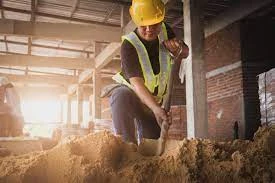
By some definitions, workers may be engaged in manual labour as unskilled or semi-skilled workers; they may be skilled tradespeople; or they may be supervisory or managerial personnel. Under safety legislation in the United Kingdom, for example, construction workers are defined as people "who work for or under the control of a contractor on a construction site"; in Canada, this can include people whose work includes ensuring conformance with building codes and regulations, and those who supervise other workers
The term is a broad and generic one and most construction workers are primarily described by the specific level and type of work they perform. Laborers comprise a large grouping in most national construction industries. In the United States, for example, in May 2021 the construction sector employed just over 7.5 million people, of whom just over 820,000 were laborers, while 573,000 were carpenters, 508,000 were electricians, 258,000 were equipment operators and 230,000 were construction managers. Like most business sectors, there is also substantial white-collar employment in construction - 681,000 US workers were recorded by the United States Department of Labor as in 'office and administrative support occupations' in May 2021. In 2020 the United States reported that, of the total number of construction workers, around 30% of workers were Hispanic and around 11% were women
Examples of poor pay and working conditions for migrant workers
n 2008, a Human Rights Watch report described unsafe and unfair working conditions in China and a failure on the part of the government to enforce labor standards in the construction industry. The International Labour Organization (ILO) estimated that, at the end of 2006, 90% of the 40 million construction workers in China were migrant workers. Many turned to work after their farming communities collapsed into poverty.
In the United States, illegal immigrant labor is prevalent in the industry. Due to workers' questionable legal status, some employers commit crimes such as wage theft and violation of workplace standards, running little risk of consequences. Similar abuse occurred in Qatar during preparations for the 2022 FIFA World Cup where workers, mostly from poor countries in the Indian subcontinent, worked in desert conditions for as little as €6.20 a day.[

Chicken Sexer: In an interview with Fox News, former Dirty Jobs host Mike Rowe revealed the five worst assignments he did for the show and he named chicken sexer as one of them. In order to determine the sex of a baby chick, someone has to squeeze excrement from the chicken to get an unobstructed view of the organs by looking up its rectum. Flip out over these 14 wonderful and wacky chicken coop ideas.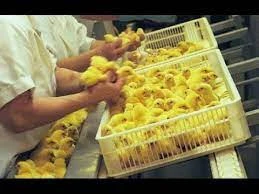
Urine collector: As the name suggests, urine farmers have to farm urine from animals such as deer, so as to create an effective hunting lure. Most of the times the urine collector has to be involved in the urine collecting process. These urine collecting farms often contain rooms where the deers are kept overnight.
The floor of the rooms has tiny small holes where the urine drips and gets collected into large storage containers. The collected urine is packaged and refrigerated and shipped off for selling.
The floor of the rooms has tiny small holes where the urine drips and gets collected into large storage containers. The collected urine is packaged and refrigerated and shipped off for selling.

Portable toilet cleaner:
Portable toilet cleaners have to deal with human excrement every day as a part of their daily grind. Since portable toilets do not have any mechanism for eliminating the human wastes being dumped, the only method that can be used to clean such structures is only by manual cleaning.
Portable cleaners have to clean portable toilets from top to bottom and that also means the walls of the toilet also has to be cleaned and disinfected completely so that it can be reused.
The only blessing that these workers have is the pressurized water hoses which allow them to clean a portable toilet within a matter of minutes, and this also helps them in disposing the used toilet papers from the toilet.
These employees work at least cleaning 50 to 60 portable toilets in a day.
The job might also have occupational hazards since they are coming in contact with excrement so there are chances that employees may get diarrhea, nausea or even typhoid or hepatitis.
So it is necessary that employees should wear protective clothing and make sure that they are properly disinfected after the job.
Whatever the work conditions maybe these employees’ bear a lot and in the end, they get paid with almost $60,000 annually. This is one of the jobs that pays high.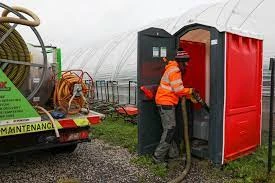
Portable toilet cleaners have to deal with human excrement every day as a part of their daily grind. Since portable toilets do not have any mechanism for eliminating the human wastes being dumped, the only method that can be used to clean such structures is only by manual cleaning.
Portable cleaners have to clean portable toilets from top to bottom and that also means the walls of the toilet also has to be cleaned and disinfected completely so that it can be reused.
The only blessing that these workers have is the pressurized water hoses which allow them to clean a portable toilet within a matter of minutes, and this also helps them in disposing the used toilet papers from the toilet.
These employees work at least cleaning 50 to 60 portable toilets in a day.
The job might also have occupational hazards since they are coming in contact with excrement so there are chances that employees may get diarrhea, nausea or even typhoid or hepatitis.
So it is necessary that employees should wear protective clothing and make sure that they are properly disinfected after the job.
Whatever the work conditions maybe these employees’ bear a lot and in the end, they get paid with almost $60,000 annually. This is one of the jobs that pays high.
Garbage collectors:
Many garbage collectors have the tough job of collecting trash from each street corner by working for long shifts and also ensure that they do not get hit by the raging traffic while working out in the street. This is also the main reason why trash collecting is ranked as one of the toughest and high paying dangerous jobs in the world.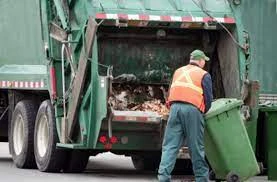
Many garbage collectors have the tough job of collecting trash from each street corner by working for long shifts and also ensure that they do not get hit by the raging traffic while working out in the street. This is also the main reason why trash collecting is ranked as one of the toughest and high paying dangerous jobs in the world.
See this old shirt? I wore it to my son’s first baseball game tonight. Not because I wanted to, but because I had just gotten off work. I’m a welder. Clothes don’t last long before they just catch on fire constantly. Remember, I had just gotten off work in time to make it to my sons first ever baseball game. Everyone was staring me up and down as if I was trash. Steady looking me up and down. Yes, my shirt had holes in it. Because this shirt has caught fire more times than I can say. Along with every other shirt I work in. What they don’t know, is this shirt also helped me pay bills and put food on the table.
Quit judging people by what they wear. I’m not poor and I’m not worthless. I work for a living and all I have is work and bed time cloths and I’m the only one that sponsored my kids team. Where was your suit and tie when it came to signing up to be a sponsor.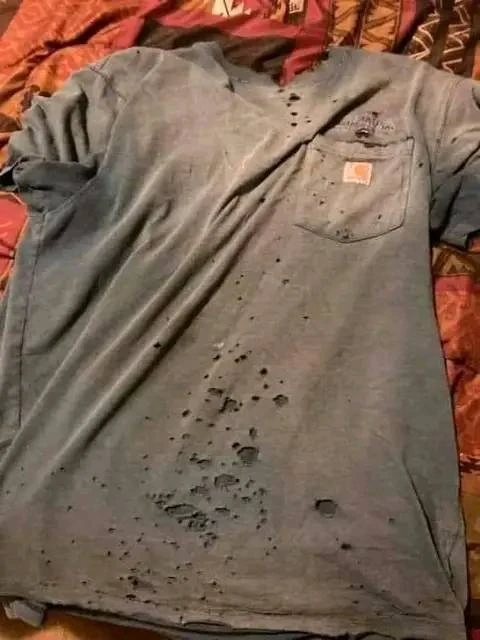
Quit judging people by what they wear. I’m not poor and I’m not worthless. I work for a living and all I have is work and bed time cloths and I’m the only one that sponsored my kids team. Where was your suit and tie when it came to signing up to be a sponsor.

Pest control! Roaches, rats, snakes, spiders, skunks, bats, termites, wasps... often in tight, dirty spaces. Okay, they wear protective gear, but that just makes it hotter. Oh and they often use toxic chemicals.
Landfill workers operate heavy equipment such as large dozers, compactors, motor graders, loaders, and other equipment to spread, compact and cover landfill solid waste with dirt to grade and landscape the landfill site, construct roads at the landfill or for other similar purposes.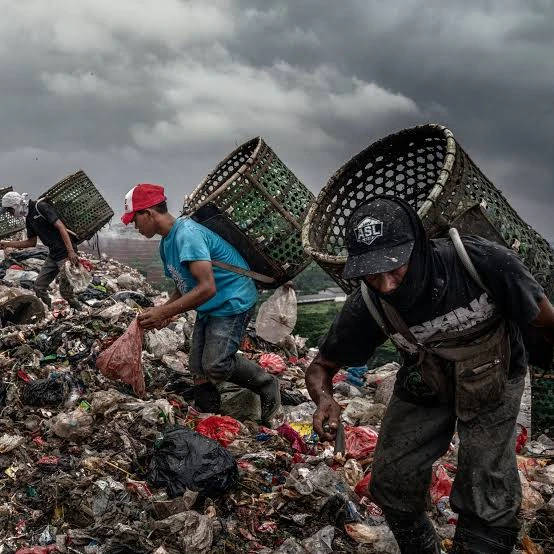
Low-skilled migrants contribute hugely to the economies in which they work, as well as to their countries of origin. They deserve greater respect and much better treatment.
Millions of workers from developing Asia and the Pacific venture to richer economies in the region, the Middle East, and beyond to fill gaps in the labor market. They take on menial jobs that require little schooling and no formal qualifications. These low-skilled migrants clean clothes, homes, offices, and streets; construct buildings; staff fishing vessels; tend to the children of white collar professionals; pick crops; wash dishes; stock shelves; and carry heavy loads. Migrant workers perform dirty, difficult and dangerous jobs that people in their host country don't wish to do.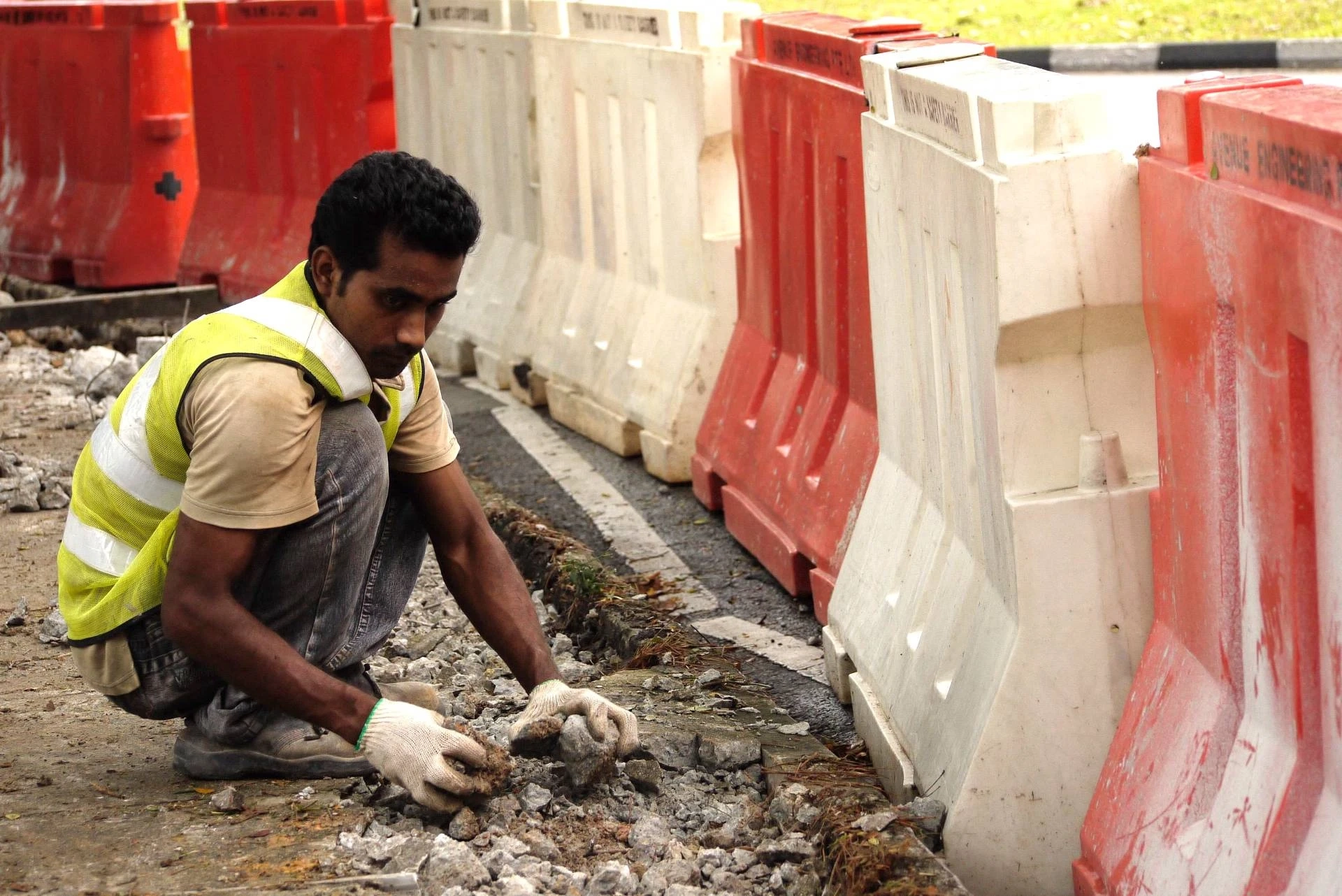
Millions of workers from developing Asia and the Pacific venture to richer economies in the region, the Middle East, and beyond to fill gaps in the labor market. They take on menial jobs that require little schooling and no formal qualifications. These low-skilled migrants clean clothes, homes, offices, and streets; construct buildings; staff fishing vessels; tend to the children of white collar professionals; pick crops; wash dishes; stock shelves; and carry heavy loads. Migrant workers perform dirty, difficult and dangerous jobs that people in their host country don't wish to do.
1

1
Animal Castrator
It’s not an enviable job but one that has to get done on farms. Dirty jobs are still jobs. Restraining an animal and then performing the incision is dirty work.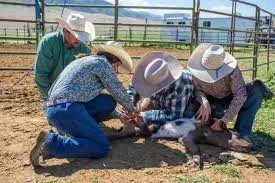
It’s not an enviable job but one that has to get done on farms. Dirty jobs are still jobs. Restraining an animal and then performing the incision is dirty work.
Animal Urine Collector You laughed when you found out coyote urine is one of 20 weird things you can buy at Home Depot but did you think about how they collect it? An animal urine collector is a unique job for sure. According to a Wise Step article, deer have to be kept in rooms overnight. The floor in the room has tiny holes where the urine drips and gets collected. Urine collectors have to come up with a gallon each night, but they typically earn around $80,000 a year, Wise Step said.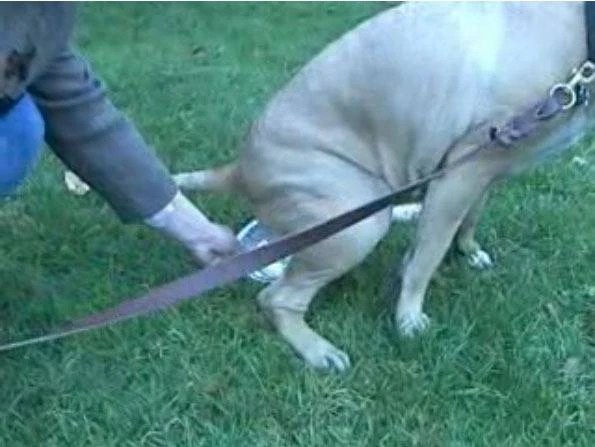
1
1
Sealcoat
Sealcoating, or pavement sealing, is the process of applying a protective coating to asphalt-based pavements to provide a layer of protection from the elements: water, oils, and U.V. damage.
The effects of asphalt sealers have been debated. Asphalt sealing is marketed as increasing the life of the asphalt, but there is no independent research that proves these claims. Asphalt sealing can also make the asphalt more slippery and impact the environment.
Pavement sealcoat products come in a variety of standards. For example, refined tar-based sealer offers the best protecting against water penetration and chemical resistance. Asphalt-based sealer typically offers poor protection against environmental, chemical and harsher climates (salt water). Petroleum-based sealer offer protection against water and chemicals somewhere between the other two sealers. Another difference between coatings is in terms of wear. Again, refined tar-based sealer offers the best wear characteristics (typically 3–5 years) while asphalt-based sealer may last 1–3 years. Petroleum-based sealer falls between refined tar and asphalt.
There are concerns about pavement sealer polluting the environment after it is abraded from the surface of the pavement. Some states in North America have banned the use of coal tar–based sealants primarily based on United States Geological Survey studies
Types
There are primarily five types of pavement sealers.
These are commonly known as:
Refined tar-based (coal tar based)
Asphalt-based
Acrylic (Paint)
Fast Dry
Oil-based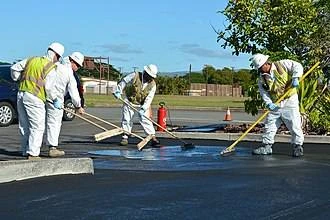
Sealcoating, or pavement sealing, is the process of applying a protective coating to asphalt-based pavements to provide a layer of protection from the elements: water, oils, and U.V. damage.
The effects of asphalt sealers have been debated. Asphalt sealing is marketed as increasing the life of the asphalt, but there is no independent research that proves these claims. Asphalt sealing can also make the asphalt more slippery and impact the environment.
Pavement sealcoat products come in a variety of standards. For example, refined tar-based sealer offers the best protecting against water penetration and chemical resistance. Asphalt-based sealer typically offers poor protection against environmental, chemical and harsher climates (salt water). Petroleum-based sealer offer protection against water and chemicals somewhere between the other two sealers. Another difference between coatings is in terms of wear. Again, refined tar-based sealer offers the best wear characteristics (typically 3–5 years) while asphalt-based sealer may last 1–3 years. Petroleum-based sealer falls between refined tar and asphalt.
There are concerns about pavement sealer polluting the environment after it is abraded from the surface of the pavement. Some states in North America have banned the use of coal tar–based sealants primarily based on United States Geological Survey studies
Types
There are primarily five types of pavement sealers.
These are commonly known as:
Refined tar-based (coal tar based)
Asphalt-based
Acrylic (Paint)
Fast Dry
Oil-based
1
1
Ironworker
Occupation typeVocational
Activity sectorsConstruction
Description
CompetenciesHeights, patience, steady hand, ability to read plans, physically strong
Education requiredApprenticeship
Fields of
employmentConstruction
An ironworker is a tradesman who works in the iron-working industry. Ironworkers assemble the structural framework in accordance with engineered drawings and install the metal support pieces for new buildings. They also repair and renovate old structures using reinforced concrete and steel. Ironworkers may work on factories, steel mills, and utility plants.
A structural/ornamental ironworker fabricates and erects (or even dismantles) the structural steel framework of pre-engineered metal buildings, single and multi-story buildings, stadiums, arenas, hospitals, towers, wind turbines, and bridges. Ironworkers also unload, place and tie reinforcing steel bars, (rebar) as well as install post-tensioning systems, both of which give strength to the concrete used in piers, footings, slabs, buildings, and bridges. Ironworkers load, unload, place, and set machinery and equipment as well as operate power hoists, forklifts, and aerial lifts. They unload, place, and fasten metal decking, safety netting, and edge rails to facilitate safe working practices. Ironworkers finish buildings by erecting curtain wall and window wall systems, stairs and handrails, metal doors, and sheeting and elevator fronts. Ironworkers perform all types of industrial maintenance as well.
Historically ironworkers mainly worked with wrought iron or cast iron, but today they utilize many different materials including ferrous and non-ferrous metals, plastics, glass, concrete, and composites.
An ironworker is distinct from a blacksmith, which is someone who works with, shapes, and tempers raw iron.
History
Practically overnight, carpenters who built wooden bridges became ironworkers by the 1880s. It was seen as a new, exciting job for pioneers in America, despite its dangers. A worker could risk his life on high structures for about two dollars per day.
The production of cast iron parts in larger and larger sizes brought about the use of cranes. This heavy equipment was used in the early 1900s to construct high structures and buildings. They used cranes to lift steel girders into place and used rivets to connect the girders to the columns of a structure. The mortality rate of men working in this trade was the highest of all trades and they would be lucky to go 10 years without a serious or fatal injury.[citation needed]
In the late 19th century, workers formed the International Union of Ironworkers because of concerns they had about safety on-the-job and the lack of protection from employers. The union's first order of business was to give widows of ironworkers $50 to cover the costs of a funeral and to give disabled ironworkers $5 a week to compensate for lost wages. With the increase in benefits from unionization, the Union greatly increased its presence in numbers in the early 1900s. Approximately 10,000 workers were considered Union Ironworkers.
In the early 1900s, during the third great immigration wave,[5] the Ironworker wage in real 2010 US dollars was $9.50 (2010) to $12 (2010) per hour (40 to 50 cents an hour in 1900). Following the imposition of immigration quotas in 1921[5] wages rose to $17.50 (2010) an hour ($1.37) for a structural ironworker just prior to the Great Depression, and the real wage subsequently only dropped 10% to $16.00 (2010) ($1.05) given the deflation during the depression. However, following the wartime destruction of manufacturing complexes - with the exception of North America, 1956 wages for structural, ornamental, and rebar ironworkers rose to $27.30 (2010) an hour ($3.40). By 1970, through the Cold war buildup, iron worker wages peaked at $44.80 (2010) ($7.97). Then, following the 1965 new immigration policy and the start of the fourth great migration wave, wages fell 10% to $40.38 (2010) by 1980 ($15.26), and fell another 20% to $29.90 (2010) per hour ($20.88) by 1990, comparable to the 1950s wage rate. With the end of the Cold War buildup in 1991, ironworker rates have since stayed constant and were $29.30 (2010) an hour ($24.15) in 2002. In 2010 the mean wage for Ohio ironworkers, both union and nonunion, was $24.66 per hour; the 75th percentile for the nation was $29.51 - likely for the unionized workforce and indicates that for the past 20 years, Ironworker wages have been stagnant for various reasons, - most prominently the offset in real wages created by debt, today 126% of their income compared to 40% in 1952, allowing short-term survival on less than the living wage.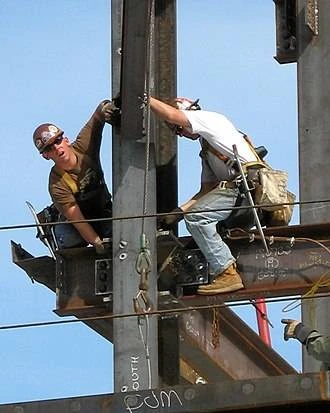
Occupation typeVocational
Activity sectorsConstruction
Description
CompetenciesHeights, patience, steady hand, ability to read plans, physically strong
Education requiredApprenticeship
Fields of
employmentConstruction
An ironworker is a tradesman who works in the iron-working industry. Ironworkers assemble the structural framework in accordance with engineered drawings and install the metal support pieces for new buildings. They also repair and renovate old structures using reinforced concrete and steel. Ironworkers may work on factories, steel mills, and utility plants.
A structural/ornamental ironworker fabricates and erects (or even dismantles) the structural steel framework of pre-engineered metal buildings, single and multi-story buildings, stadiums, arenas, hospitals, towers, wind turbines, and bridges. Ironworkers also unload, place and tie reinforcing steel bars, (rebar) as well as install post-tensioning systems, both of which give strength to the concrete used in piers, footings, slabs, buildings, and bridges. Ironworkers load, unload, place, and set machinery and equipment as well as operate power hoists, forklifts, and aerial lifts. They unload, place, and fasten metal decking, safety netting, and edge rails to facilitate safe working practices. Ironworkers finish buildings by erecting curtain wall and window wall systems, stairs and handrails, metal doors, and sheeting and elevator fronts. Ironworkers perform all types of industrial maintenance as well.
Historically ironworkers mainly worked with wrought iron or cast iron, but today they utilize many different materials including ferrous and non-ferrous metals, plastics, glass, concrete, and composites.
An ironworker is distinct from a blacksmith, which is someone who works with, shapes, and tempers raw iron.
History
Practically overnight, carpenters who built wooden bridges became ironworkers by the 1880s. It was seen as a new, exciting job for pioneers in America, despite its dangers. A worker could risk his life on high structures for about two dollars per day.
The production of cast iron parts in larger and larger sizes brought about the use of cranes. This heavy equipment was used in the early 1900s to construct high structures and buildings. They used cranes to lift steel girders into place and used rivets to connect the girders to the columns of a structure. The mortality rate of men working in this trade was the highest of all trades and they would be lucky to go 10 years without a serious or fatal injury.[citation needed]
In the late 19th century, workers formed the International Union of Ironworkers because of concerns they had about safety on-the-job and the lack of protection from employers. The union's first order of business was to give widows of ironworkers $50 to cover the costs of a funeral and to give disabled ironworkers $5 a week to compensate for lost wages. With the increase in benefits from unionization, the Union greatly increased its presence in numbers in the early 1900s. Approximately 10,000 workers were considered Union Ironworkers.
In the early 1900s, during the third great immigration wave,[5] the Ironworker wage in real 2010 US dollars was $9.50 (2010) to $12 (2010) per hour (40 to 50 cents an hour in 1900). Following the imposition of immigration quotas in 1921[5] wages rose to $17.50 (2010) an hour ($1.37) for a structural ironworker just prior to the Great Depression, and the real wage subsequently only dropped 10% to $16.00 (2010) ($1.05) given the deflation during the depression. However, following the wartime destruction of manufacturing complexes - with the exception of North America, 1956 wages for structural, ornamental, and rebar ironworkers rose to $27.30 (2010) an hour ($3.40). By 1970, through the Cold war buildup, iron worker wages peaked at $44.80 (2010) ($7.97). Then, following the 1965 new immigration policy and the start of the fourth great migration wave, wages fell 10% to $40.38 (2010) by 1980 ($15.26), and fell another 20% to $29.90 (2010) per hour ($20.88) by 1990, comparable to the 1950s wage rate. With the end of the Cold War buildup in 1991, ironworker rates have since stayed constant and were $29.30 (2010) an hour ($24.15) in 2002. In 2010 the mean wage for Ohio ironworkers, both union and nonunion, was $24.66 per hour; the 75th percentile for the nation was $29.51 - likely for the unionized workforce and indicates that for the past 20 years, Ironworker wages have been stagnant for various reasons, - most prominently the offset in real wages created by debt, today 126% of their income compared to 40% in 1952, allowing short-term survival on less than the living wage.

HIGH-RISE WINDOW-CLEANING
If a building is a clean, nonsmoking office environment and stands on a clean side street, it likely needs its windows cleaned less frequently. If the building is home to industrial work or a medical facility, sees a lot of foot traffic, is located on a busy street or near a substantial body of water, or must contend with smog or frequent avian visitors, the windows will need attention more often.
CLIMBING TOOLS
Movable platform: Much like the fixed scaffolds used for shorter buildings, a high rise window cleaning platform gives the window cleaner a stable place to stand while cleaning high-rise windows. But with a movable platform, when it's time to move down to the next floor, a pulley of ropes lowers the platform.
Bosun's chair: If window cleaners are not standing on a movable platform, they typically use a bosun's chair. The bosun's chair takes its name from seafaring. On a ship, the bosun, or boatswain, is the officer in charge of the crew and equipment, and a bosun's chair is a harness-like rope contraption that can suspend the bosun aloft to work on the ship's masts or rigging. In window cleaning, a bosun's chair is a small platform attached to a pulley that can lower it when the cleaner needs to descend to the next floor. Window cleaners can often suspend their buckets from hooks on the bottom of the bosun's chair, as well.
SAFETY TOOLS
Safety belt or harness: A window cleaner safety belt or harness is critical for window cleaners who are working on a platform. If the platform falls, the safety harness, which hooks to the building, ensures the window cleaner remains securely suspended in the air.
Protective gloves: Window cleaning is a messy business, and rain and snow make it messier. Protective gloves are must-have items, especially in the winter when wet hands can quickly freeze. Cold hands can lead to frostbite, and they also make the window climber less nimble and safe.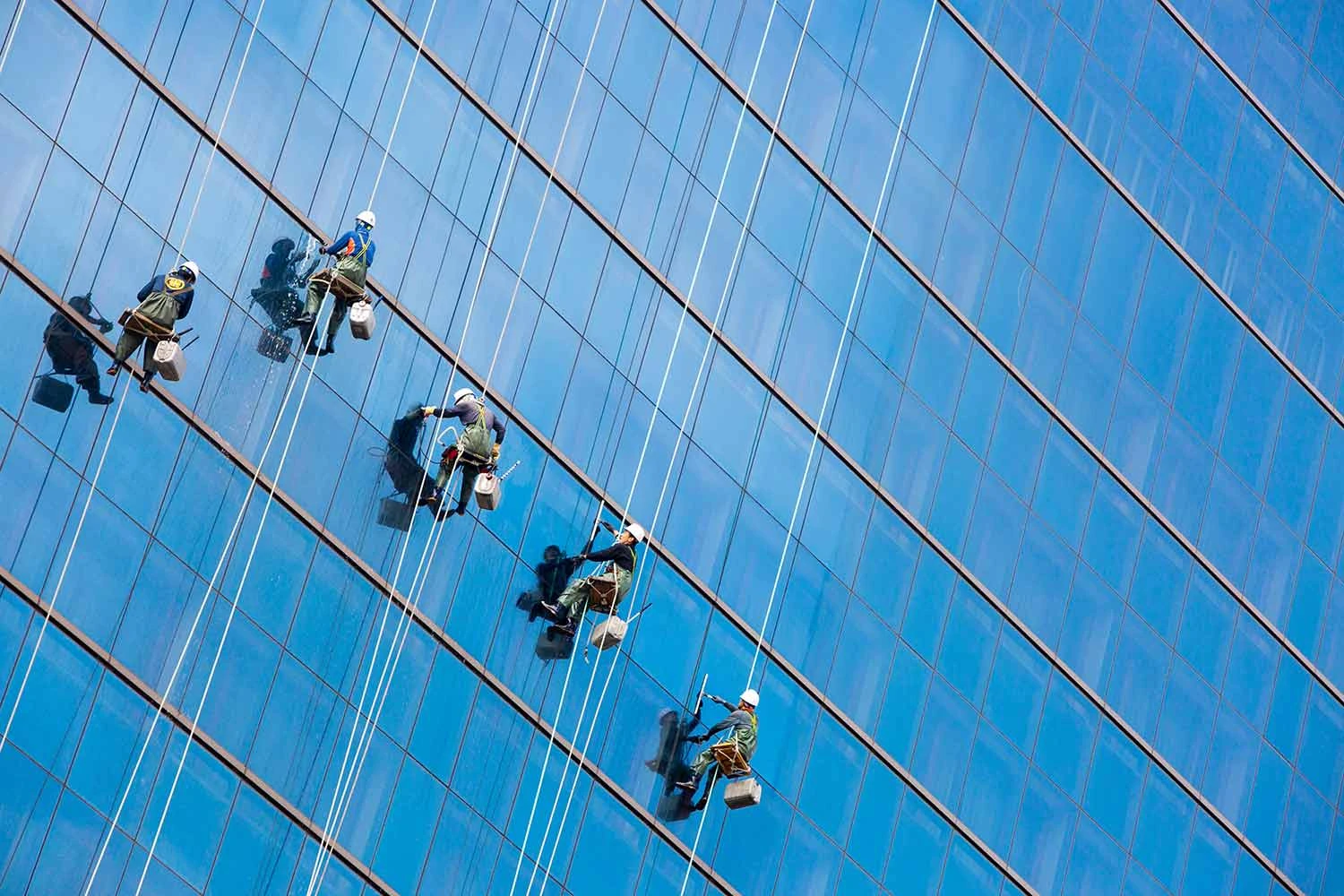
If a building is a clean, nonsmoking office environment and stands on a clean side street, it likely needs its windows cleaned less frequently. If the building is home to industrial work or a medical facility, sees a lot of foot traffic, is located on a busy street or near a substantial body of water, or must contend with smog or frequent avian visitors, the windows will need attention more often.
CLIMBING TOOLS
Movable platform: Much like the fixed scaffolds used for shorter buildings, a high rise window cleaning platform gives the window cleaner a stable place to stand while cleaning high-rise windows. But with a movable platform, when it's time to move down to the next floor, a pulley of ropes lowers the platform.
Bosun's chair: If window cleaners are not standing on a movable platform, they typically use a bosun's chair. The bosun's chair takes its name from seafaring. On a ship, the bosun, or boatswain, is the officer in charge of the crew and equipment, and a bosun's chair is a harness-like rope contraption that can suspend the bosun aloft to work on the ship's masts or rigging. In window cleaning, a bosun's chair is a small platform attached to a pulley that can lower it when the cleaner needs to descend to the next floor. Window cleaners can often suspend their buckets from hooks on the bottom of the bosun's chair, as well.
SAFETY TOOLS
Safety belt or harness: A window cleaner safety belt or harness is critical for window cleaners who are working on a platform. If the platform falls, the safety harness, which hooks to the building, ensures the window cleaner remains securely suspended in the air.
Protective gloves: Window cleaning is a messy business, and rain and snow make it messier. Protective gloves are must-have items, especially in the winter when wet hands can quickly freeze. Cold hands can lead to frostbite, and they also make the window climber less nimble and safe.
1
1
When researchers want to most accurately test a horse's pH level, these guys need to get the "freshest" manure sample which requires forcibly retrieving it from the animal.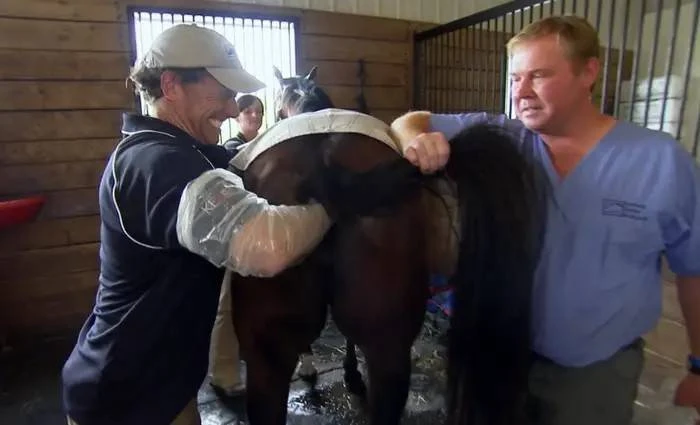
2
1