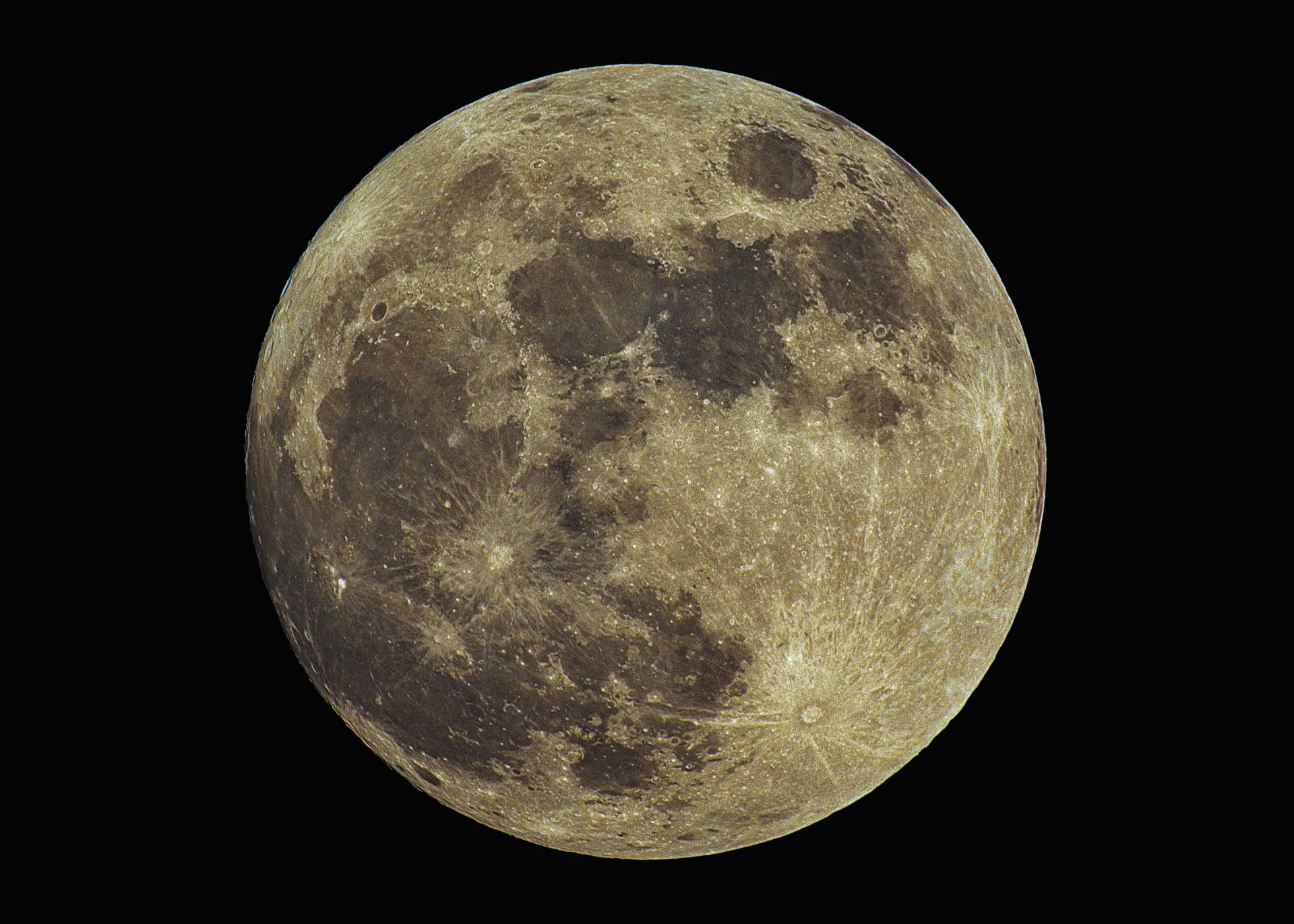
My first Lunar stacking attempt - looking for suggestions…
0 reactions
My first Lunar stacking attempt - looking for suggestions
This is my first serious attempt at lunar photography since upgrading to better gear. I previously owned much weaker lenses, so I'm finally happy to show something of this quality, even though I'm a complete novice in processing.
I struggled significantly with field rotation using a regular tripod, but I eventually found a unique workflow that worked for me (described below). I am looking for criticism on how to improve.
Equipment:
Camera: Nikon D7100
Lens: Nikkor 200-500mm f/5.6
Teleconverter: Nikon TC-20E (2x)
(Effective focal length: 1000mm base, \~1500mm with DX crop body)
Standard Tripod (no tracking)
Acquisition:
Shutter Speed: 1/160s
Aperture: f/14
ISO: 125
Frames: 80 frames stacked (out of \~180 total)
Processing Workflow:
PIPP: Used for initial centering and to cull the top 80 best frames. However, the program failed to fix the severe field rotation from the static tripod.
Adobe Photoshop (Part 1): Imported the 80 best TIFF files from PIPP as a stack with "Attempt to Automatically Align Source Images" checked. This worked flawlessly to re-center and, most importantly, correct the rotation of every single frame.
AutoStakkert! 4: Stacking the pre-aligned 80 frames from Photoshop.
Registax 6: Used Wavelets for sharpening and RGB Balance for color (purely experimental, trial-and-error approach).
Adobe Photoshop (Part 2): Final adjustments in Camera Raw to pull out more color and detail (also experimental).
Questions for the Community:
1. The Teleconverter Question: My current setup gives immense magnification, but the 2x TC drops me to f/11 base. I shot at f/14. I know the TC adds glass and can introduce softness.
Would I be better off removing the 2x TC, shooting on the native 200-500mm (which on my D7100 is roughly \~750mm effective), and losing magnification but gaining lens sharpness and a brighter aperture (f/5.6 base)? Which approach typically yields better final quality?
2. Acquisition Settings: Are my settings (1/160s, f/14, ISO 125) correct for this type of moon? Should I be aiming for a faster shutter speed with higher ISO to combat atmospheric seeing, or is ISO 125 the right call?
3. General Critique: As a beginner, I know I might have "overcooked" the sharpening in Registax. Any advice on how to improve my processing to get more details without the artifacts would be great.
Thanks for any suggestions!
#space
source
This is my first serious attempt at lunar photography since upgrading to better gear. I previously owned much weaker lenses, so I'm finally happy to show something of this quality, even though I'm a complete novice in processing.
I struggled significantly with field rotation using a regular tripod, but I eventually found a unique workflow that worked for me (described below). I am looking for criticism on how to improve.
Equipment:
Camera: Nikon D7100
Lens: Nikkor 200-500mm f/5.6
Teleconverter: Nikon TC-20E (2x)
(Effective focal length: 1000mm base, \~1500mm with DX crop body)
Standard Tripod (no tracking)
Acquisition:
Shutter Speed: 1/160s
Aperture: f/14
ISO: 125
Frames: 80 frames stacked (out of \~180 total)
Processing Workflow:
PIPP: Used for initial centering and to cull the top 80 best frames. However, the program failed to fix the severe field rotation from the static tripod.
Adobe Photoshop (Part 1): Imported the 80 best TIFF files from PIPP as a stack with "Attempt to Automatically Align Source Images" checked. This worked flawlessly to re-center and, most importantly, correct the rotation of every single frame.
AutoStakkert! 4: Stacking the pre-aligned 80 frames from Photoshop.
Registax 6: Used Wavelets for sharpening and RGB Balance for color (purely experimental, trial-and-error approach).
Adobe Photoshop (Part 2): Final adjustments in Camera Raw to pull out more color and detail (also experimental).
Questions for the Community:
1. The Teleconverter Question: My current setup gives immense magnification, but the 2x TC drops me to f/11 base. I shot at f/14. I know the TC adds glass and can introduce softness.
Would I be better off removing the 2x TC, shooting on the native 200-500mm (which on my D7100 is roughly \~750mm effective), and losing magnification but gaining lens sharpness and a brighter aperture (f/5.6 base)? Which approach typically yields better final quality?
2. Acquisition Settings: Are my settings (1/160s, f/14, ISO 125) correct for this type of moon? Should I be aiming for a faster shutter speed with higher ISO to combat atmospheric seeing, or is ISO 125 the right call?
3. General Critique: As a beginner, I know I might have "overcooked" the sharpening in Registax. Any advice on how to improve my processing to get more details without the artifacts would be great.
Thanks for any suggestions!
#space
source


| 3,000 mlx | |
| 3 | |
| 0 |