
13 reactions
This is a weighty subject on which much literature and political cooperation, at local (national) and global levels, exist. See Climate Change , Politics of Climate Change and Climate Change Mitigation Policies .
Apologies for my answer not following a straightforward “1, 2, 3” format. Here are my thoughts on #SomethingForEnvironment
Environmental protection is a shared goal, but the starting points vary across the globe, for example, from drilling fresh-water wells to water-treatment plants. What is your local status quo? What do you consider “next steps?”
IMHO, public health is the central issue. Consequently, it necessarily entails government intervention to provide services it is impractical for the private sector to provide. Reliance on private sector entities (individuals or corporations), which either cannot or will not shoulder responsibility for the communities in which they are located, yields a piecemeal solution. Their decision to open a center of operation is purely commercial.
Include “Environmental Conservation & Protection” in the school curriculum to raise youngsters’ awareness. Most might not feel connected to the issues; theory and practice are different things; hopefully, some children understand. Comprehension sets in when faced with reality; typically, as adults, people encounter situations pertinent to themselves, their families and communities and what was taught suddenly makes sense. Better late than never? Unfortunately, few people are interested in government affairs.
Individual, public-sector agencies responsible for land, water and air quality need to be established. The following agencies are responsible for land (impact and mitigation), water and air quality in the San Francisco Bay area. What agencies exist where you live?
LAND
After the United States federal government passed the National Environmental Policy Act (NEPA), the state of California, introduced The California Environmental Quality Act (CEQA, 1970). CEQA does not directly regulate land uses but, instead, requires state and local agencies within California to follow a protocol of analysis and public disclosure of environmental impacts of proposed projects and, in a departure from NEPA, adopt all feasible measures to mitigate those impacts.
WATER
East Bay Municipal Utility District (EBMUD), colloquially referred to as "East Bay Mud", is a public utility district which provides water and sewage treatment services for an area of approximately 331 square miles (860 km2) in the eastern side of the San Francisco Bay . EBMUD provides drinking water for people in portions of Alameda County and Contra Costa County in California , including the cities of Richmond , El Cerrito , Hercules , San Pablo , Pinole , Lafayette , Moraga , Orinda , Danville , Oakland , Piedmont , Emeryville , Berkeley , Albany , Alameda , San Leandro , neighboring unincorporated regions, and portions of cities such as Hayward and San Ramon . Sewage treatment services are provided for 685,000 people in an 88-square-mile area (as of 2018). EBMUD currently has an average annual growth rate of 0.8% and is projected to serve 1.6 million people by 2030. Headquartered in Oakland, EBMUD owns and maintains two water storage reservoirs on the Mokelumne River, five terminal reservoirs, 91 miles (146 km) of water transmission aqueducts, 4,100 miles (6,600 km) of water mains, six water treatment plants (WTPs), 29 miles (47 km) of wastewater interceptor sewer lines and a regional wastewater treatment facility (WWTF) rated at a maximum treatment capacity of 320 MGD.
The Alameda County Water District (ACWD) is a public agency in Alameda County, California , United States, which has responsibilities for managing and protecting certain groundwater resources within Alameda County. While most of the county is served by the East Bay Municipal Utility District , the Alameda County Water District serves only the cities of Newark , Fremont , and Union City . While not an administrative unit of the county government, this water district derives certain of its authorities from the County of Alameda. In particular, much of the work of the ACWD relates to management of the Niles Cone aquifer . (ACWD, 2007) Some of the work of the ACWD is regional in nature, coordinating with water management agencies of the San Francisco Peninsula and Santa Clara Valley Water District . (S.F. Bay, 2003) The Alameda County Water Agency receives grant funding from such agencies as the U.S. Environmental Protection Agency and State of California Department of Water Resources, for the purposes of technical assessment of the Niles Cone and other hydrological features of its jurisdictional area.. Specific capital programs of the ACWD include the construction of water supply pipelines, monitoring wells and blending facilities.(Earth Metrics Inc, 1990)
AIR
The Bay Area Air Quality Management District (BAAQMD) is the regional, public agency that regulates the stationary sources of air pollution in the nine counties of California's San Francisco Bay Area : Alameda , Contra Costa , Marin , Napa , San Francisco , San Mateo , Santa Clara , southwestern Solano and southern Sonoma . The BAAQMD is governed by a 24-member Board of Directors composed of elected officials from each of the nine Bay Area counties. The board has the duty of adopting air pollution regulations for the district. It is one of 35 Air Quality Management Districts in California
Regulatory agencies should be adequately staffed and funded to ensure effective oversight of policies and practices. Not only should they enjoy police powers [the latitude to devise policies for the public good], but they should also be imbued with the authority to prosecute – first, as a deterrent; secondly, as punitive action. For instance, “ Walmart To Pay $7.5M For Dumping Toxic Waste Into NorCal Landfills .”
Local governments in California have set themselves goals to reduce their respective municipalities’ carbon footprints and introduced measures to attain them, ranging from energy-efficient construction codes, per CEQA, to residential energy-conservation ordinances. Public policy, however, can become complicated, as is the case with carbon offsets and credits to achieve a desired aggregate effect.
As mentioned at the outset, the complexity of environmental protection means there's much to discuss; political will and private support of public policy are essential, if any measure of success is to be achieved.
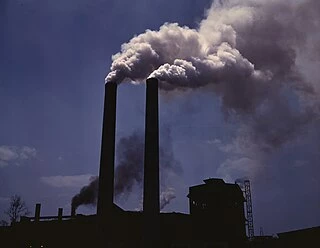
[ PHOTO CAPTION: Smokestacks, Alfred T. Palmer ]
Apologies for my answer not following a straightforward “1, 2, 3” format. Here are my thoughts on #SomethingForEnvironment
Environmental protection is a shared goal, but the starting points vary across the globe, for example, from drilling fresh-water wells to water-treatment plants. What is your local status quo? What do you consider “next steps?”
IMHO, public health is the central issue. Consequently, it necessarily entails government intervention to provide services it is impractical for the private sector to provide. Reliance on private sector entities (individuals or corporations), which either cannot or will not shoulder responsibility for the communities in which they are located, yields a piecemeal solution. Their decision to open a center of operation is purely commercial.
Include “Environmental Conservation & Protection” in the school curriculum to raise youngsters’ awareness. Most might not feel connected to the issues; theory and practice are different things; hopefully, some children understand. Comprehension sets in when faced with reality; typically, as adults, people encounter situations pertinent to themselves, their families and communities and what was taught suddenly makes sense. Better late than never? Unfortunately, few people are interested in government affairs.
Individual, public-sector agencies responsible for land, water and air quality need to be established. The following agencies are responsible for land (impact and mitigation), water and air quality in the San Francisco Bay area. What agencies exist where you live?
LAND
After the United States federal government passed the National Environmental Policy Act (NEPA), the state of California, introduced The California Environmental Quality Act (CEQA, 1970). CEQA does not directly regulate land uses but, instead, requires state and local agencies within California to follow a protocol of analysis and public disclosure of environmental impacts of proposed projects and, in a departure from NEPA, adopt all feasible measures to mitigate those impacts.
WATER
East Bay Municipal Utility District (EBMUD), colloquially referred to as "East Bay Mud", is a public utility district which provides water and sewage treatment services for an area of approximately 331 square miles (860 km2) in the eastern side of the San Francisco Bay . EBMUD provides drinking water for people in portions of Alameda County and Contra Costa County in California , including the cities of Richmond , El Cerrito , Hercules , San Pablo , Pinole , Lafayette , Moraga , Orinda , Danville , Oakland , Piedmont , Emeryville , Berkeley , Albany , Alameda , San Leandro , neighboring unincorporated regions, and portions of cities such as Hayward and San Ramon . Sewage treatment services are provided for 685,000 people in an 88-square-mile area (as of 2018). EBMUD currently has an average annual growth rate of 0.8% and is projected to serve 1.6 million people by 2030. Headquartered in Oakland, EBMUD owns and maintains two water storage reservoirs on the Mokelumne River, five terminal reservoirs, 91 miles (146 km) of water transmission aqueducts, 4,100 miles (6,600 km) of water mains, six water treatment plants (WTPs), 29 miles (47 km) of wastewater interceptor sewer lines and a regional wastewater treatment facility (WWTF) rated at a maximum treatment capacity of 320 MGD.
The Alameda County Water District (ACWD) is a public agency in Alameda County, California , United States, which has responsibilities for managing and protecting certain groundwater resources within Alameda County. While most of the county is served by the East Bay Municipal Utility District , the Alameda County Water District serves only the cities of Newark , Fremont , and Union City . While not an administrative unit of the county government, this water district derives certain of its authorities from the County of Alameda. In particular, much of the work of the ACWD relates to management of the Niles Cone aquifer . (ACWD, 2007) Some of the work of the ACWD is regional in nature, coordinating with water management agencies of the San Francisco Peninsula and Santa Clara Valley Water District . (S.F. Bay, 2003) The Alameda County Water Agency receives grant funding from such agencies as the U.S. Environmental Protection Agency and State of California Department of Water Resources, for the purposes of technical assessment of the Niles Cone and other hydrological features of its jurisdictional area.. Specific capital programs of the ACWD include the construction of water supply pipelines, monitoring wells and blending facilities.(Earth Metrics Inc, 1990)
AIR
The Bay Area Air Quality Management District (BAAQMD) is the regional, public agency that regulates the stationary sources of air pollution in the nine counties of California's San Francisco Bay Area : Alameda , Contra Costa , Marin , Napa , San Francisco , San Mateo , Santa Clara , southwestern Solano and southern Sonoma . The BAAQMD is governed by a 24-member Board of Directors composed of elected officials from each of the nine Bay Area counties. The board has the duty of adopting air pollution regulations for the district. It is one of 35 Air Quality Management Districts in California
Regulatory agencies should be adequately staffed and funded to ensure effective oversight of policies and practices. Not only should they enjoy police powers [the latitude to devise policies for the public good], but they should also be imbued with the authority to prosecute – first, as a deterrent; secondly, as punitive action. For instance, “ Walmart To Pay $7.5M For Dumping Toxic Waste Into NorCal Landfills .”
Local governments in California have set themselves goals to reduce their respective municipalities’ carbon footprints and introduced measures to attain them, ranging from energy-efficient construction codes, per CEQA, to residential energy-conservation ordinances. Public policy, however, can become complicated, as is the case with carbon offsets and credits to achieve a desired aggregate effect.
As mentioned at the outset, the complexity of environmental protection means there's much to discuss; political will and private support of public policy are essential, if any measure of success is to be achieved.
[ PHOTO CAPTION: Smokestacks, Alfred T. Palmer ]


| 156,000 mlx | |
| 52 | |
| 13 |