
6 reactions
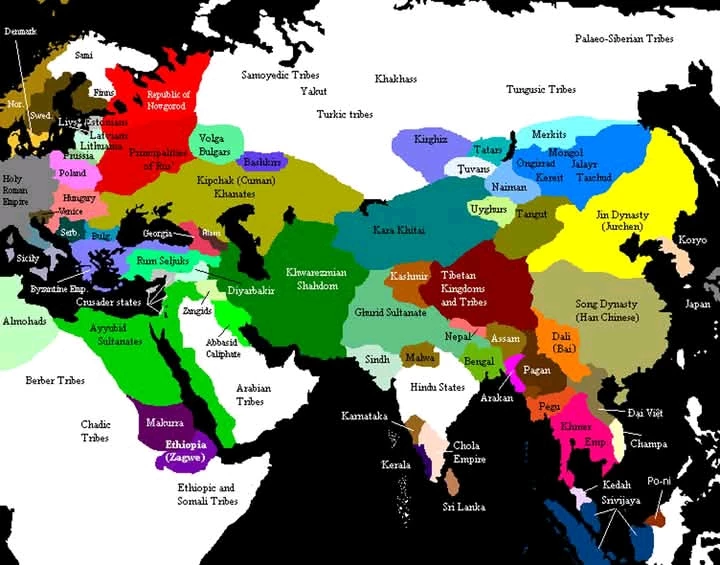
Eurasia before 1200
Before 1200, Eurasia saw the rise and fall of numerous civilizations, the development of trade routes like the Silk Road, and the spread of religions and cultural ideas across vast distances, with political landscapes often fragmented and ruled by various empires and smaller states.
Key Developments and Features:
Civilizations and Empires:
Mesopotamia, Indus Valley, and China: These regions saw the emergence of some of the earliest civilizations, characterized by complex urban centers, writing systems, and organized societies.
Minoan Civilization: In southern Europe, the Minoan civilization of the Aegean Islands flourished, leaving behind sophisticated art, writing, and a network of trade.
Hittite and Egyptian Empires: By the 2nd millennium BC, the eastern coastlines of the Mediterranean were dominated by the Hittite and Egyptian empires, competing for control over city-states in the Levant.
Tang and Song Dynasties in China: These dynasties presided over a vibrant market economy, encouraging trade, technological innovation, and population growth.
Abbasid Caliphate: The Abbasid administration in Baghdad fostered a stable and prosperous environment for trade, connecting Arab merchants with their Chinese counterparts.
Islamic Expansion: Islam expanded from its origins in the Arabian Peninsula, leading to the formation of Muslim-ruled states in various regions, including West Africa and South Asia.
Fragmented Political Landscape: On the eve of the Mongol conquests, Eurasia was politically fragmented, with control divided among numerous small states.
Trade and Cultural Exchange:
Silk Road: The Silk Road facilitated the exchange of goods, ideas, and cultures between East and West, including silk, tea, porcelain, and other commodities.
Religious Exchange: Religions like Buddhism, Christianity, Manichaeism, and Zoroastrianism spread across Eurasia, influencing various cultures and societies.
Technological Innovations: Innovations in metal use, warfare techniques, and other areas, like the use of chariots and paper, had a significant impact on Eurasian societies.
Nomadic Empires:
Central Eurasia: Nomadic powers, like the Turks in Iran and Anatolia, controlled vast portions of Central Eurasia, stretching from China to Europe.
The Mongols: The Mongol Empire, which emerged around 1200, would eventually conquer most of the Islamic world, China, and all of Central Asia.
Subsistence Economies in Eastern Europe:
Until the end of the eleventh century, the peoples of eastern and western Slavonic countries lived in a largely subsistence economy.
Regional Variations:
Europe: Europe was divided into a few large kingdoms, many small states, and some city-states, with local nobles holding considerable power.
South Asia: Much of northern India was ruled by an Islamic ruler known as the Sultan of Delhi, with many local rivals also ruling small states.
Southeast Asia: Large states, like the Angkor Empire, flourished in Southeast Asia.
Before 1200, Eurasia saw the rise and fall of numerous civilizations, the development of trade routes like the Silk Road, and the spread of religions and cultural ideas across vast distances, with political landscapes often fragmented and ruled by various empires and smaller states.
Key Developments and Features:
Civilizations and Empires:
Mesopotamia, Indus Valley, and China: These regions saw the emergence of some of the earliest civilizations, characterized by complex urban centers, writing systems, and organized societies.
Minoan Civilization: In southern Europe, the Minoan civilization of the Aegean Islands flourished, leaving behind sophisticated art, writing, and a network of trade.
Hittite and Egyptian Empires: By the 2nd millennium BC, the eastern coastlines of the Mediterranean were dominated by the Hittite and Egyptian empires, competing for control over city-states in the Levant.
Tang and Song Dynasties in China: These dynasties presided over a vibrant market economy, encouraging trade, technological innovation, and population growth.
Abbasid Caliphate: The Abbasid administration in Baghdad fostered a stable and prosperous environment for trade, connecting Arab merchants with their Chinese counterparts.
Islamic Expansion: Islam expanded from its origins in the Arabian Peninsula, leading to the formation of Muslim-ruled states in various regions, including West Africa and South Asia.
Fragmented Political Landscape: On the eve of the Mongol conquests, Eurasia was politically fragmented, with control divided among numerous small states.
Trade and Cultural Exchange:
Silk Road: The Silk Road facilitated the exchange of goods, ideas, and cultures between East and West, including silk, tea, porcelain, and other commodities.
Religious Exchange: Religions like Buddhism, Christianity, Manichaeism, and Zoroastrianism spread across Eurasia, influencing various cultures and societies.
Technological Innovations: Innovations in metal use, warfare techniques, and other areas, like the use of chariots and paper, had a significant impact on Eurasian societies.
Nomadic Empires:
Central Eurasia: Nomadic powers, like the Turks in Iran and Anatolia, controlled vast portions of Central Eurasia, stretching from China to Europe.
The Mongols: The Mongol Empire, which emerged around 1200, would eventually conquer most of the Islamic world, China, and all of Central Asia.
Subsistence Economies in Eastern Europe:
Until the end of the eleventh century, the peoples of eastern and western Slavonic countries lived in a largely subsistence economy.
Regional Variations:
Europe: Europe was divided into a few large kingdoms, many small states, and some city-states, with local nobles holding considerable power.
South Asia: Much of northern India was ruled by an Islamic ruler known as the Sultan of Delhi, with many local rivals also ruling small states.
Southeast Asia: Large states, like the Angkor Empire, flourished in Southeast Asia.


4

1

1
| 12,000 mlx | |
| 15 | |
| 6 |