
13 reactions
In the final, tragic months of her young life, 14-year-old Czesława Kwoka was deported to Auschwitz-Birkenau with her mother during the Nazi occupation of Poland. A Polish Catholic girl, she was among thousands of civilians swept up in the Nazis’ brutal effort to crush resistance and terrorize the population. Shortly after arriving at the camp, her mother died, leaving Czesława alone in an unfamiliar, violent world. Isolated, frightened, and unable to speak German, she faced the horrors of Auschwitz as just one of many children who were imprisoned and condemned for nothing more than their identity.
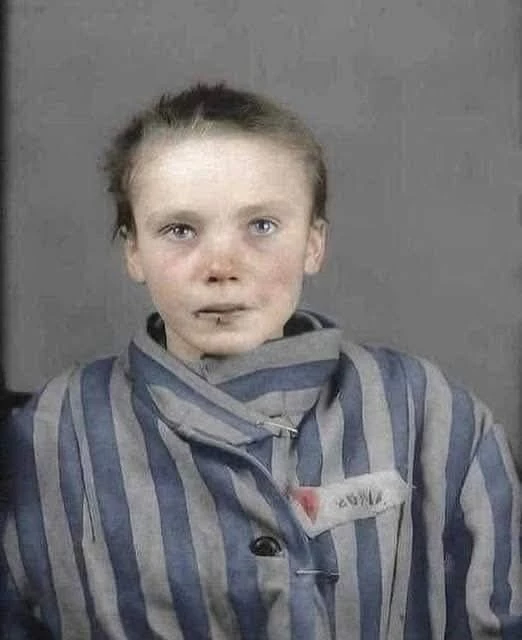
Just days before her death on February 18, 1943, Czesława was photographed for Nazi documentation by Wilhelm Brasse, a fellow prisoner forced to take thousands of inmate portraits. Brasse later recalled that a guard had beaten Czesława moments before the photo was taken, leaving her lip bruised and her expression full of fear. In the image, her eyes tell a story of shock, confusion, and deep sorrow. She had no way to understand the cruelty around her, and no voice with which to plead for her life. Her execution, carried out by a phenol injection to the heart, came swiftly and without mercy—a fate shared by countless other innocent victims.
Decades later, Czesława’s haunting photo found renewed life through the work of Brazilian artist Marina Amaral, who meticulously colorized the black-and-white image. Her goal was to restore Czesława’s humanity, to bring warmth and reality back to a face too often lost in the anonymity of history. The vivid rendering gave millions a chance to see her not just as a statistic, but as a real child—with emotions, fears, and dreams. Today, her portrait stands as a solemn reminder of the children murdered in the Holocaust, a tribute to their stolen lives, and a call to remember the human cost of hatred and silence.
Just days before her death on February 18, 1943, Czesława was photographed for Nazi documentation by Wilhelm Brasse, a fellow prisoner forced to take thousands of inmate portraits. Brasse later recalled that a guard had beaten Czesława moments before the photo was taken, leaving her lip bruised and her expression full of fear. In the image, her eyes tell a story of shock, confusion, and deep sorrow. She had no way to understand the cruelty around her, and no voice with which to plead for her life. Her execution, carried out by a phenol injection to the heart, came swiftly and without mercy—a fate shared by countless other innocent victims.
Decades later, Czesława’s haunting photo found renewed life through the work of Brazilian artist Marina Amaral, who meticulously colorized the black-and-white image. Her goal was to restore Czesława’s humanity, to bring warmth and reality back to a face too often lost in the anonymity of history. The vivid rendering gave millions a chance to see her not just as a statistic, but as a real child—with emotions, fears, and dreams. Today, her portrait stands as a solemn reminder of the children murdered in the Holocaust, a tribute to their stolen lives, and a call to remember the human cost of hatred and silence.


| 31,000 mlx | |
| 27 | |
| 13 |

The colorization brings a heartbreaking humanity to her story, making the tragedy even more palpable.


Heartbreaking and deeply human. Czesława’s story reminds us that behind every number was a child with a name, a face, and a soul. Her eyes still speak what words cannot. 🕊️💔