
3 reactions
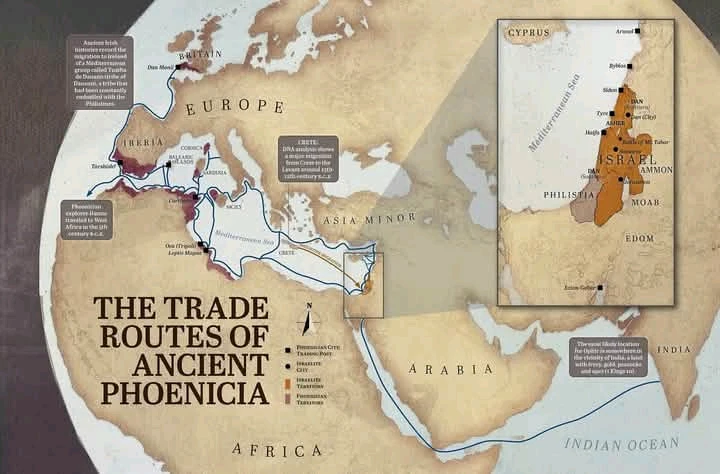
The Trade Routes of Ancient Phoenicia
Introduction
The Phoenicians were a maritime civilization that thrived between 1500 BCE and 300 BCE along the eastern Mediterranean coast, in present-day Lebanon, Syria, and northern Israel/Palestine. Renowned for their seafaring skills, the Phoenicians established an extensive trade network that connected the Mediterranean world, North Africa, and even parts of the Atlantic coast. This document explores the major trade routes, key commodities, and the economic impact of Phoenician trade.
1. Major Trade Routes of the Phoenicians
The Phoenicians relied on both maritime and overland trade routes, linking different civilizations and facilitating economic and cultural exchange.
A. Mediterranean Trade Routes
• The Phoenicians established major port cities such as Tyre, Sidon, and Byblos, which served as trade hubs.
• Their ships sailed across the Mediterranean Sea, connecting:
o Egypt and the Levant (exporting cedarwood, textiles, and papyrus)
o Anatolia (modern Turkey) (trading metals such as copper and tin)
o Greece and the Aegean islands (exchanging glassware, purple dye, and luxury goods)
o Italy (Etruscan territories) (trading ceramics, olives, and wine)
o Carthage and North Africa (establishing colonies and trade posts)
B. Atlantic and Western Trade Routes
• The Phoenicians sailed beyond the Strait of Gibraltar, reaching:
o Southern Iberia (modern Spain and Portugal) for silver and tin
o Morocco (Lixus, Mogador) for metals and fishing trade
o Possible voyages to West Africa and Britain in search of gold and tin
C. Overland Trade Routes
• Overland trade connected Phoenicia to:
o Mesopotamia (Babylon, Assyria) through caravan routes carrying textiles, spices, and metals.
o Arabian Peninsula for incense, spices, and precious stones.
o Persian Empire during the later period, contributing to a vast trade network.
2. Key Commodities in Phoenician Trade
The Phoenicians were skilled traders of valuable goods, including:
• Purple dye (Tyrian Purple) – extracted from murex shellfish, highly valued in the ancient world.
• Cedarwood – used for shipbuilding and construction, exported to Egypt and Mesopotamia.
• Glassware – Phoenicians were pioneers in glassmaking.
• Metals (gold, silver, tin, copper) – sourced from Iberia, Cyprus, and Anatolia.
• Textiles and pottery – known for high-quality craftsmanship.
• Papyrus and scrolls – exported from Byblos, which became a major center for writing materials.
3. The Role of Phoenician Colonies in Trade
• The Phoenicians established colonies and trading posts across the Mediterranean to facilitate commerce.
• Notable colonies included:
o Carthage (Tunisia) – Became the most powerful Phoenician colony and later an empire.
o Gadir (modern Cádiz, Spain) – Key point for trade with Iberia.
o Lixus and Mogador (Morocco) – Connected to African trade routes.
o Malta, Sicily, and Sardinia – Important trade stations between the eastern and western Mediterranean.
4. Economic and Cultural Impact of Phoenician Trade
• Spread of the Phoenician alphabet, which influenced Greek and Latin scripts.
• Established a vast commercial network that linked different civilizations, facilitating cultural exchanges.
• Strengthened the economies of major Mediterranean powers by providing essential goods.
• Laid the foundation for later maritime empires, such as Carthage and Rome.
Conclusion
The Phoenician trade routes were among the most extensive in the ancient world, connecting distant regions and shaping economic and cultural exchanges. Their innovative seafaring, advanced trading networks, and establishment of colonies left a lasting legacy in Mediterranean history.
Introduction
The Phoenicians were a maritime civilization that thrived between 1500 BCE and 300 BCE along the eastern Mediterranean coast, in present-day Lebanon, Syria, and northern Israel/Palestine. Renowned for their seafaring skills, the Phoenicians established an extensive trade network that connected the Mediterranean world, North Africa, and even parts of the Atlantic coast. This document explores the major trade routes, key commodities, and the economic impact of Phoenician trade.
1. Major Trade Routes of the Phoenicians
The Phoenicians relied on both maritime and overland trade routes, linking different civilizations and facilitating economic and cultural exchange.
A. Mediterranean Trade Routes
• The Phoenicians established major port cities such as Tyre, Sidon, and Byblos, which served as trade hubs.
• Their ships sailed across the Mediterranean Sea, connecting:
o Egypt and the Levant (exporting cedarwood, textiles, and papyrus)
o Anatolia (modern Turkey) (trading metals such as copper and tin)
o Greece and the Aegean islands (exchanging glassware, purple dye, and luxury goods)
o Italy (Etruscan territories) (trading ceramics, olives, and wine)
o Carthage and North Africa (establishing colonies and trade posts)
B. Atlantic and Western Trade Routes
• The Phoenicians sailed beyond the Strait of Gibraltar, reaching:
o Southern Iberia (modern Spain and Portugal) for silver and tin
o Morocco (Lixus, Mogador) for metals and fishing trade
o Possible voyages to West Africa and Britain in search of gold and tin
C. Overland Trade Routes
• Overland trade connected Phoenicia to:
o Mesopotamia (Babylon, Assyria) through caravan routes carrying textiles, spices, and metals.
o Arabian Peninsula for incense, spices, and precious stones.
o Persian Empire during the later period, contributing to a vast trade network.
2. Key Commodities in Phoenician Trade
The Phoenicians were skilled traders of valuable goods, including:
• Purple dye (Tyrian Purple) – extracted from murex shellfish, highly valued in the ancient world.
• Cedarwood – used for shipbuilding and construction, exported to Egypt and Mesopotamia.
• Glassware – Phoenicians were pioneers in glassmaking.
• Metals (gold, silver, tin, copper) – sourced from Iberia, Cyprus, and Anatolia.
• Textiles and pottery – known for high-quality craftsmanship.
• Papyrus and scrolls – exported from Byblos, which became a major center for writing materials.
3. The Role of Phoenician Colonies in Trade
• The Phoenicians established colonies and trading posts across the Mediterranean to facilitate commerce.
• Notable colonies included:
o Carthage (Tunisia) – Became the most powerful Phoenician colony and later an empire.
o Gadir (modern Cádiz, Spain) – Key point for trade with Iberia.
o Lixus and Mogador (Morocco) – Connected to African trade routes.
o Malta, Sicily, and Sardinia – Important trade stations between the eastern and western Mediterranean.
4. Economic and Cultural Impact of Phoenician Trade
• Spread of the Phoenician alphabet, which influenced Greek and Latin scripts.
• Established a vast commercial network that linked different civilizations, facilitating cultural exchanges.
• Strengthened the economies of major Mediterranean powers by providing essential goods.
• Laid the foundation for later maritime empires, such as Carthage and Rome.
Conclusion
The Phoenician trade routes were among the most extensive in the ancient world, connecting distant regions and shaping economic and cultural exchanges. Their innovative seafaring, advanced trading networks, and establishment of colonies left a lasting legacy in Mediterranean history.


1

1

1
| 8,000 mlx | |
| 16 | |
| 3 |