
0 reactions
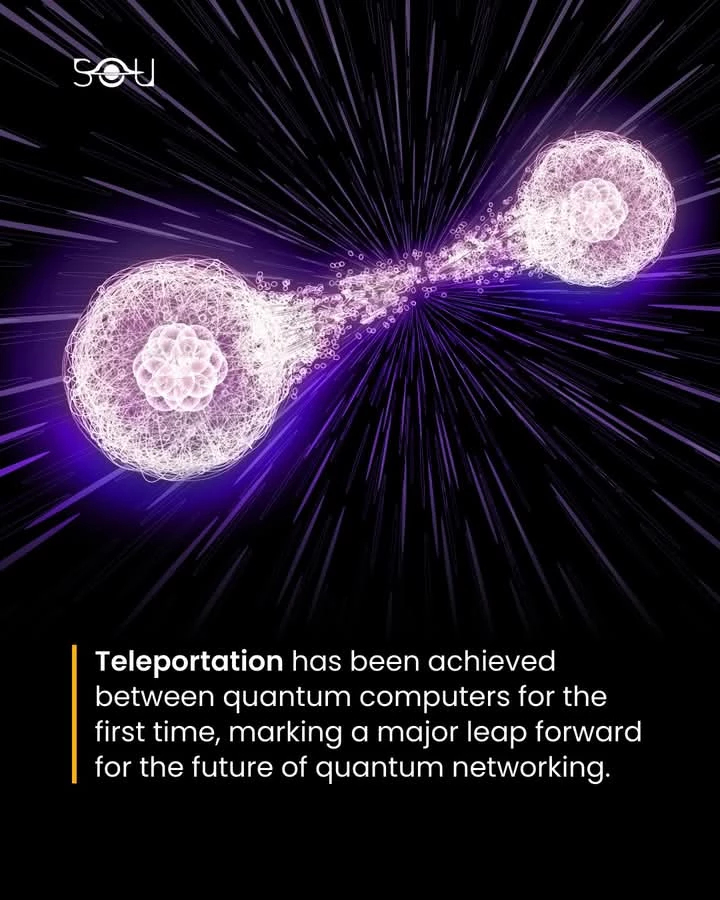
In a groundbreaking experiment, physicists at Oxford University achieved teleportation between two quantum computers, successfully distributing critical units of a quantum processor across multiple machines without sacrificing performance.
This feat demonstrates the potential for scaling quantum technology by teleporting quantum states across a network of connected systems.
The experiment involved entangling the quantum states of different objects (qubits) and using measurements on one to force an entangled object some distance away to adopt the original's quantum identity. While the teleportation occurred over a short distance of two meters, it proves the feasibility of creating quantum supercomputers by linking smaller processors.
Unlike transmitting quantum information via light waves, which are susceptible to corruption, teleportation relies on transmitting classical binary data containing measurement results. This data allows the receiving end to manipulate its entangled particle to replicate the original.
In the Oxford experiment, the teleported spin state achieved an 86% match with the original, sufficient for it to serve as a logic gate for Grover's algorithm, which ran with 71% efficiency across the two processors. The photonic links used to interconnect the modules offer valuable flexibility, enabling upgrades or replacements without disrupting the entire architecture.
This advancement could diversify the applications of quantum networks, potentially transforming them into tools for fundamental physics research. The research was published in Nature.
📄 RESEARCH PAPER:
D. Main et al., "Distributed quantum computing across an optical network link", Nature (2025)
This feat demonstrates the potential for scaling quantum technology by teleporting quantum states across a network of connected systems.
The experiment involved entangling the quantum states of different objects (qubits) and using measurements on one to force an entangled object some distance away to adopt the original's quantum identity. While the teleportation occurred over a short distance of two meters, it proves the feasibility of creating quantum supercomputers by linking smaller processors.
Unlike transmitting quantum information via light waves, which are susceptible to corruption, teleportation relies on transmitting classical binary data containing measurement results. This data allows the receiving end to manipulate its entangled particle to replicate the original.
In the Oxford experiment, the teleported spin state achieved an 86% match with the original, sufficient for it to serve as a logic gate for Grover's algorithm, which ran with 71% efficiency across the two processors. The photonic links used to interconnect the modules offer valuable flexibility, enabling upgrades or replacements without disrupting the entire architecture.
This advancement could diversify the applications of quantum networks, potentially transforming them into tools for fundamental physics research. The research was published in Nature.
📄 RESEARCH PAPER:
D. Main et al., "Distributed quantum computing across an optical network link", Nature (2025)


| 8,000 mlx | |
| 22 | |
| 0 |