Cygnus Loop untracked with a Nikon D5000 I finally gave…
0 reactions
Cygnus Loop untracked with a Nikon D5000
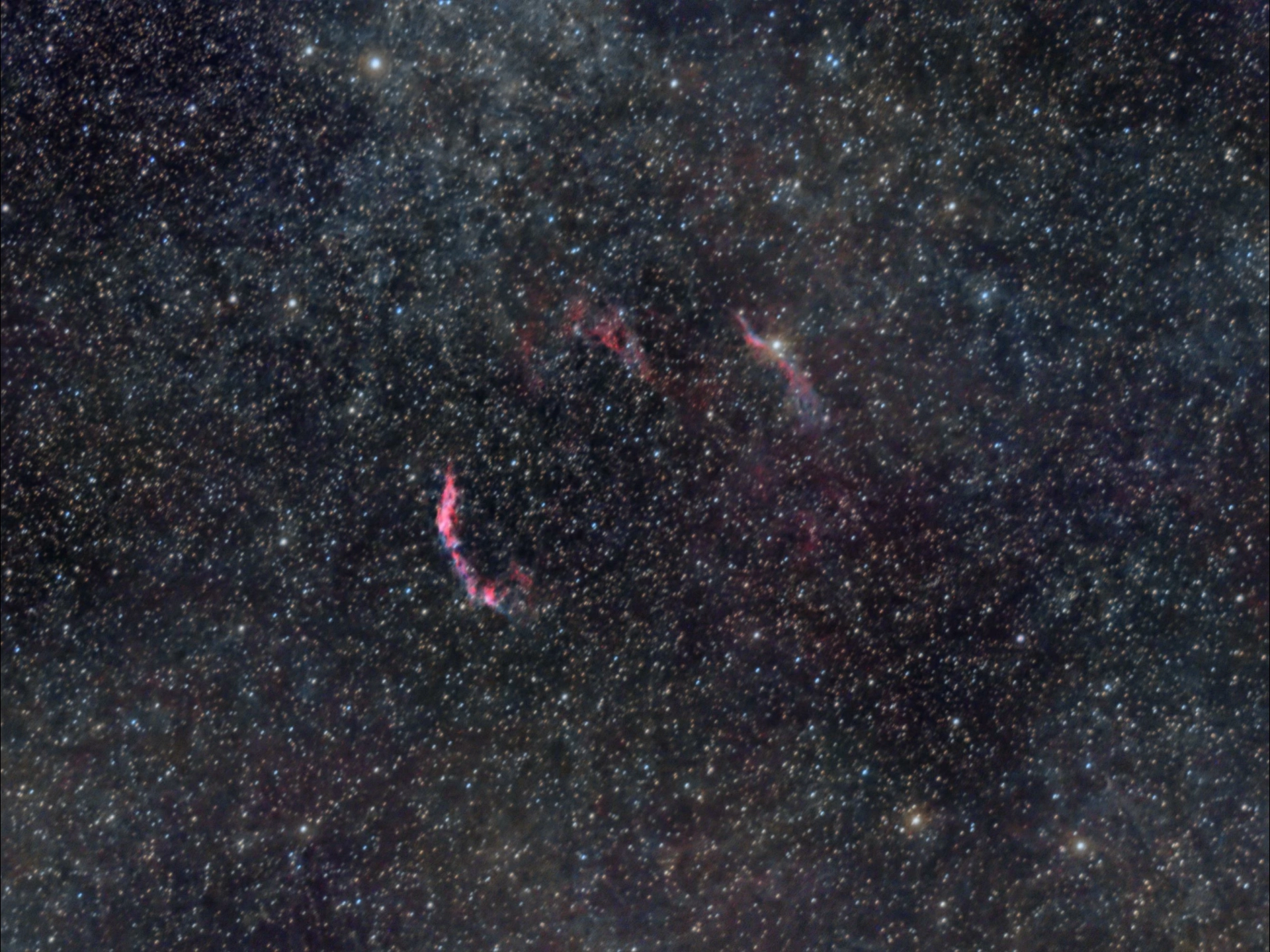
I finally gave the Cygnus Loop a try with my untracked DSLR setup and I’m honestly pretty happy that I managed to pull out this much signal.
This was shot from a fixed tripod with short exposures and a lot of frames. I know there is still a lot of room for improvement, but for an untracked attempt I’m really happy that both the Western and Eastern Veil came through.
Because of the dense star field, I also used **StarNet star removal** during processing to help separate the nebula from the stars and make the structure stand out a bit more.
**Acquisition:**
Nikon D5000
100 mm lens
Untracked tripod
753 light frames
5 second exposures
Total integration: about 62 minutes
ISO 6400
Darks and biases used
**Processing:**
Stacked in Siril
Background work in GraXpert
StarNet used for star removal / starless processing
I went with 100 mm because the Cygnus Loop is huge and I wanted to keep the whole structure in frame without having to reframe too often. The tradeoff is that the target appears smaller, but it made the session much easier overall.
The biggest challenge was definitely the rich star field. Even with star removal, I’m still figuring out how to better balance the stars, background, and faint filaments without making the image look too harsh or noisy.
For an untracked result, I’m pretty happy with this one. Any advice on processing wide-field Cygnus Loop data, especially star reduction, background control, or bringing out faint structure more cleanly, would be appreciated.
#space
source
I finally gave the Cygnus Loop a try with my untracked DSLR setup and I’m honestly pretty happy that I managed to pull out this much signal.
This was shot from a fixed tripod with short exposures and a lot of frames. I know there is still a lot of room for improvement, but for an untracked attempt I’m really happy that both the Western and Eastern Veil came through.
Because of the dense star field, I also used **StarNet star removal** during processing to help separate the nebula from the stars and make the structure stand out a bit more.
**Acquisition:**
Nikon D5000
100 mm lens
Untracked tripod
753 light frames
5 second exposures
Total integration: about 62 minutes
ISO 6400
Darks and biases used
**Processing:**
Stacked in Siril
Background work in GraXpert
StarNet used for star removal / starless processing
I went with 100 mm because the Cygnus Loop is huge and I wanted to keep the whole structure in frame without having to reframe too often. The tradeoff is that the target appears smaller, but it made the session much easier overall.
The biggest challenge was definitely the rich star field. Even with star removal, I’m still figuring out how to better balance the stars, background, and faint filaments without making the image look too harsh or noisy.
For an untracked result, I’m pretty happy with this one. Any advice on processing wide-field Cygnus Loop data, especially star reduction, background control, or bringing out faint structure more cleanly, would be appreciated.
#space
source


| 3,000 mlx | |
| 5 | |
| 0 |