Alfred Ely Beach built a subterranean wonder in total…
0 reactions
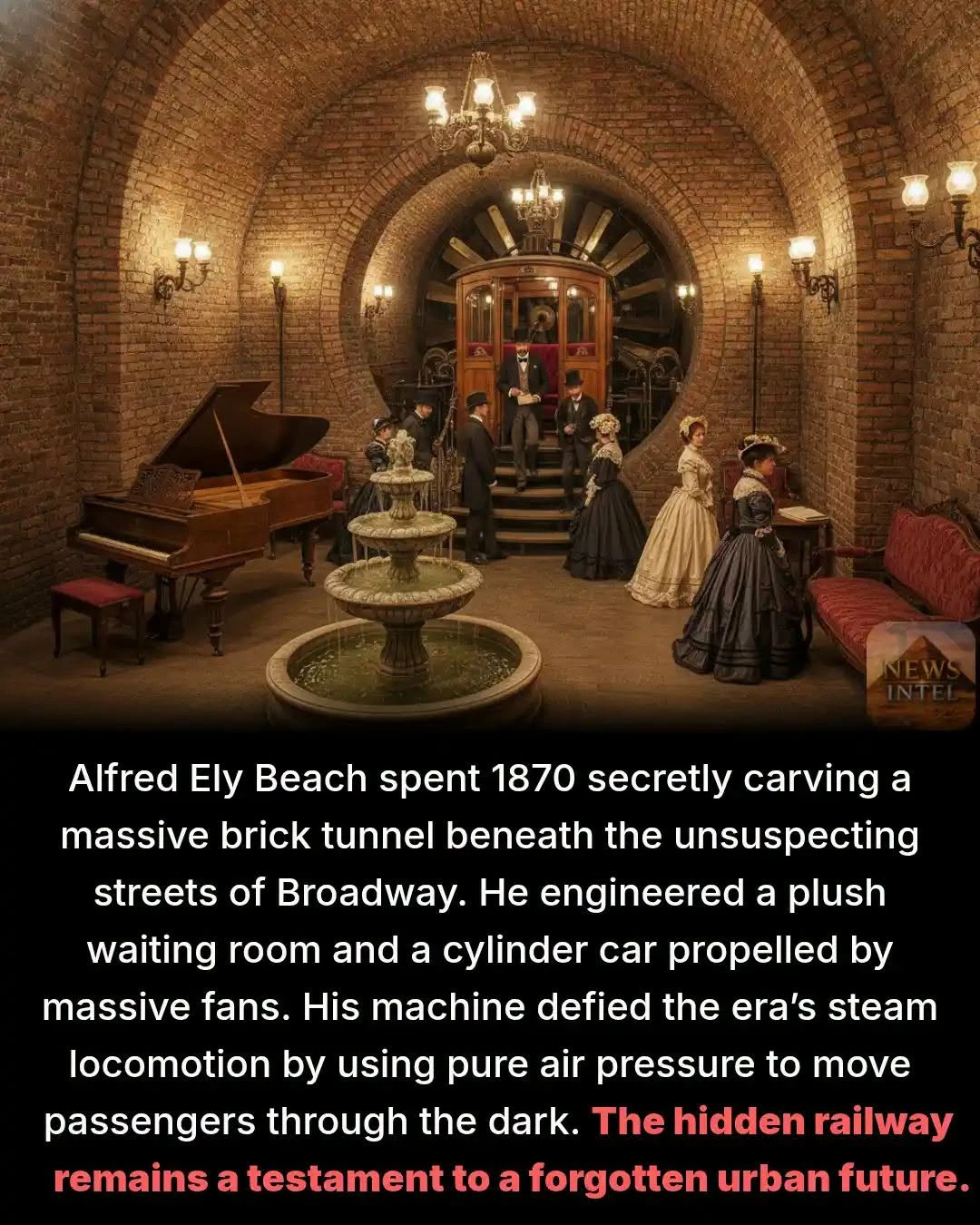
Alfred Ely Beach built a subterranean wonder in total secrecy to avoid the political corruption of Boss Tweed. He knew the city needed transit, but realized the authorities would never grant permission for his visionary project.
Working under the cover of night, his team moved tons of dirt in muffled carts to prevent the public from hearing the excavation below Broadway. The tunnel stretched only one block but represented a radical departure from nineteenth-century engineering norms.
The interior was far from a damp sewer. Beach decorated the waiting room with a grand piano, a fountain, and expensive frescoes to prove that underground travel could be luxurious.
The car itself was a cylindrical wooden capsule designed to fit perfectly within the curved brick walls. It relied on a massive hundred-ton fan known as the Western Tornado to push and pull it through the tube.
This pneumatic system eliminated the smoke and soot of traditional steam engines, making it the cleanest transit option of 1870. It was a silent revolution happening right beneath the feet of thousands of New Yorkers.
When the doors finally opened to the public, citizens were shocked to find a high-tech masterpiece where they expected only dirt and darkness. The project proved that pneumatic power was more than a theoretical dream.
However, the political machine of the era eventually crushed the expansion of this air-powered network. The tunnel was sealed shut after only a few years of operation and remained largely forgotten for decades.
Workers rediscovered the intact station and its decaying car during subway construction in 1912, revealing the preserved ghost of a lost technological path. The leather seats and brickwork had survived the passage of time in eerie silence.
We often assume technology moves in a straight line toward progress, yet this project suggests an entirely different path was available. The true potential of pneumatic transit remains buried in the silt of Lower Manhattan. #wilgman
Working under the cover of night, his team moved tons of dirt in muffled carts to prevent the public from hearing the excavation below Broadway. The tunnel stretched only one block but represented a radical departure from nineteenth-century engineering norms.
The interior was far from a damp sewer. Beach decorated the waiting room with a grand piano, a fountain, and expensive frescoes to prove that underground travel could be luxurious.
The car itself was a cylindrical wooden capsule designed to fit perfectly within the curved brick walls. It relied on a massive hundred-ton fan known as the Western Tornado to push and pull it through the tube.
This pneumatic system eliminated the smoke and soot of traditional steam engines, making it the cleanest transit option of 1870. It was a silent revolution happening right beneath the feet of thousands of New Yorkers.
When the doors finally opened to the public, citizens were shocked to find a high-tech masterpiece where they expected only dirt and darkness. The project proved that pneumatic power was more than a theoretical dream.
However, the political machine of the era eventually crushed the expansion of this air-powered network. The tunnel was sealed shut after only a few years of operation and remained largely forgotten for decades.
Workers rediscovered the intact station and its decaying car during subway construction in 1912, revealing the preserved ghost of a lost technological path. The leather seats and brickwork had survived the passage of time in eerie silence.
We often assume technology moves in a straight line toward progress, yet this project suggests an entirely different path was available. The true potential of pneumatic transit remains buried in the silt of Lower Manhattan. #wilgman


| 103,000 mlx | |
| 15 | |
| 0 |