NGC 6888 - Crescent Nebula **NGC 6888 – The Crescent…
0 reactions
NGC 6888 - Crescent Nebula
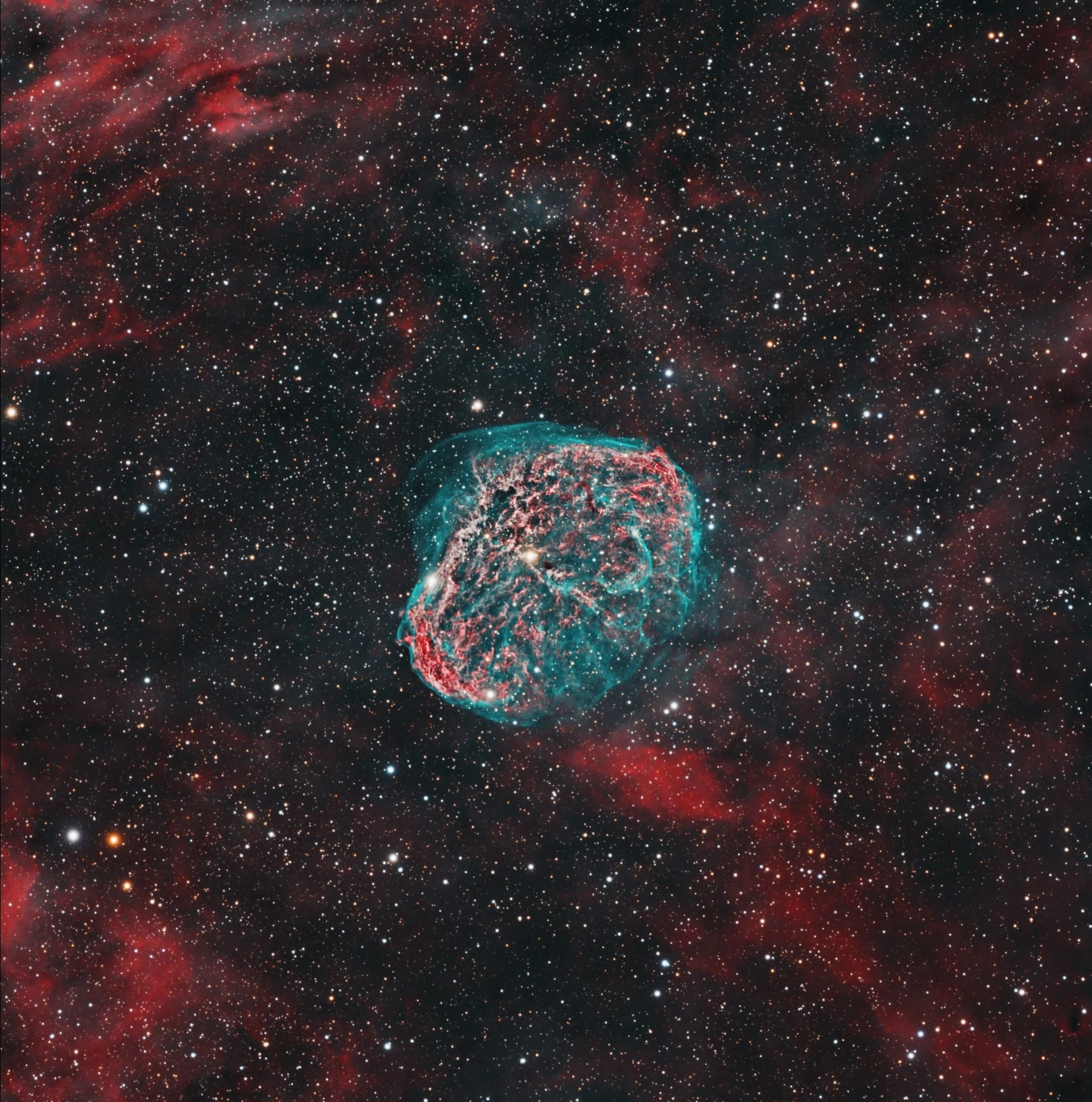
**NGC 6888 – The Crescent Nebula** 🌙✨
This is **NGC 6888**, the stunning Crescent Nebula, an emission nebula located in the constellation **Cygnus**, approximately **5,000 light-years** from Earth.
Its distinctive crescent shape is the result of a dramatic cosmic interaction. At its center lies **WR 136**, a rare and extremely powerful **Wolf-Rayet** star nearing the end of its life.
Powerful stellar winds, traveling at more than **1,500 km/s**, are sweeping up material expelled during an earlier evolutionary stage, compressing and heating the surrounding gas until it glows.
🔴 **Red:** Ionized Hydrogen (Hα)
🔵🟢 **Blue/Green:** Doubly ionized Oxygen (OIII)
These emissions create the intricate filaments and chaotic structures that make NGC 6888 one of the most fascinating deep-sky objects of the northern summer sky.
In a few hundred thousand years, WR 136 is expected to end its life in a spectacular supernova explosion, enriching interstellar space with heavy elements that will eventually become part of new stars and planetary systems.
📍 **Object:** NGC 6888 – Crescent Nebula
🌌 **Constellation:** Cygnus
📏 **Distance:** \~5,000 light-years
⭐ **Central Star:** WR 136 (Wolf-Rayet)
The universe is a continuous cycle of birth, transformation, and death. This image captures one of the most spectacular moments of that cycle.
📸 **Imaging Details**
**235 × 300-second exposures**
**Total integration:** 19h 35m
**Captured:** July 17–20, 2026
**Location:** Corato, Apulia, Italy (Bortle 6)
**Telescope:** Askar 91F APO
**Mount:** Sky-Watcher EQ6-R Pro
**Camera:** ToupTek ATR533C
**Filter:** SVBONY SV220 Dual Band (Hα/OIII)
**Processing:** PixInsight
Clear skies! ✨
#space
**NGC 6888 – The Crescent Nebula** 🌙✨
This is **NGC 6888**, the stunning Crescent Nebula, an emission nebula located in the constellation **Cygnus**, approximately **5,000 light-years** from Earth.
Its distinctive crescent shape is the result of a dramatic cosmic interaction. At its center lies **WR 136**, a rare and extremely powerful **Wolf-Rayet** star nearing the end of its life.
Powerful stellar winds, traveling at more than **1,500 km/s**, are sweeping up material expelled during an earlier evolutionary stage, compressing and heating the surrounding gas until it glows.
🔴 **Red:** Ionized Hydrogen (Hα)
🔵🟢 **Blue/Green:** Doubly ionized Oxygen (OIII)
These emissions create the intricate filaments and chaotic structures that make NGC 6888 one of the most fascinating deep-sky objects of the northern summer sky.
In a few hundred thousand years, WR 136 is expected to end its life in a spectacular supernova explosion, enriching interstellar space with heavy elements that will eventually become part of new stars and planetary systems.
📍 **Object:** NGC 6888 – Crescent Nebula
🌌 **Constellation:** Cygnus
📏 **Distance:** \~5,000 light-years
⭐ **Central Star:** WR 136 (Wolf-Rayet)
The universe is a continuous cycle of birth, transformation, and death. This image captures one of the most spectacular moments of that cycle.
📸 **Imaging Details**
**235 × 300-second exposures**
**Total integration:** 19h 35m
**Captured:** July 17–20, 2026
**Location:** Corato, Apulia, Italy (Bortle 6)
**Telescope:** Askar 91F APO
**Mount:** Sky-Watcher EQ6-R Pro
**Camera:** ToupTek ATR533C
**Filter:** SVBONY SV220 Dual Band (Hα/OIII)
**Processing:** PixInsight
Clear skies! ✨
#space


| 4,000 mlx | |
| 5 | |
| 0 |