
3 reactions
The story of Atlantis, as told by Plato in Timaeus and Critias, has fascinated scholars and explorers for centuries. According to Plato, the tale originated from Solon, the great Athenian lawmaker, who supposedly learned it from the Egyptian priest Sonchis of Saïs during a visit to Egypt around 590 BCE. The priests described an advanced civilization that existed 9,000 years before Solon’s time (roughly 11,600 years ago), which was located beyond the "Pillars of Hercules" (modern-day Strait of Gibraltar) and ultimately sank beneath the waves.
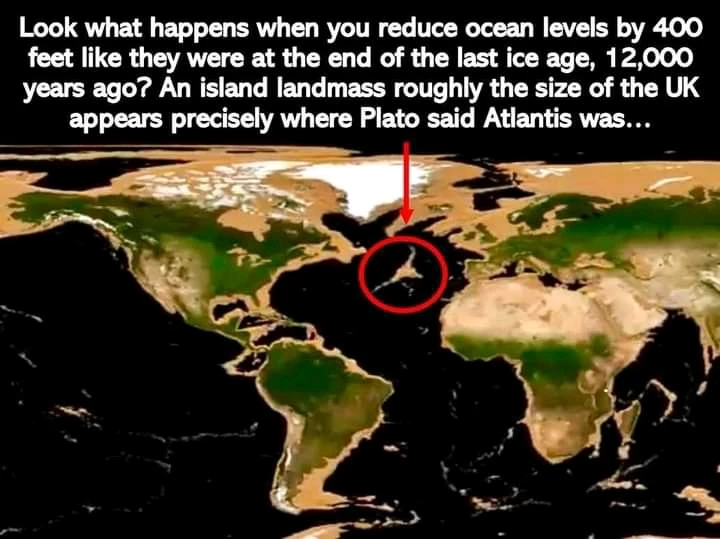
This timeline intriguingly aligns with the end of the Younger Dryas period, a time of massive climate change and rising sea levels, which could have submerged ancient coastal settlements. Some researchers and theorists suggest that the Azores, a volcanic island chain in the Atlantic Ocean, could be the remnants of this lost land. These islands, belonging to Portugal, are located along the Mid-Atlantic Ridge, a tectonic boundary that could have experienced dramatic geological upheavals.
The Azores Hypothesis proposes that Atlantis was not a single island but rather a larger landmass, possibly a now-submerged ridge that connected parts of the Atlantic. Supporters point to underwater structures, unusual basalt formations, and alleged submerged ruins as evidence. However, mainstream archaeology and geology argue that the Azores were never part of a large sunken continent but rather volcanic islands that have always been isolated.
So, could the Azores be Atlantis? While no definitive proof exists, the location and timeline are intriguing. Plato’s account remains open to interpretation—whether it was history, allegory, or a mix of both, it continues to spark the imagination.
What do you think? Could Atlantis have been real, or was it purely a philosophical metaphor?
This timeline intriguingly aligns with the end of the Younger Dryas period, a time of massive climate change and rising sea levels, which could have submerged ancient coastal settlements. Some researchers and theorists suggest that the Azores, a volcanic island chain in the Atlantic Ocean, could be the remnants of this lost land. These islands, belonging to Portugal, are located along the Mid-Atlantic Ridge, a tectonic boundary that could have experienced dramatic geological upheavals.
The Azores Hypothesis proposes that Atlantis was not a single island but rather a larger landmass, possibly a now-submerged ridge that connected parts of the Atlantic. Supporters point to underwater structures, unusual basalt formations, and alleged submerged ruins as evidence. However, mainstream archaeology and geology argue that the Azores were never part of a large sunken continent but rather volcanic islands that have always been isolated.
So, could the Azores be Atlantis? While no definitive proof exists, the location and timeline are intriguing. Plato’s account remains open to interpretation—whether it was history, allegory, or a mix of both, it continues to spark the imagination.
What do you think? Could Atlantis have been real, or was it purely a philosophical metaphor?


3
| 9,000 mlx | |
| 6 | |
| 3 |