As America’s auto debt nears $1.7 trillion, repossessions…
0 reactions
As America’s auto debt nears $1.7 trillion, repossessions are reaching levels not seen since the Great Recession. Inside an industry at the front line of the country’s affordability crisis.
atthew Pitman started in the automobile-repossession industry as a teen-ager, coiling cables at a tow lot in his home town, Phoenix. This was the eighties. His boss went by Joker and wore a “badge” around his neck, like a cop. Law-enforcement officers are sworn to serve the public; repossessors work for banks. Pitman justifies conflating the two by saying that a lot of repo guys are “ex-law enforcement, ex-military,” which is true, and that all repossessors “have to have complete balls of brass.” He became a repo man in his early twenties and called himself the Ninja. The license plate on his first work truck read “*GOTCHA*.”
Pitman moved to Orem, Utah, to repo there and across the state. He had been in the business for well over a decade when, in the fall of 2006, the Spanish-language scripted series “Operación Repo” became the No. 1 program on Telemundo. A reviewer described the show as “a telenovela on Red Bull” and “Judge Judy with a choke hold”; it depicted a family repo business in the San Fernando Valley whose employees brawled with debtors, and with one another. An English-language version, “Operation Repo,” débuted a couple of years later, teeing up a glut of derivative content. Pitman decided that he could do better than what the popular culture had to offer. He already filmed his repos, for liability purposes, a defensive protocol that was becoming industry standard. In January, 2008, he started a YouTube channel. He applied for a new vanity license plate that read “*REPO N UT,*” for “Repo in Utah.” The plate came back in error, sans spaces—“*REPONUT*.” Pitman kept both the plate and the nickname, reluctantly. “I hated the ‘nut,’ because I’m not nuts,” he told me. “I’m a very grounded, not-crazy person.”
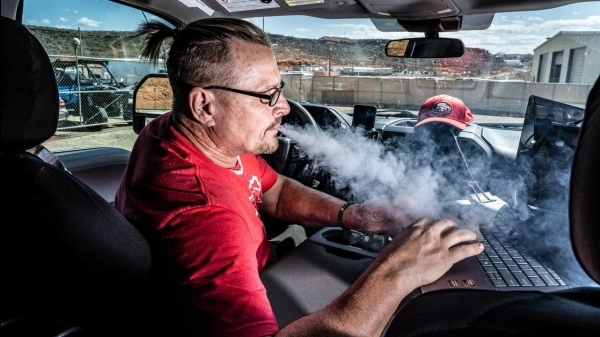
Pitman is six feet tall, with hazel eyes and blond hair, which he keeps buzzed on the sides and floppy on top, or slicked into a stubby pony. He wears wraparound sunglasses with a bandanna or a backward baseball cap, or both. His land speed is a consistent half sprint. He speaks in complete, fluid sentences but, at times, jackhammer fast. No topic escapes his enthusiasm (“I *love* festivals!”) or his powers of observation (the “little lobster-claw hands” of the Starbucks mermaid, the absence of residential surveillance cameras). His autodidactic impulses may lead him to the history of clock towers or to the interplanetary rarity of wood. Absolute is his opinion on the superiority of Dobermans (“Dobies”), which, he believes, don’t shed as much as other breeds. “Dog hair? Forget it,” he said the other day. “If I got a car bad enough, I’ll put a garbage bag over the seat before I’ll sit in it, it’s so gross. After a day of working, you go home, and you literally have a separate hamper for your work clothes. We get grease, we get solvents, we get grime.” Repo, he declared, “is not *quite* as manly as underwater welding, but it’s a pretty manly job.”
Pitman called his YouTube channel RepoNut. GoPro was his camera of choice. He would clamp one to the windshield trim of his rig, point it at himself, and just talk. Each “*INSTANT SEIZURE ORDER*,” issued by a lender, gave him cause to monologue about the endless variables of his trade. Repoing a BMW X series (all-wheel drive) is different from repoing a Honda Civic (front-wheel drive). A good repo agent adjusts for terrain, weather, angle, blockage, flat tires, dead batteries, locked doors, and human interference. Repo agents have been shot, stabbed, hit by cars. They’ve been beaten with tire irons, bottles, planks, chains. During the *COVID*\-19 pandemic, some states temporarily banned repos; when orders resumed, there was a spike in violence against repossessors. In 2023, at least seven were killed—the highest number on record. This spring, the North American Repossessors Summit (*NARS*), a convention put on by the industry’s leading trade group, the American Recovery Association (A.R.A.), opened with a harrowing video montage of wounded, terrified repo agents steering out of the line of fire, shrieking, “Oh, my God!” and “Motherfucker!” and “I’m shot, I’m shot, I’m shot, I’m shot, I’m shot! I need help!” One driver, visibly shaking after having narrowly avoided a bullet, screamed, “I can’t *do* this shit no more!” People in the audience were crying. The lights came up, and *NARS* awarded medals to two drivers who had sustained gunshot wounds, one in the head. Their peers gave them a standing ovation.
Pitman operated on a core belief that “when people like you, they won’t harm you.” He disarmed debtors with friendly banter. “Beautiful Jeep!” he’d say. “Did you build that out yourself?” On RepoNut, he once explained, “By the time a repo man shows up at someone’s house to take their vehicle, they’re oftentimes in bankruptcy, divorce, fighting with their spouse constantly. Financial ruin sometimes, even. Their *life’s* falling apart.” He recorded and posted anyway.
RepoNut started during the Great Recession. Nearly nine million jobs were lost between December of 2007 and early 2010. Forced to make tough spending choices, many Americans prioritized their car payment over the mortgage, weighing the urgent need for personal transportation—work and groceries, church and medical appointments—against the relatively slow-moving process of home foreclosure. Even so, at the recession’s peak, in 2009, 1.8 million cars were repossessed, according to Cox Automotive, an unprecedented number. Pitman’s was the face that thousands of consumers saw, or didn’t, when the financial system came for them.
Repossessors and tow-truck drivers work different jobs but use the same equipment. The tow truck was patented in 1918 by Ernest Holmes, Sr., the owner of an auto-repair shop in Chattanooga, Tennessee, who pulled vehicles out of ditches using a modified Cadillac and chains. Today’s tow trucks, also known as wreckers, are computerized work stations with integrated digital dashboards, camera systems, blind-spot monitoring, and hydraulic rotators. Pitman eventually switched from a wrecker to a “sneaker” unit, a heavy-duty Ford F-series pickup equipped with a steel boom, shaped like a cross, that can be maneuvered with joysticks from inside the cab. He could extend the boom, like a stinger, to “hook” and lift a vehicle’s front or back wheels within seconds.
The tactical aspects of repo interested him more than the mechanical. Pitman liked finding cars that drivers didn’t want found. He got his taste for “investigating” in childhood, after smelling Burger King on his parents’ clothes and watching them lie about where they’d been. Their deception “didn’t *hurt* me,” he said. “I just found it interesting.” He began to figure out, ahead of time, what everyone was getting for Christmas, and followed his older brother when he sneaked out at night, learning that there was power in discovering information, and in withholding it.
When Pitman started in repo, orders arrived by fax; agents used foldout maps. He got ahead by working dead paper. Fresh eyes on an unfulfilled assignment generated leads that lesser repo guys never saw. A target vehicle that went missing from the address listed on a loan account might be parked down the block, or in a friend’s driveway or a cousin’s garage, or in a storage unit, a church parking lot, a barn. Pitman once tracked a vehicle to a shipping container headed for Hawaii. A debtor’s grandparents’ house was often a good place to look: older people don’t move around that much. Pitman observed that you could tell a lot about a family by how close together everybody lived—data, potentially, for later. Hard-core hiders are called skips, as in skipped town. A skip could maintain spotless op sec and still be undone by an associate’s social-media incontinence; Pitman once noticed a license plate in the background of a photo on the Facebook feed of a target’s relative, traced the plate to an unchecked address, and drove by the house. There sat his repo.
#cars
source
atthew Pitman started in the automobile-repossession industry as a teen-ager, coiling cables at a tow lot in his home town, Phoenix. This was the eighties. His boss went by Joker and wore a “badge” around his neck, like a cop. Law-enforcement officers are sworn to serve the public; repossessors work for banks. Pitman justifies conflating the two by saying that a lot of repo guys are “ex-law enforcement, ex-military,” which is true, and that all repossessors “have to have complete balls of brass.” He became a repo man in his early twenties and called himself the Ninja. The license plate on his first work truck read “*GOTCHA*.”
Pitman moved to Orem, Utah, to repo there and across the state. He had been in the business for well over a decade when, in the fall of 2006, the Spanish-language scripted series “Operación Repo” became the No. 1 program on Telemundo. A reviewer described the show as “a telenovela on Red Bull” and “Judge Judy with a choke hold”; it depicted a family repo business in the San Fernando Valley whose employees brawled with debtors, and with one another. An English-language version, “Operation Repo,” débuted a couple of years later, teeing up a glut of derivative content. Pitman decided that he could do better than what the popular culture had to offer. He already filmed his repos, for liability purposes, a defensive protocol that was becoming industry standard. In January, 2008, he started a YouTube channel. He applied for a new vanity license plate that read “*REPO N UT,*” for “Repo in Utah.” The plate came back in error, sans spaces—“*REPONUT*.” Pitman kept both the plate and the nickname, reluctantly. “I hated the ‘nut,’ because I’m not nuts,” he told me. “I’m a very grounded, not-crazy person.”
Pitman is six feet tall, with hazel eyes and blond hair, which he keeps buzzed on the sides and floppy on top, or slicked into a stubby pony. He wears wraparound sunglasses with a bandanna or a backward baseball cap, or both. His land speed is a consistent half sprint. He speaks in complete, fluid sentences but, at times, jackhammer fast. No topic escapes his enthusiasm (“I *love* festivals!”) or his powers of observation (the “little lobster-claw hands” of the Starbucks mermaid, the absence of residential surveillance cameras). His autodidactic impulses may lead him to the history of clock towers or to the interplanetary rarity of wood. Absolute is his opinion on the superiority of Dobermans (“Dobies”), which, he believes, don’t shed as much as other breeds. “Dog hair? Forget it,” he said the other day. “If I got a car bad enough, I’ll put a garbage bag over the seat before I’ll sit in it, it’s so gross. After a day of working, you go home, and you literally have a separate hamper for your work clothes. We get grease, we get solvents, we get grime.” Repo, he declared, “is not *quite* as manly as underwater welding, but it’s a pretty manly job.”
Pitman called his YouTube channel RepoNut. GoPro was his camera of choice. He would clamp one to the windshield trim of his rig, point it at himself, and just talk. Each “*INSTANT SEIZURE ORDER*,” issued by a lender, gave him cause to monologue about the endless variables of his trade. Repoing a BMW X series (all-wheel drive) is different from repoing a Honda Civic (front-wheel drive). A good repo agent adjusts for terrain, weather, angle, blockage, flat tires, dead batteries, locked doors, and human interference. Repo agents have been shot, stabbed, hit by cars. They’ve been beaten with tire irons, bottles, planks, chains. During the *COVID*\-19 pandemic, some states temporarily banned repos; when orders resumed, there was a spike in violence against repossessors. In 2023, at least seven were killed—the highest number on record. This spring, the North American Repossessors Summit (*NARS*), a convention put on by the industry’s leading trade group, the American Recovery Association (A.R.A.), opened with a harrowing video montage of wounded, terrified repo agents steering out of the line of fire, shrieking, “Oh, my God!” and “Motherfucker!” and “I’m shot, I’m shot, I’m shot, I’m shot, I’m shot! I need help!” One driver, visibly shaking after having narrowly avoided a bullet, screamed, “I can’t *do* this shit no more!” People in the audience were crying. The lights came up, and *NARS* awarded medals to two drivers who had sustained gunshot wounds, one in the head. Their peers gave them a standing ovation.
Pitman operated on a core belief that “when people like you, they won’t harm you.” He disarmed debtors with friendly banter. “Beautiful Jeep!” he’d say. “Did you build that out yourself?” On RepoNut, he once explained, “By the time a repo man shows up at someone’s house to take their vehicle, they’re oftentimes in bankruptcy, divorce, fighting with their spouse constantly. Financial ruin sometimes, even. Their *life’s* falling apart.” He recorded and posted anyway.
RepoNut started during the Great Recession. Nearly nine million jobs were lost between December of 2007 and early 2010. Forced to make tough spending choices, many Americans prioritized their car payment over the mortgage, weighing the urgent need for personal transportation—work and groceries, church and medical appointments—against the relatively slow-moving process of home foreclosure. Even so, at the recession’s peak, in 2009, 1.8 million cars were repossessed, according to Cox Automotive, an unprecedented number. Pitman’s was the face that thousands of consumers saw, or didn’t, when the financial system came for them.
Repossessors and tow-truck drivers work different jobs but use the same equipment. The tow truck was patented in 1918 by Ernest Holmes, Sr., the owner of an auto-repair shop in Chattanooga, Tennessee, who pulled vehicles out of ditches using a modified Cadillac and chains. Today’s tow trucks, also known as wreckers, are computerized work stations with integrated digital dashboards, camera systems, blind-spot monitoring, and hydraulic rotators. Pitman eventually switched from a wrecker to a “sneaker” unit, a heavy-duty Ford F-series pickup equipped with a steel boom, shaped like a cross, that can be maneuvered with joysticks from inside the cab. He could extend the boom, like a stinger, to “hook” and lift a vehicle’s front or back wheels within seconds.
The tactical aspects of repo interested him more than the mechanical. Pitman liked finding cars that drivers didn’t want found. He got his taste for “investigating” in childhood, after smelling Burger King on his parents’ clothes and watching them lie about where they’d been. Their deception “didn’t *hurt* me,” he said. “I just found it interesting.” He began to figure out, ahead of time, what everyone was getting for Christmas, and followed his older brother when he sneaked out at night, learning that there was power in discovering information, and in withholding it.
When Pitman started in repo, orders arrived by fax; agents used foldout maps. He got ahead by working dead paper. Fresh eyes on an unfulfilled assignment generated leads that lesser repo guys never saw. A target vehicle that went missing from the address listed on a loan account might be parked down the block, or in a friend’s driveway or a cousin’s garage, or in a storage unit, a church parking lot, a barn. Pitman once tracked a vehicle to a shipping container headed for Hawaii. A debtor’s grandparents’ house was often a good place to look: older people don’t move around that much. Pitman observed that you could tell a lot about a family by how close together everybody lived—data, potentially, for later. Hard-core hiders are called skips, as in skipped town. A skip could maintain spotless op sec and still be undone by an associate’s social-media incontinence; Pitman once noticed a license plate in the background of a photo on the Facebook feed of a target’s relative, traced the plate to an unchecked address, and drove by the house. There sat his repo.
#cars
source


| 3,000 mlx | |
| 7 | |
| 0 |