
5 reactions
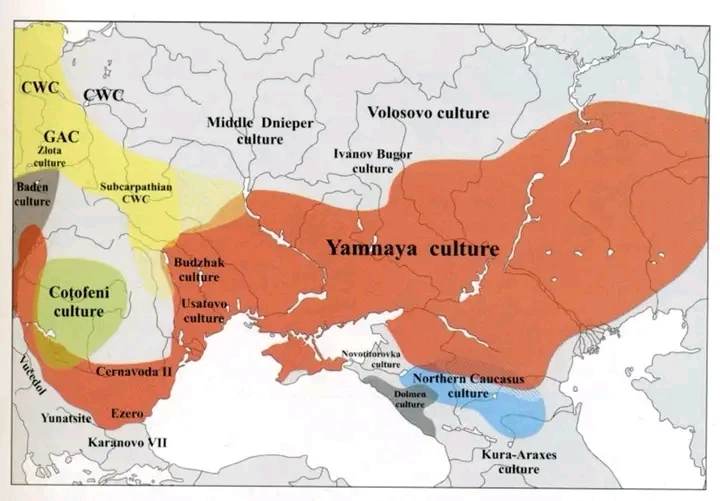
Largest expansion of the Yamnaya culture. Modified from c. 3500 origins of Usatovo culture; 3300 origins of Yamna; c. 3300–3200 expansion of Yamnaya across the Pontic-Caspian steppe; c. 2700 end of Trypillia culture, and transformation of Yamnaya into Corded Ware in the contact zone east of the Carpathian mountains; 3100–2600 Yamnaya expansion into the Danube Valley.
The people of the Yamnaya culture lived primarily as nomads, with a chiefdom system and wheeled carts and wagons that allowed them to manage large herds. They are also closely connected to Final Neolithic cultures, which later spread throughout Europe and Central Asia, especially the Corded Ware people and the Bell Beaker culture, as well as the peoples of the Sintashta, Andronovo, and Srubnaya cultures. Back migration from Corded Ware also contributed to Sintashta and Andronovo. In these groups, several aspects of the Yamnaya culture are present. Yamnaya material culture was very similar to the Afanasievo culture of South Siberia, and the populations of the two cultures are genetically indistinguishable. This suggests that the Afanasievo culture may have originated from the migration of Yamnaya groups to the Altai region or, alternatively, that both cultures developed from an earlier shared cultural source.
Genetic studies have suggested that the people of the Yamnaya culture can be modelled as a genetic admixture between a population related to Eastern European Hunter-Gatherers (EHG)[d] and people related to hunter-gatherers from the Caucasus (CHG) in roughly equal proportions, an ancestral component which is often named "Steppe ancestry", with additional admixture from Anatolian, Levantine, or Early European farmers. Genetic studies also indicate that populations associated with the Corded Ware, Bell Beaker, Sintashta, and Andronovo cultures derived large parts of their ancestry from the Yamnaya or a closely related population. Recent genetic analyses indicate that the Anatolian component in the Yamnaya comes via the Caucasus Neolithic population and not Anatolia-derived European farmers.
The Yamnaya culture is of particular interest to researchers, as the widely-accepted Kurgan hypothesis posits that the people that produced the Yamnaya culture spoke a stage of the Proto-Indo-European language. The speakers of the Proto-Indo-European language embarked on the Indo-European migrations, that gave rise to the Indo-European languages of today.
The people of the Yamnaya culture lived primarily as nomads, with a chiefdom system and wheeled carts and wagons that allowed them to manage large herds. They are also closely connected to Final Neolithic cultures, which later spread throughout Europe and Central Asia, especially the Corded Ware people and the Bell Beaker culture, as well as the peoples of the Sintashta, Andronovo, and Srubnaya cultures. Back migration from Corded Ware also contributed to Sintashta and Andronovo. In these groups, several aspects of the Yamnaya culture are present. Yamnaya material culture was very similar to the Afanasievo culture of South Siberia, and the populations of the two cultures are genetically indistinguishable. This suggests that the Afanasievo culture may have originated from the migration of Yamnaya groups to the Altai region or, alternatively, that both cultures developed from an earlier shared cultural source.
Genetic studies have suggested that the people of the Yamnaya culture can be modelled as a genetic admixture between a population related to Eastern European Hunter-Gatherers (EHG)[d] and people related to hunter-gatherers from the Caucasus (CHG) in roughly equal proportions, an ancestral component which is often named "Steppe ancestry", with additional admixture from Anatolian, Levantine, or Early European farmers. Genetic studies also indicate that populations associated with the Corded Ware, Bell Beaker, Sintashta, and Andronovo cultures derived large parts of their ancestry from the Yamnaya or a closely related population. Recent genetic analyses indicate that the Anatolian component in the Yamnaya comes via the Caucasus Neolithic population and not Anatolia-derived European farmers.
The Yamnaya culture is of particular interest to researchers, as the widely-accepted Kurgan hypothesis posits that the people that produced the Yamnaya culture spoke a stage of the Proto-Indo-European language. The speakers of the Proto-Indo-European language embarked on the Indo-European migrations, that gave rise to the Indo-European languages of today.


| 11,000 mlx | |
| 21 | |
| 5 |