
21 reactions
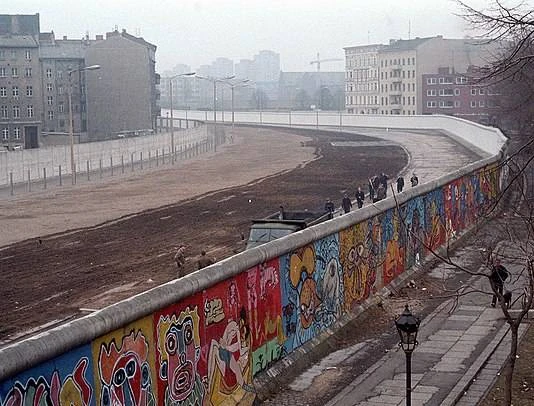
I visited Berlin in December 1988 with Major & Mrs Holt's Tours, which specialized in military history, and 11 months later the Berlin Wall came down. It had been erected in 1961 and encircled West Berlin of the Federal Republic of Germany (FDR), separating it from East Berlin and the German Democratic Republic (GDR, East Germany). The whole of Berlin was in East Germany and divided into American, British, French and Russian sectors.
Soviet Bloc propaganda portrayed the Wall as protecting its population from "fascist elements conspiring to prevent the will of the people" from building a communist state in the GDR.
Highlights...
• Passing through Checkpoint Charlie into East Berlin to visit the Pergamon Museum. The young East German conscripts were just doing their job, I suppose - passports checked three times (almost nose-to-nose while comparing the photo), mirrors on sticks under the coach/bus (checking for people whom we might be sneaking in?). It took about 30 minutes before we could proceed.
• On passing through Checkpoint Charlie, there was a "no-man's land" which consisted of several blocks of abandoned buildings that had not been repaired after WWII. The streets were clear of rubble but the buildings' masonry remained pock-marked from bullets and shrapnel and were windowless.
• After two, or three, blocks, the coach turned a corner within "no-man's land" and picked up a lone man who was our East German guide.
• East Berlin's streets were deserted, not a soul or vehicle in sight, save for a tiny fair consisting of a single merry-go round and some families on a plaza. When we saw each other, it was akin to a zoo; we simply stared at each other, from the coach and from the plaza.
• We had a scheduled stop at a cafe/patisserie on the Unter den Linden in the East. The display cases were empty as was the establishment. We were expected... as many cups and saucers and slices of cake as there were people in our party. It felt like being in a "film noir" - the waitresses dressed in black with a white apron and low-heel black shoes; the waiters in white shirts, black tie and black waistcoats. Spectacles? Decidedly 1950s.
• Given the absence of people, I recall two young boys appearing from nowhere when we left the Pergamon Museum. They stood by the door to the coach, hoping to earn some DM tips as doormen. They were courteous and smiled, doing what they could to survive.
• Lunch at the Reichstag, an administrative center at the time, followed by an on-site tour of an exhibition of Hitler's rise to power. I was puzzled that such a thing should exist. Almost a decade later (?), the "first public exhibition" on the subject went on display. Was the Reichstag exhibit a prototype?
• Mounting the viewing platforms on the western side of the Berlin Wall and training my camera on the watch towers on the other side for too long. Well, the East German guards didn't disappoint... they aimed their rifles in return.
Of course, there was much more... a visit to a Commonwealth War Graves cemetery, to the Olympic Stadium where Jesse Owens "won four gold medals in the sprint and long jump events, and became the most successful athlete to compete in Berlin" at the 1936 Olympics, to the Kaiser Wilhelm Memorial Church...
During the Cold War, a trip to Berlin was psychological (at least in my mind); very much about who was watching whom. Seeing smiling and laughing Russian officers driven from the American sector to the Russian sector in their ZiLs was an inkling of the freedoms enjoyed by some who denied it to others.
Returning from East Berlin to West Berlin, I was glad to be back in the "best open prison" in the world. Isolated in East Germany but with the amenities and liberties which we enjoy.
Soviet Bloc propaganda portrayed the Wall as protecting its population from "fascist elements conspiring to prevent the will of the people" from building a communist state in the GDR.
Highlights...
• Passing through Checkpoint Charlie into East Berlin to visit the Pergamon Museum. The young East German conscripts were just doing their job, I suppose - passports checked three times (almost nose-to-nose while comparing the photo), mirrors on sticks under the coach/bus (checking for people whom we might be sneaking in?). It took about 30 minutes before we could proceed.
• On passing through Checkpoint Charlie, there was a "no-man's land" which consisted of several blocks of abandoned buildings that had not been repaired after WWII. The streets were clear of rubble but the buildings' masonry remained pock-marked from bullets and shrapnel and were windowless.
• After two, or three, blocks, the coach turned a corner within "no-man's land" and picked up a lone man who was our East German guide.
• East Berlin's streets were deserted, not a soul or vehicle in sight, save for a tiny fair consisting of a single merry-go round and some families on a plaza. When we saw each other, it was akin to a zoo; we simply stared at each other, from the coach and from the plaza.
• We had a scheduled stop at a cafe/patisserie on the Unter den Linden in the East. The display cases were empty as was the establishment. We were expected... as many cups and saucers and slices of cake as there were people in our party. It felt like being in a "film noir" - the waitresses dressed in black with a white apron and low-heel black shoes; the waiters in white shirts, black tie and black waistcoats. Spectacles? Decidedly 1950s.
• Given the absence of people, I recall two young boys appearing from nowhere when we left the Pergamon Museum. They stood by the door to the coach, hoping to earn some DM tips as doormen. They were courteous and smiled, doing what they could to survive.
• Lunch at the Reichstag, an administrative center at the time, followed by an on-site tour of an exhibition of Hitler's rise to power. I was puzzled that such a thing should exist. Almost a decade later (?), the "first public exhibition" on the subject went on display. Was the Reichstag exhibit a prototype?
• Mounting the viewing platforms on the western side of the Berlin Wall and training my camera on the watch towers on the other side for too long. Well, the East German guards didn't disappoint... they aimed their rifles in return.
Of course, there was much more... a visit to a Commonwealth War Graves cemetery, to the Olympic Stadium where Jesse Owens "won four gold medals in the sprint and long jump events, and became the most successful athlete to compete in Berlin" at the 1936 Olympics, to the Kaiser Wilhelm Memorial Church...
During the Cold War, a trip to Berlin was psychological (at least in my mind); very much about who was watching whom. Seeing smiling and laughing Russian officers driven from the American sector to the Russian sector in their ZiLs was an inkling of the freedoms enjoyed by some who denied it to others.
Returning from East Berlin to West Berlin, I was glad to be back in the "best open prison" in the world. Isolated in East Germany but with the amenities and liberties which we enjoy.


| 51,000 mlx | |
| 172 | |
| 21 |
Indeed. A reunified Germany and Berlin are different places, today. Who knew of the changes that would come in late 1989? Everything happened so quickly. The Checkpoint Charlie Museum, which was at the Checkpoint on the West Berlin-side, has moved but still tells the stories of successful and unsuccessful escape attempts.
I was 25 in 1988. I think you might be too young to remember all this?
I was 25 in 1988. I think you might be too young to remember all this?
