
3 reactions
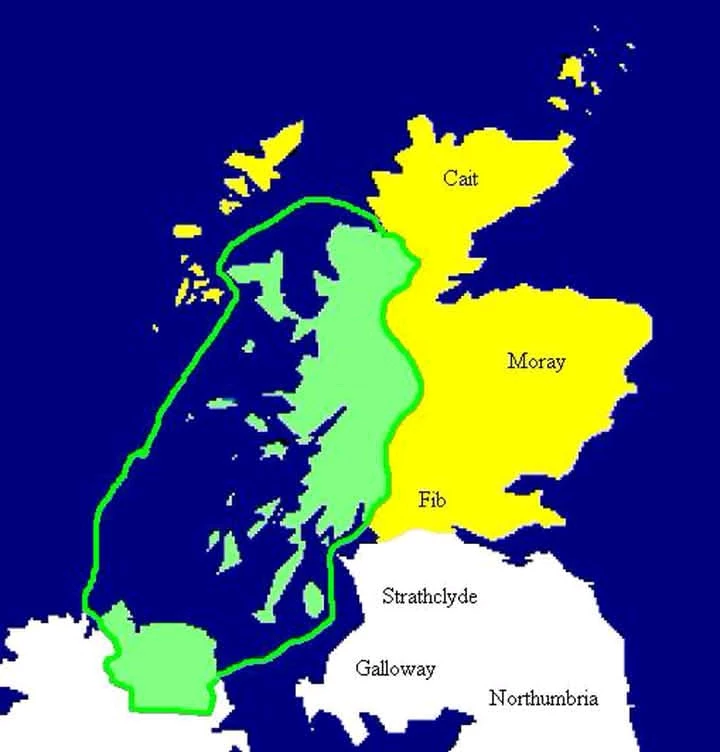
Extent of the Kingdom of Dál Riata (in green), c. AD 590. Yellow areas show occupation by the Picts.
The Kingdom of Dál Riata, a Gaelic kingdom that existed from the 5th to 9th centuries AD, encompassed areas on both sides of the North Channel, including parts of Argyll, the Inner Hebrides, and County Antrim in Northern Ireland.
Dál Riata is said to have been founded by the legendary king Fergus Mór (Fergus the Great) in the 5th century. The kingdom reached its height under Áedán mac Gabráin (r. 574–608). During his reign Dál Riata's power and influence grew; it carried out naval expeditions to Orkney and the Isle of Man, and assaults on the Brittonic kingdom of Strathclyde and Anglian kingdom of Bernicia. However, King Æthelfrith of Bernicia checked its growth at the Battle of Degsastan in 603.
Serious defeats in Ireland and Scotland during the reign of Domnall Brecc (died 642) ended Dál Riata's "golden age", and the kingdom became a client of Northumbria for a time. In the 730s the Pictish king Óengus I led campaigns against Dál Riata and brought it under Pictish overlordship by 741. There is disagreement over the fate of the kingdom from the late 8th century onwards. Some scholars have seen no revival of Dál Riatan power after the long period of foreign domination (c. 637 to c. 750–760), while others have seen a revival under Áed Find (736–778). Some even claim that the Dál Riata usurped the kingship of Fortriu. From 795 onward there were sporadic Viking raids in Dál Riata. In the following century, there may have been a merger of the Dál Riatan and Pictish crowns. Some sources say Cináed mac Ailpín (Kenneth MacAlpin) was king of Dál Riata before becoming king of the Picts in 843, following a disastrous defeat of the Picts by Vikings. The kingdom's independence ended sometime after, as it merged with Pictland to form the Kingdom of Alba.
Latin sources often referred to the inhabitants of Dál Riata as Scots (Scoti), a name originally used by Roman and Greek writers for the Irish Gaels who raided and colonised Roman Britain. Later, it came to refer to Gaels, whether from Ireland or elsewhere.[6] They are referred to herein as Gaels or as Dál Riatans.
The Kingdom of Dál Riata, a Gaelic kingdom that existed from the 5th to 9th centuries AD, encompassed areas on both sides of the North Channel, including parts of Argyll, the Inner Hebrides, and County Antrim in Northern Ireland.
Dál Riata is said to have been founded by the legendary king Fergus Mór (Fergus the Great) in the 5th century. The kingdom reached its height under Áedán mac Gabráin (r. 574–608). During his reign Dál Riata's power and influence grew; it carried out naval expeditions to Orkney and the Isle of Man, and assaults on the Brittonic kingdom of Strathclyde and Anglian kingdom of Bernicia. However, King Æthelfrith of Bernicia checked its growth at the Battle of Degsastan in 603.
Serious defeats in Ireland and Scotland during the reign of Domnall Brecc (died 642) ended Dál Riata's "golden age", and the kingdom became a client of Northumbria for a time. In the 730s the Pictish king Óengus I led campaigns against Dál Riata and brought it under Pictish overlordship by 741. There is disagreement over the fate of the kingdom from the late 8th century onwards. Some scholars have seen no revival of Dál Riatan power after the long period of foreign domination (c. 637 to c. 750–760), while others have seen a revival under Áed Find (736–778). Some even claim that the Dál Riata usurped the kingship of Fortriu. From 795 onward there were sporadic Viking raids in Dál Riata. In the following century, there may have been a merger of the Dál Riatan and Pictish crowns. Some sources say Cináed mac Ailpín (Kenneth MacAlpin) was king of Dál Riata before becoming king of the Picts in 843, following a disastrous defeat of the Picts by Vikings. The kingdom's independence ended sometime after, as it merged with Pictland to form the Kingdom of Alba.
Latin sources often referred to the inhabitants of Dál Riata as Scots (Scoti), a name originally used by Roman and Greek writers for the Irish Gaels who raided and colonised Roman Britain. Later, it came to refer to Gaels, whether from Ireland or elsewhere.[6] They are referred to herein as Gaels or as Dál Riatans.


1

1

1
| 8,000 mlx | |
| 23 | |
| 3 |