NATURE’S HEART 💚🐉 When two tutubi join together, their…

5 reactions
NATURE’S HEART 💚🐉
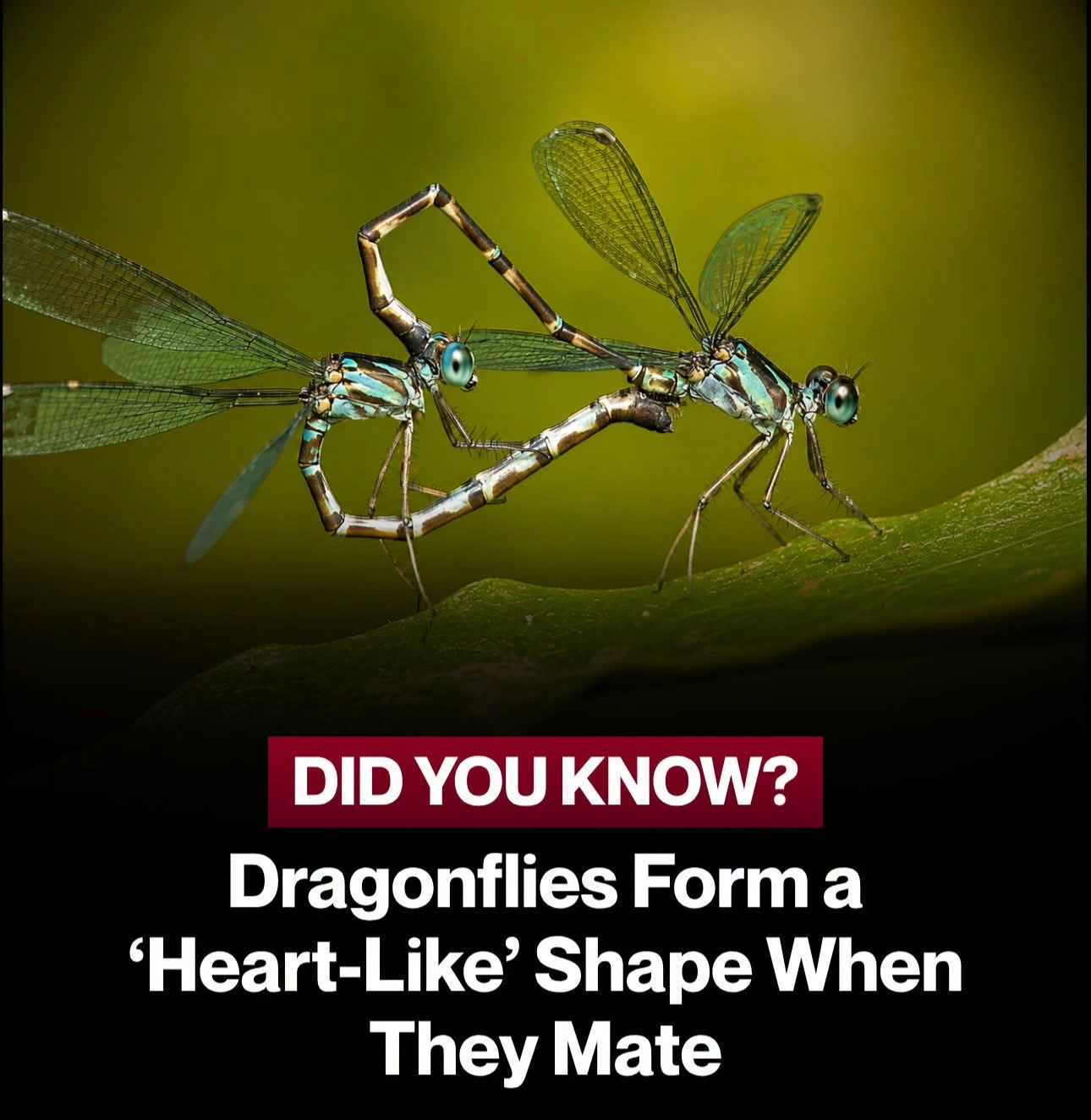
When two tutubi join together, their bodies may form a loop that looks like a wheel—or even a heart.
But this shape is not random.
It is part of their mating behavior.
Dragonflies and damselflies belong to the insect order Odonata. They are known for their large eyes, powerful wings, fast flight, and life cycle closely connected to water.
Their mating process, however, is one of the most unusual in the insect world.
Before mating, the male transfers sperm from an opening near the end of his abdomen to a secondary reproductive structure closer to the front of his body.
He then uses special claspers at the tip of his abdomen to hold the female. Once connected, the pair may fly or rest together in what is called the tandem position.
The female then bends her abdomen forward to reach the male’s secondary reproductive organ.
This creates the famous “wheel position.”
From the side, their joined bodies may resemble a circle, loop, or heart-like shape.
It may look romantic to humans, but biologically, it is a precise posture shaped by the anatomy of these insects.
In simpler terms, the male holds the female while she curls her body forward to complete sperm transfer.
Dragonfly mating may also involve competition. In some species, males remain attached to females or guard them nearby to reduce the chance of another male mating with them.
After mating, the female usually lays her eggs in or near water. Depending on the species, the eggs may be placed on aquatic plants, dropped onto the water, or deposited in wet areas.
The young dragonflies, called nymphs or naiads, spend the early part of their lives underwater before emerging as the winged adults we see near ponds, rice fields, streams, canals, and wetlands.
Their adult lives unfold in the air.
But their story begins beneath the water.
So when you see tutubi forming a wheel or heart-like shape, you are not only witnessing a beautiful moment in nature.
You are seeing anatomy, reproduction, and survival in motion.
Nature’s “heart” is not always romance.
Sometimes, it is biology.
When two tutubi join together, their bodies may form a loop that looks like a wheel—or even a heart.
But this shape is not random.
It is part of their mating behavior.
Dragonflies and damselflies belong to the insect order Odonata. They are known for their large eyes, powerful wings, fast flight, and life cycle closely connected to water.
Their mating process, however, is one of the most unusual in the insect world.
Before mating, the male transfers sperm from an opening near the end of his abdomen to a secondary reproductive structure closer to the front of his body.
He then uses special claspers at the tip of his abdomen to hold the female. Once connected, the pair may fly or rest together in what is called the tandem position.
The female then bends her abdomen forward to reach the male’s secondary reproductive organ.
This creates the famous “wheel position.”
From the side, their joined bodies may resemble a circle, loop, or heart-like shape.
It may look romantic to humans, but biologically, it is a precise posture shaped by the anatomy of these insects.
In simpler terms, the male holds the female while she curls her body forward to complete sperm transfer.
Dragonfly mating may also involve competition. In some species, males remain attached to females or guard them nearby to reduce the chance of another male mating with them.
After mating, the female usually lays her eggs in or near water. Depending on the species, the eggs may be placed on aquatic plants, dropped onto the water, or deposited in wet areas.
The young dragonflies, called nymphs or naiads, spend the early part of their lives underwater before emerging as the winged adults we see near ponds, rice fields, streams, canals, and wetlands.
Their adult lives unfold in the air.
But their story begins beneath the water.
So when you see tutubi forming a wheel or heart-like shape, you are not only witnessing a beautiful moment in nature.
You are seeing anatomy, reproduction, and survival in motion.
Nature’s “heart” is not always romance.
Sometimes, it is biology.


3

2
| 9,000 mlx | |
| 33 | |
| 5 |