5 reactions
Curve Finance soft liquidation works, but CRV plunges 28%
Curve Finance’s LLAMMA successfully handled liquidation during a hack attempt, but CRV token fell by 28%, sparking concerns in the DeFi community.
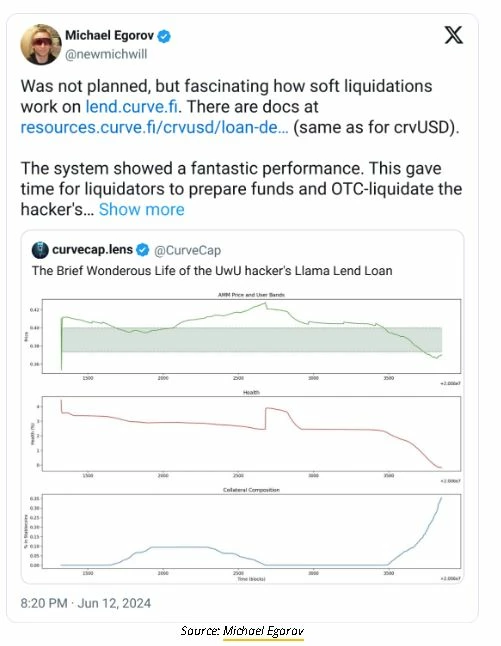
Curve Finance’s soft liquidation mechanism successfully managed a real-world test during a recent hacking attempt, but the native token CRV price plunged over 28% amid the chaos.
Despite the significant fall in CRV value, Curve Finance’s liquidation process functioned as intended.
Related: Curve Finance founder’s $100M debt could trigger a DeFi implosion: Report
Management of liquidation risks
According to onchain data , Michael Egorov, founder of Curve Finance, faced substantial liquidation pressures on June 13 when the CRV token price fell.
Egorov’s transaction history shows attempts to manage his debt positions, executing multiple liquidations over a short period.
He also made repayments and withdrawals to and from decentralized finance (DeFi) platforms like Inverse Finance and Curve.fi.
Related: Curve Finance awards dev $250K for finding reentrancy vulnerability
Advertisement
Trade smart with Markets Pro instant alerts. Claim your 65% discount now!
Ad
The soft liquidation mechanism is part of Curve Finance’s Lending-Liquidating Automate Market Maker Algorithm (LLAMMA).
LLAMMA soft liquidation mechanism
This mechanism ensures liquidations occur without resulting in “bad debts" — debt that cannot be repaid or liquidated profitably.
According to the official LLAMMA documentation, when a new loan is created, the collateral is deposited into a specific number of bands across the automated market maker (AMM).
“Unlike regular liquidation, which has a single liquidation price, LLAMMA has multiple liquidation ranges (represented by the bands) and continuously liquidates the collateral if needed.”
However, the documentation also highlights that positions “in soft-liquidation/de-liquidation are suffering losses due to selling and buying of collateral.”
“...If the position is not in soft liquidation, no losses occur. These losses decrease the health of the loan. Once a user’s health is at 0%, the user’s position may face a hard liquidation, which closes the loan.”
Related: Curve Finance founder cuts debt to $42.7M, settles entire Aave loan
Market hits steep learning curve
Despite the protective measures functioning as intended, the market reacted sharply to the event, witnessing a CRV price drop of over 28% in the last 24 hours.
This news follows previous coverage by Cointelegraph on Curve Finance’s underlying “systemic risks” — particularly concerning Egorov’s debt obligations.
Curve Finance’s LLAMMA successfully handled liquidation during a hack attempt, but CRV token fell by 28%, sparking concerns in the DeFi community.
Curve Finance’s soft liquidation mechanism successfully managed a real-world test during a recent hacking attempt, but the native token CRV price plunged over 28% amid the chaos.
Despite the significant fall in CRV value, Curve Finance’s liquidation process functioned as intended.
Related: Curve Finance founder’s $100M debt could trigger a DeFi implosion: Report
Management of liquidation risks
According to onchain data , Michael Egorov, founder of Curve Finance, faced substantial liquidation pressures on June 13 when the CRV token price fell.
Egorov’s transaction history shows attempts to manage his debt positions, executing multiple liquidations over a short period.
He also made repayments and withdrawals to and from decentralized finance (DeFi) platforms like Inverse Finance and Curve.fi.
Related: Curve Finance awards dev $250K for finding reentrancy vulnerability
Advertisement
Trade smart with Markets Pro instant alerts. Claim your 65% discount now!
Ad
The soft liquidation mechanism is part of Curve Finance’s Lending-Liquidating Automate Market Maker Algorithm (LLAMMA).
LLAMMA soft liquidation mechanism
This mechanism ensures liquidations occur without resulting in “bad debts" — debt that cannot be repaid or liquidated profitably.
According to the official LLAMMA documentation, when a new loan is created, the collateral is deposited into a specific number of bands across the automated market maker (AMM).
“Unlike regular liquidation, which has a single liquidation price, LLAMMA has multiple liquidation ranges (represented by the bands) and continuously liquidates the collateral if needed.”
However, the documentation also highlights that positions “in soft-liquidation/de-liquidation are suffering losses due to selling and buying of collateral.”
“...If the position is not in soft liquidation, no losses occur. These losses decrease the health of the loan. Once a user’s health is at 0%, the user’s position may face a hard liquidation, which closes the loan.”
Related: Curve Finance founder cuts debt to $42.7M, settles entire Aave loan
Market hits steep learning curve
Despite the protective measures functioning as intended, the market reacted sharply to the event, witnessing a CRV price drop of over 28% in the last 24 hours.
This news follows previous coverage by Cointelegraph on Curve Finance’s underlying “systemic risks” — particularly concerning Egorov’s debt obligations.


| 30,000 mlx | |
| 26 | |
| 5 |