A cool guide on ADHD Hey everyone. So, after I posted my…
0 reactions
A cool guide on ADHD
Hey everyone.
So, after I posted my guide on studying consistently, a bunch of people started asking me about ADHD. I don't personally have severe ADHD, and most of my focus issues were fixed through some basic habits and lifestyle changes which are also majorly helpful in treating ADHD as well. But since this topic kept coming up again and again, I ended up going down a whole rabbit hole of research papers, interviews, and podcasts.
I took a ton of notes while watching people like Dr. Ned Hallowell, Dr. John Kruse, Andrew Huberman, and going through ADHD research. I figured I'd just share the notes here because I feel like a lot of people confuse ADHD with just being distracted, unmotivated, addicted to their phones, or just struggling with basic discipline.
Please know this isn't meant to diagnose anyone. It's just a collection of the most useful stuff I learned that might actually help you figure out whether you're dealing with actual ADHD or just something else.
This is going to be more of a summary.
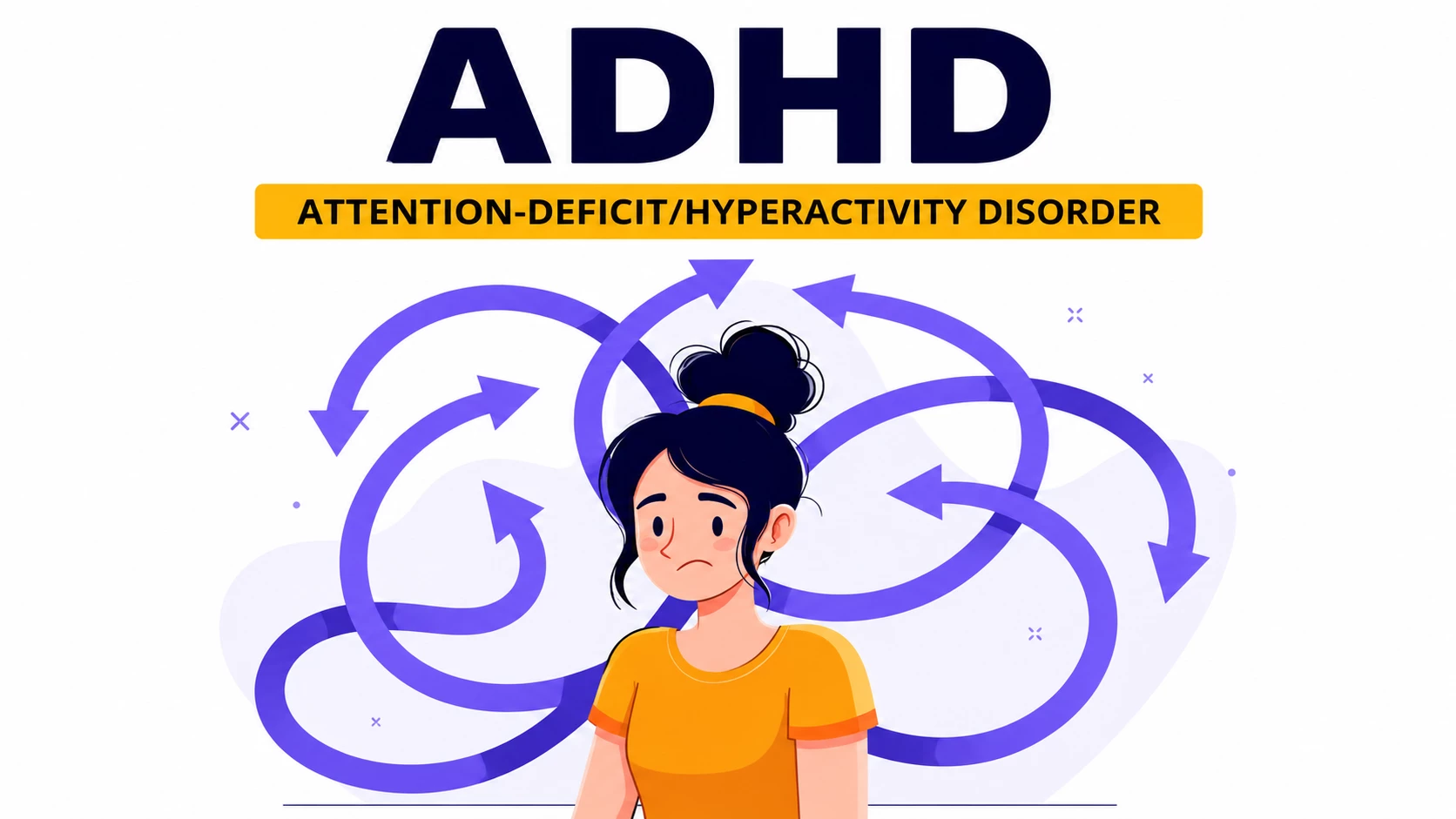
One of the biggest misconceptions I had before researching all this was thinking that ADHD basically means a lack of attention. Apparently, that's not really the case. A better way to describe it is a lack of control over your attention.
People with ADHD can sometimes focus harder than anyone else when something is actually interesting to them. The main problem is directing that focus onto things that aren't immediately stimulating.
Some common inattentive symptoms include forgetting tasks, losing your stuff, not following through on commitments, and getting distracted constantly. On the hyperactive/impulsive side, it can look like interrupting people while they speak, blurting things out, fidgeting all the time, or literally feeling physically uncomfortable just sitting still.
Also, ADHD has nothing to do with your intelligence. Another thing that came up repeatedly is that a lot of people with ADHD are extremely sensitive to their environment (Like I said in my previous post, this is the most important thing I worked on).
A lot of experts actually describe the ADHD brain as being interest-driven instead of importance-driven.
For example, a normal person can usually force themselves to do something boring just because they know it's important. But someone with ADHD might know it's super important but still struggle to engage with it unless there's some novelty, urgency, challenge, or genuine interest involved.
Researchers also talk about two major brain systems:
* The Default Mode Network (DMN), which is active during daydreaming, self-reflection, and when your mind is wandering.
* Task-focused networks that handle your attention and executive function.
Normally these systems take turns. When one is active, the other quiets down.
But in ADHD, they often seem to overlap way more than they should. It's almost like the brain is trying to focus and daydream at the exact same time, which creates a lot of mental noise.
Dopamine and norepinephrine also play a huge role here.
Dopamine helps with motivation and reduces irrelevant mental noise, while norepinephrine helps amplify the important signals.
Low dopamine allows way too many unrelated brain circuits to stay active, which makes it super hard to filter out distractions.
Dr. Ned Hallowell describes ADHD as having a Ferrari engine but with bicycle brakes. Lots of power and creativity, but very weak impulse control.
Regarding medication, please refer to the main notes. And obviously, consult a doctor before consuming any of them.
Medication is basically like eyeglasses. It doesn't magically make someone smarter. It just helps the brain focus on things that actually matter even when they aren't particularly interesting to do.
There are also non-stimulant options like Modafinil, Guanfacine, Clonidine, and Wellbutrin that work through different mechanisms and might be a better fit for some people.
Stimulants aren't entirely risk-free. There are potential cardiovascular effects, sleep issues, appetite suppression, and in rare cases, even stimulant-induced psychosis.
Dr. John Kruse talks about four foundations that should definitely be in place whether you're taking medication or not (This is exactly what I personally worked on):
* Sleep: Apparently, sleep consistency matters a lot more than most people even realize. A lot of people with ADHD naturally lean towards being night owls, but maintaining a predictable sleep schedule still makes a huge difference. As I stated in my last post as well, I built a schedule where I have a strict rule to get rid of all electronic devices an hour before sleeping.
* Eating regularly: As I said before how a healthy diet changed my overall health and focus. With a healthy diet, I felt more fresh, less lethargic, and less frustrated as well. The strongest dietary recommendation I saw across the board was reducing simple sugars. I saw noticeable improvements in hyperactivity and attention just after reducing sugar intake. Omega-3s also have a decent amount of evidence behind them, especially EPA and DHA. They can really improve attention and possibly even reduce the amount of medication some people need.
* Exercise: Aerobic exercise really seems to help burn off some of that excess nervous system activity that messes with your focus. One method involves spending around 17 minutes focusing completely on your internal sensations like your breathing and heartbeat, which is basically the meditation I mentioned before as well. The whole idea here is to train your attention and reduce what researchers call "attentional blinks." Basically, during this meditation session, especially in the starting stages, your brain will have so many voices going on while you're trying to focus on your breath. There will be a lot of times when you'll suddenly realize that your attention has shifted from your breath to some random story running in your head, and then you have to take control and pull it back again. This is exactly like a simulation of real life. The more you practice it, the longer, more conscious, and controlled your attention span becomes.
* Relaxation or downtime: Another hack was panoramic vision. Basically, instead of locking your eyes onto just one thing, you intentionally widen your visual field and take in your surroundings. According to researchers, this shifts the brain out of a stressed, tunnel-vision state (Focused Mode) and into a much more relaxed attentional mode (Diffused Mode).
Basically, focused mode is activated when you narrow your vision into something, whether it is your phone, laptop, or literally anything. This requires energy because in this mode you are actively trying to consume information. This is exactly why it is not suggested to use your phone during a study break or to narrow your focus.
Diffused mode is more of a relaxed mode where you are not trying to tunnel or narrow your focus onto something.
Many people describe struggling way more with shame, frustration, negative self-talk, and relationship problems than with the attention part itself.
One concept that kept showing up was "time blindness" or "time agnosia."
A lot of people with ADHD describe their life as existing in only two categories: "now" and "not now."
That's exactly why deadlines can feel infinitely far away until suddenly they're due tomorrow.
The final thing that really stood out to me was how much modern technology might actually be making everything worse, and well, this is something I kept mentioning as well.
Several experts argued that smartphones, constant notifications, short-form content, and endless context switching can literally create ADHD-like symptoms even in people who don't actually have ADHD.
So, whether you have ADHD or not, it's probably worth paying attention to how much time you're spending just bouncing between apps and scrolling feeds.
Anyway, these are just the main highlights from my notes. Definitely do not use this post as a diagnosis tool, but if you've always wondered whether your struggles are actually ADHD or just some poor habits, hopefully, some of this gives you a better framework to think about it.
Link for main notes: https://app.notion.com/p/ADHD-research-37ff210605ec80ea9679e92d5bd6bc3d?source=copy\_link https://app.notion.com/p/ADHD-research-37ff210605ec80ea9679e92d5bd6bc3d?source=copy_link
|Sources:|
|:-|
|Attention-Deficit/Hyperactivity Disorder (ADHD) - National Institute of Mental Health (NIMH) https://www.nimh.nih.gov/health/topics/attention-deficit-hyperactivity-disorder-adhd|
|The No.1 ADHD Expert: How To Master Your ADHD - Dr NED Hallowell - YouTube https://www.youtube.com/watch?v=LZacXMQmSG8|
|Adderall, Stimulants & Modafinil for ADHD: Short- & Long-Term Effects - YouTube https://www.youtube.com/watch?v=sxgCC4H1dl8|
|Improve Focus with Behavioral Tools & Medication for ADHD https://www.youtube.com/watch?v=NtQ-kdLlQiU|
|ADHD & How Anyone Can Improve Their Focus - YouTube https://www.youtube.com/watch?v=hFL6qRIJZ_Y|
#entertainment
source
Hey everyone.
So, after I posted my guide on studying consistently, a bunch of people started asking me about ADHD. I don't personally have severe ADHD, and most of my focus issues were fixed through some basic habits and lifestyle changes which are also majorly helpful in treating ADHD as well. But since this topic kept coming up again and again, I ended up going down a whole rabbit hole of research papers, interviews, and podcasts.
I took a ton of notes while watching people like Dr. Ned Hallowell, Dr. John Kruse, Andrew Huberman, and going through ADHD research. I figured I'd just share the notes here because I feel like a lot of people confuse ADHD with just being distracted, unmotivated, addicted to their phones, or just struggling with basic discipline.
Please know this isn't meant to diagnose anyone. It's just a collection of the most useful stuff I learned that might actually help you figure out whether you're dealing with actual ADHD or just something else.
This is going to be more of a summary.
One of the biggest misconceptions I had before researching all this was thinking that ADHD basically means a lack of attention. Apparently, that's not really the case. A better way to describe it is a lack of control over your attention.
People with ADHD can sometimes focus harder than anyone else when something is actually interesting to them. The main problem is directing that focus onto things that aren't immediately stimulating.
Some common inattentive symptoms include forgetting tasks, losing your stuff, not following through on commitments, and getting distracted constantly. On the hyperactive/impulsive side, it can look like interrupting people while they speak, blurting things out, fidgeting all the time, or literally feeling physically uncomfortable just sitting still.
Also, ADHD has nothing to do with your intelligence. Another thing that came up repeatedly is that a lot of people with ADHD are extremely sensitive to their environment (Like I said in my previous post, this is the most important thing I worked on).
A lot of experts actually describe the ADHD brain as being interest-driven instead of importance-driven.
For example, a normal person can usually force themselves to do something boring just because they know it's important. But someone with ADHD might know it's super important but still struggle to engage with it unless there's some novelty, urgency, challenge, or genuine interest involved.
Researchers also talk about two major brain systems:
* The Default Mode Network (DMN), which is active during daydreaming, self-reflection, and when your mind is wandering.
* Task-focused networks that handle your attention and executive function.
Normally these systems take turns. When one is active, the other quiets down.
But in ADHD, they often seem to overlap way more than they should. It's almost like the brain is trying to focus and daydream at the exact same time, which creates a lot of mental noise.
Dopamine and norepinephrine also play a huge role here.
Dopamine helps with motivation and reduces irrelevant mental noise, while norepinephrine helps amplify the important signals.
Low dopamine allows way too many unrelated brain circuits to stay active, which makes it super hard to filter out distractions.
Dr. Ned Hallowell describes ADHD as having a Ferrari engine but with bicycle brakes. Lots of power and creativity, but very weak impulse control.
Regarding medication, please refer to the main notes. And obviously, consult a doctor before consuming any of them.
Medication is basically like eyeglasses. It doesn't magically make someone smarter. It just helps the brain focus on things that actually matter even when they aren't particularly interesting to do.
There are also non-stimulant options like Modafinil, Guanfacine, Clonidine, and Wellbutrin that work through different mechanisms and might be a better fit for some people.
Stimulants aren't entirely risk-free. There are potential cardiovascular effects, sleep issues, appetite suppression, and in rare cases, even stimulant-induced psychosis.
Dr. John Kruse talks about four foundations that should definitely be in place whether you're taking medication or not (This is exactly what I personally worked on):
* Sleep: Apparently, sleep consistency matters a lot more than most people even realize. A lot of people with ADHD naturally lean towards being night owls, but maintaining a predictable sleep schedule still makes a huge difference. As I stated in my last post as well, I built a schedule where I have a strict rule to get rid of all electronic devices an hour before sleeping.
* Eating regularly: As I said before how a healthy diet changed my overall health and focus. With a healthy diet, I felt more fresh, less lethargic, and less frustrated as well. The strongest dietary recommendation I saw across the board was reducing simple sugars. I saw noticeable improvements in hyperactivity and attention just after reducing sugar intake. Omega-3s also have a decent amount of evidence behind them, especially EPA and DHA. They can really improve attention and possibly even reduce the amount of medication some people need.
* Exercise: Aerobic exercise really seems to help burn off some of that excess nervous system activity that messes with your focus. One method involves spending around 17 minutes focusing completely on your internal sensations like your breathing and heartbeat, which is basically the meditation I mentioned before as well. The whole idea here is to train your attention and reduce what researchers call "attentional blinks." Basically, during this meditation session, especially in the starting stages, your brain will have so many voices going on while you're trying to focus on your breath. There will be a lot of times when you'll suddenly realize that your attention has shifted from your breath to some random story running in your head, and then you have to take control and pull it back again. This is exactly like a simulation of real life. The more you practice it, the longer, more conscious, and controlled your attention span becomes.
* Relaxation or downtime: Another hack was panoramic vision. Basically, instead of locking your eyes onto just one thing, you intentionally widen your visual field and take in your surroundings. According to researchers, this shifts the brain out of a stressed, tunnel-vision state (Focused Mode) and into a much more relaxed attentional mode (Diffused Mode).
Basically, focused mode is activated when you narrow your vision into something, whether it is your phone, laptop, or literally anything. This requires energy because in this mode you are actively trying to consume information. This is exactly why it is not suggested to use your phone during a study break or to narrow your focus.
Diffused mode is more of a relaxed mode where you are not trying to tunnel or narrow your focus onto something.
Many people describe struggling way more with shame, frustration, negative self-talk, and relationship problems than with the attention part itself.
One concept that kept showing up was "time blindness" or "time agnosia."
A lot of people with ADHD describe their life as existing in only two categories: "now" and "not now."
That's exactly why deadlines can feel infinitely far away until suddenly they're due tomorrow.
The final thing that really stood out to me was how much modern technology might actually be making everything worse, and well, this is something I kept mentioning as well.
Several experts argued that smartphones, constant notifications, short-form content, and endless context switching can literally create ADHD-like symptoms even in people who don't actually have ADHD.
So, whether you have ADHD or not, it's probably worth paying attention to how much time you're spending just bouncing between apps and scrolling feeds.
Anyway, these are just the main highlights from my notes. Definitely do not use this post as a diagnosis tool, but if you've always wondered whether your struggles are actually ADHD or just some poor habits, hopefully, some of this gives you a better framework to think about it.
Link for main notes: https://app.notion.com/p/ADHD-research-37ff210605ec80ea9679e92d5bd6bc3d?source=copy\_link https://app.notion.com/p/ADHD-research-37ff210605ec80ea9679e92d5bd6bc3d?source=copy_link
|Sources:|
|:-|
|Attention-Deficit/Hyperactivity Disorder (ADHD) - National Institute of Mental Health (NIMH) https://www.nimh.nih.gov/health/topics/attention-deficit-hyperactivity-disorder-adhd|
|The No.1 ADHD Expert: How To Master Your ADHD - Dr NED Hallowell - YouTube https://www.youtube.com/watch?v=LZacXMQmSG8|
|Adderall, Stimulants & Modafinil for ADHD: Short- & Long-Term Effects - YouTube https://www.youtube.com/watch?v=sxgCC4H1dl8|
|Improve Focus with Behavioral Tools & Medication for ADHD https://www.youtube.com/watch?v=NtQ-kdLlQiU|
|ADHD & How Anyone Can Improve Their Focus - YouTube https://www.youtube.com/watch?v=hFL6qRIJZ_Y|
#entertainment
source


| 1,000 mlx | |
| 4 | |
| 0 |