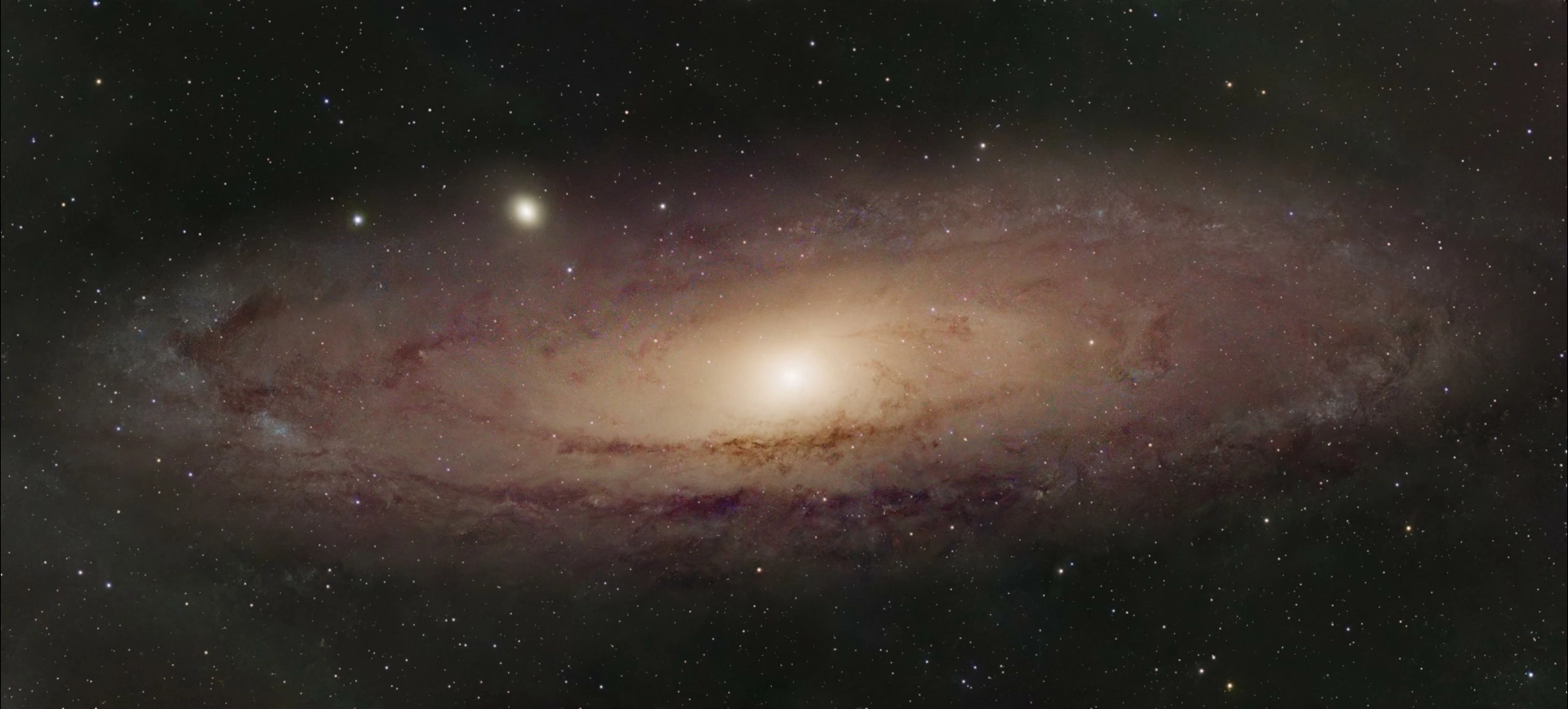
M31 Andromeda Galaxy This image of M31 was integrated and…
1 reactions
M31 Andromeda Galaxy
This image of M31 was integrated and postprocessed from 469x20s subs taken with a Seestar S50 in equatorial mode from Washington DC (Bortle 8) on September 16, 2026. Since the full structure of M31 falls outside the field of view of the Seestar a framing technique was used. Framing is like a mosaic technique but a bit different from it. It is Seestar’s technique for imaging an extended object.
Initially, 574x20s subs were gotten. However, after preprocessing in PixInsight (PI) using Cosmetic Correction, Debayering, Star Alignment and Local Normalization, before the final step of integration, the number of subs became reduced.
The master image generated by Integration was rotated and dynamically cropped in PI and processed in GraXpert to remove gradients. Further processing was done in PI using BlurXT, SPCC (for color correction) and Histogram transformation (to delinearize). To reduce the dynamic range of the bright core of M31, 15% of an HDR multiscale transform-modified clone of the result from the preceding process steps was blended with 85% of the unmodified original. StarXT was applied to separate the stars only portion from the galaxy. A mask was generated using Game in Script > Utilities and used to protect the background in the galaxy image. Local Histogram Equalization followed by Color saturation and Curves transformation were applied to the galaxy. The mask was then inverted to protect the galaxy and NoiseXT was applied to the background. NoiseXT was also applied to the stars only image followed by Morphological transformation > Morphological selection to reduce the brightness of the stars. The processed galaxy and stars only images were then recombined. The mask was reapplied to protect the galaxy and the midtones and shadows of the background were adjusted. Finally, the result was enhanced for sharpness.
#space
This image of M31 was integrated and postprocessed from 469x20s subs taken with a Seestar S50 in equatorial mode from Washington DC (Bortle 8) on September 16, 2026. Since the full structure of M31 falls outside the field of view of the Seestar a framing technique was used. Framing is like a mosaic technique but a bit different from it. It is Seestar’s technique for imaging an extended object.
Initially, 574x20s subs were gotten. However, after preprocessing in PixInsight (PI) using Cosmetic Correction, Debayering, Star Alignment and Local Normalization, before the final step of integration, the number of subs became reduced.
The master image generated by Integration was rotated and dynamically cropped in PI and processed in GraXpert to remove gradients. Further processing was done in PI using BlurXT, SPCC (for color correction) and Histogram transformation (to delinearize). To reduce the dynamic range of the bright core of M31, 15% of an HDR multiscale transform-modified clone of the result from the preceding process steps was blended with 85% of the unmodified original. StarXT was applied to separate the stars only portion from the galaxy. A mask was generated using Game in Script > Utilities and used to protect the background in the galaxy image. Local Histogram Equalization followed by Color saturation and Curves transformation were applied to the galaxy. The mask was then inverted to protect the galaxy and NoiseXT was applied to the background. NoiseXT was also applied to the stars only image followed by Morphological transformation > Morphological selection to reduce the brightness of the stars. The processed galaxy and stars only images were then recombined. The mask was reapplied to protect the galaxy and the midtones and shadows of the background were adjusted. Finally, the result was enhanced for sharpness.
#space


1
| 4,000 mlx | |
| 5 | |
| 1 |