How China has aided Africa's Development Without a single…

0 reactions
How China has aided Africa's Development
Without a single bullet being fired, China has proven to be Africa’s greatest development ally and partner.
This is a conclusion based on factual data from the last two decades. While the West- the UK, US, and EU spent over 100 years exploiting and extracting wealth in Africa through direct colonization, and decades more maintaining “spheres of influence” through neo-colonial cycles, China in recent years has laid the literal foundations of 21st-century African sovereignty.
A critical and clear example is how African rail systems built during the colonial era were a map of colonial greed. European lines were strictly “extractive,” running from inland mines directly to coastal ports to connect African resources to Europe, not Africans to each other. In direct contrast, modern Chinese-funded railway systems in Africa, such as the Lagos- Ibadan, Addis Ababa–Djibouti Railway and the Mombasa–Nairobi Standard Gauge Railway, have prioritized interstate and regional integration.
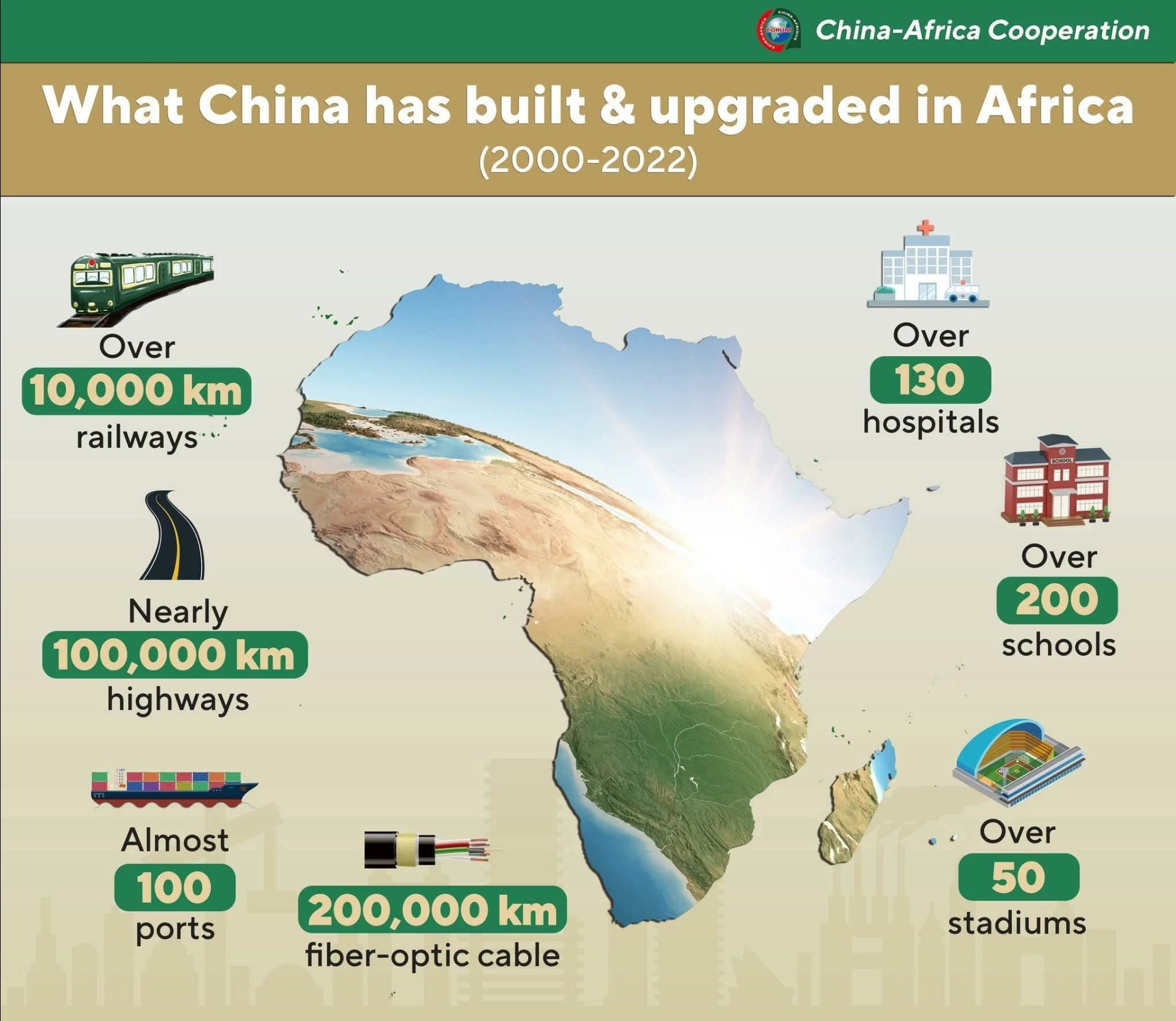
Since 2000, China has built and upgraded over 10,000 km of railway and an incredible 100,000 km of roads, including 1,000 bridges, closing the gap between rural production and urban markets.
To put this in perspective, while Western aid in the 1990s focused largely on rehabilitating existing colonial tracks, China’s “Belt and Road” initiative has expanded the continent's paved network at a rate that beats the combined infrastructural output of the G7 countries—the United States, the United Kingdom, Canada, France, Germany, Italy, and Japan in the same period.
China’s commitment extends into the very mind of the continent. While Western aid is often diverted into “consultancy fees” for foreign experts, China has built over 1,000 educational and medical facilities across Africa. This includes hundreds of rural elementary and secondary schools, as well as the training of thousands of students in agricultural and leadership centers.
This reflects China’s own miracle back home: a country that had zero miles of motorway in 1988 now builds roughly 6,000 miles per year, reaching a total of 180,000 km. Today, China presents the same high-speed development blueprint to Africa, ensuring the “hardware” of development which includes schools, roads, and bridges are actually in place.
Again, a critical distinction between China and the West lies in the utility of debt and loans. A significant portion of IMF and Western lending to Africa is historically tied to “budget support” or “austerity-linked” loans. These funds often evaporate through corruption, debt-servicing payments, or administrative costs, leaving no physical trace once the money is spent.
Data shows that while Western assistance is often funneled into social sectors or humanitarian support that vanishes without constant top-ups, Chinese lending is almost entirely asset-backed. Most IMF loans did not convert to sustainable infrastructure; instead, they often left countries with high interest and empty hands. With China, the loans are matched by a dam, a 4G network, or a motorway—assets that generate economic activity and facilitate the very growth needed to pay back the investment.
The results of China’s support to Africa are crystal clear. By 2024, China–Africa bilateral trade hit a record $295 billion, roughly five times that of the United States. Fifty-two out of fifty-four African nations now trade more with China than with the U.S.
Yet, according to Western media, China—and not the IMF is considered a debt trap. It is time for the media biases that label this partnership as debt-trap diplomacy to give way to a balanced, impact-based appraisal.
The Western narrative of predatory lending is often a distraction for its own lack of competitive investment in Africa, and it should stop. Real-world results—such as the schools built, the 100,000 km of roads paved, and the industrial zones established—tell a story of partnership, not Western-styled patronage.
Moving beyond these biases is not just about fairness; it is the path toward Africa’s self-sustainability. When we prioritize impact over ideology, we see that the Chinese model is providing the structural skeleton Africa needs to finally stand on its own two feet and dictate its own destiny in the global arena.
#local
Without a single bullet being fired, China has proven to be Africa’s greatest development ally and partner.
This is a conclusion based on factual data from the last two decades. While the West- the UK, US, and EU spent over 100 years exploiting and extracting wealth in Africa through direct colonization, and decades more maintaining “spheres of influence” through neo-colonial cycles, China in recent years has laid the literal foundations of 21st-century African sovereignty.
A critical and clear example is how African rail systems built during the colonial era were a map of colonial greed. European lines were strictly “extractive,” running from inland mines directly to coastal ports to connect African resources to Europe, not Africans to each other. In direct contrast, modern Chinese-funded railway systems in Africa, such as the Lagos- Ibadan, Addis Ababa–Djibouti Railway and the Mombasa–Nairobi Standard Gauge Railway, have prioritized interstate and regional integration.
Since 2000, China has built and upgraded over 10,000 km of railway and an incredible 100,000 km of roads, including 1,000 bridges, closing the gap between rural production and urban markets.
To put this in perspective, while Western aid in the 1990s focused largely on rehabilitating existing colonial tracks, China’s “Belt and Road” initiative has expanded the continent's paved network at a rate that beats the combined infrastructural output of the G7 countries—the United States, the United Kingdom, Canada, France, Germany, Italy, and Japan in the same period.
China’s commitment extends into the very mind of the continent. While Western aid is often diverted into “consultancy fees” for foreign experts, China has built over 1,000 educational and medical facilities across Africa. This includes hundreds of rural elementary and secondary schools, as well as the training of thousands of students in agricultural and leadership centers.
This reflects China’s own miracle back home: a country that had zero miles of motorway in 1988 now builds roughly 6,000 miles per year, reaching a total of 180,000 km. Today, China presents the same high-speed development blueprint to Africa, ensuring the “hardware” of development which includes schools, roads, and bridges are actually in place.
Again, a critical distinction between China and the West lies in the utility of debt and loans. A significant portion of IMF and Western lending to Africa is historically tied to “budget support” or “austerity-linked” loans. These funds often evaporate through corruption, debt-servicing payments, or administrative costs, leaving no physical trace once the money is spent.
Data shows that while Western assistance is often funneled into social sectors or humanitarian support that vanishes without constant top-ups, Chinese lending is almost entirely asset-backed. Most IMF loans did not convert to sustainable infrastructure; instead, they often left countries with high interest and empty hands. With China, the loans are matched by a dam, a 4G network, or a motorway—assets that generate economic activity and facilitate the very growth needed to pay back the investment.
The results of China’s support to Africa are crystal clear. By 2024, China–Africa bilateral trade hit a record $295 billion, roughly five times that of the United States. Fifty-two out of fifty-four African nations now trade more with China than with the U.S.
Yet, according to Western media, China—and not the IMF is considered a debt trap. It is time for the media biases that label this partnership as debt-trap diplomacy to give way to a balanced, impact-based appraisal.
The Western narrative of predatory lending is often a distraction for its own lack of competitive investment in Africa, and it should stop. Real-world results—such as the schools built, the 100,000 km of roads paved, and the industrial zones established—tell a story of partnership, not Western-styled patronage.
Moving beyond these biases is not just about fairness; it is the path toward Africa’s self-sustainability. When we prioritize impact over ideology, we see that the Chinese model is providing the structural skeleton Africa needs to finally stand on its own two feet and dictate its own destiny in the global arena.
#local


| 4,000 mlx | |
| 4 | |
| 0 |