
0 reactions
Nasib bundo history he was a freedom fighter
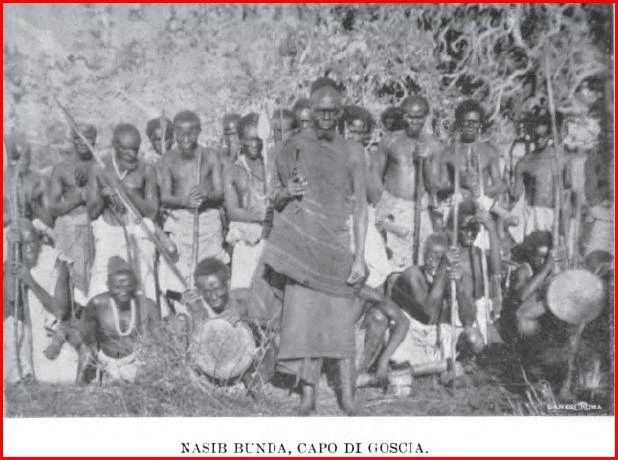
Tradition attributes to Nassib Bunda many of the institutions and customs noted by the early colonial authorities in Goshaland. It is said that he sought to reinstate the practice of organizing villages along ethnic lines. He may also be responsible for the practice of appointing Sagale to supervise newly arrived immigrants and thereby ensuring his control of the burgeoning Gosha settlements. He established certain rules of land tenure: no non-bantu Somalis were allowed to settle in Goshaland, for example, and land abandoned for four years reverted back to the village Gamas- its founding families. Finally, he is said to have established penalties for a number of crimes, Including rape, adultery, homicide, and injury or insult to headmen or Sagale (Zoli 1927:149-150, 181-182, 244-245, 25 3-259).
From the fragmentary evidence, one can infer some of the sources of Nassib Bunda’s power and the mechanisms he used to extend it over Goshaland. Some of these mechanisms dearly built upon existing beliefs of the settlers; others grew out of the peculiar circumstances of late nineteenth-century Somalia and involved alliances with elements of the sur-rounding Somali society.
Nassib Bunda is remembered as a courageous warrior and military leader. Many stories speak of his success in defending his followers against Somali pastorals. A string of early successes against ******* and Biyomaal raiding parties enhanced his reputation as both protector and magician; he was said to be able to summon the animals of the forest and river to his cause (Fieldnotes 1971, Rossetti I900). Age-classes do not seem to have been institutionalized in Goshaland, but all able-bodied males had to give military service and each village of the confederation had a military head responsible for its contingent of militiamen. With arms acquired from Zanzibari traders in the 1880’s, Nassib Bunda created a special force of musket bearers under his own command, and it became the core of his fighting forces, supported by a second line of archers and spear bearers (Zoli 1927:198). Firearms enabled Goshaland to take the offensive in the last few years of the century: on several occasions, Nassib Bunda directed an attack against a Somali pastorals (nomadic thorn enclosure) in retaliation for a Somali raid on a friendly caravan trader (Robecchi.-Brichetti 1899:209). several occasion, Nassib Bunda directed an attack against a Somali pastorals (nomadic thorn enclosure) in retaliation for a Somali raid on a friendly caravan trader (Robecchi.-Brichetti 1899:209).
But it was not only military success that secured Nassib Bunda’s reputation. He was an acknowledged master of the mystical arts, combining Islamic and African practices. In exercising his leadership, his reputed ability to command animals in defending Goshaland has already been -mentioned. Rather less popular was his supposed power over the crocodiles of the Juba, which he used against Gosha rivals; and he threatened family heads with gory death if they refused to give him their daughters in marriage.” Given the unfamiliar surroundings with It’s unknown spirits, it is not surprising that the settlers should emphasize their leader’s supernatural powers. Religious specialists often play an important role in frontier situations, as in the already noted instance of the Zigua Mganga’s. What Nassib Bunda did was to combine supernatural expertise military prowess. His claim to Islamic mystical knowledge contributed further to his prestige among his overwhelmingly illiterate followers, for it suggested control in the world of their former masters. Islamic trappings also provided a source of political legitimacy that transcended ethnic ties. It is not surprising that after 1885 Nassib Bunda styled himself “sultan” of Goshaland- and was recognized as such by Zanzibar and, later, European authorities. In the 1890’s, an Italian traveler found in Nassib’s employ a learned Muslim secretary who served him as an Advisor and correspondent with Muslim authorities in Barawe and Zanzibar (cited in Rossetti I900:36).
Nassib Bunda’s policies were conditioned by the proximity of other political communities. A shrewd diplomat, he effectively used external alliances with neighboring Somalis and with Arab representatives of the su1tans of Zanzibar. In his earlier years, it appears, Nassib Bunda was hostile to all Somali clans save the Tunni, one of whom had rescued him from slavery and whose notables helped him gain recognition from the Egyptian expedition. Peaceful relations with the Tunni involved trade and the diffusion of Islamic learning. On at least one occasion, Nassib and some followers visited Baraawe, a center of the Qadiriya Muslim brotherhood and the main trading town of the Tunni (Rossetti 1900:33).
(Zoli 1927:1929). In exchange, Bi-maal and Shekhal raids on Gosha people diminished; the exchange of crops for livestock products became easier; and Nassib Bunda had perhaps secured external allies in his struggle for domination of the Gosha confederation. Clearly, once Nassib had achieved internal Gosha leadership, its maintenance required other kinds of skills. Having built a reputation as an ardent foe of Somali domination, Nassib Bunda sought, after 1885, out-side recognition of his territorial supremacy. To do this, he needed a modus Vivendi with his neighbors. The task was greatly facilitated by the segmentary nature of Somali politics on the one hand and, on the other, by the desire of Zanzibar’s sultans now under increasing British influence-to promote peaceful trade in their vast East African dominions.
Among the Somali, frequent feuding among lineage’s and clan segments encouraged a politics of limited alliances that achieved temporary balance of power in districts where resources had to be shared. Nassib adapted this system to his own needs by allying himself with certain Somali clans, he reduced the threat to Goshaland’s insured a certain respect from other Somali clans who strength that such alliances could bring. Thus, while internally the Gosha polity was built on social, political, and religious principles shared by most of the settlers, its external relations had to borrow from the pragmatic’ Somali model. There is no evidence of any ritual sanctions or explanations of these alliances.
Nassib Bunda’s accommodation with the Zanzibar regime upon his short-lived recognition by the Egyptian expedition which bar saw as a direct challenge to its supremacy in East African policy used Zanzibar’s official efforts to end the slave trade and subs trade in other commodities. Sultan Barghash’s efforts to establish trading stations along the Somali coast had found little Somali support and frequent Somali hostility. The emergence of the Gosha enclave held out to Zanzibar the prospect of a new market and a commercial corridor to interior. Hence, by the 1880’s, Nassib Bunda was able to secure Zanzibar’s recognition of his authority (together with supply of firearms and ammunition) in exchange for his acceptance of the Sultan’s right to up the Juba, a trade that never amounted to much.
#local
Tradition attributes to Nassib Bunda many of the institutions and customs noted by the early colonial authorities in Goshaland. It is said that he sought to reinstate the practice of organizing villages along ethnic lines. He may also be responsible for the practice of appointing Sagale to supervise newly arrived immigrants and thereby ensuring his control of the burgeoning Gosha settlements. He established certain rules of land tenure: no non-bantu Somalis were allowed to settle in Goshaland, for example, and land abandoned for four years reverted back to the village Gamas- its founding families. Finally, he is said to have established penalties for a number of crimes, Including rape, adultery, homicide, and injury or insult to headmen or Sagale (Zoli 1927:149-150, 181-182, 244-245, 25 3-259).
From the fragmentary evidence, one can infer some of the sources of Nassib Bunda’s power and the mechanisms he used to extend it over Goshaland. Some of these mechanisms dearly built upon existing beliefs of the settlers; others grew out of the peculiar circumstances of late nineteenth-century Somalia and involved alliances with elements of the sur-rounding Somali society.
Nassib Bunda is remembered as a courageous warrior and military leader. Many stories speak of his success in defending his followers against Somali pastorals. A string of early successes against ******* and Biyomaal raiding parties enhanced his reputation as both protector and magician; he was said to be able to summon the animals of the forest and river to his cause (Fieldnotes 1971, Rossetti I900). Age-classes do not seem to have been institutionalized in Goshaland, but all able-bodied males had to give military service and each village of the confederation had a military head responsible for its contingent of militiamen. With arms acquired from Zanzibari traders in the 1880’s, Nassib Bunda created a special force of musket bearers under his own command, and it became the core of his fighting forces, supported by a second line of archers and spear bearers (Zoli 1927:198). Firearms enabled Goshaland to take the offensive in the last few years of the century: on several occasions, Nassib Bunda directed an attack against a Somali pastorals (nomadic thorn enclosure) in retaliation for a Somali raid on a friendly caravan trader (Robecchi.-Brichetti 1899:209). several occasion, Nassib Bunda directed an attack against a Somali pastorals (nomadic thorn enclosure) in retaliation for a Somali raid on a friendly caravan trader (Robecchi.-Brichetti 1899:209).
But it was not only military success that secured Nassib Bunda’s reputation. He was an acknowledged master of the mystical arts, combining Islamic and African practices. In exercising his leadership, his reputed ability to command animals in defending Goshaland has already been -mentioned. Rather less popular was his supposed power over the crocodiles of the Juba, which he used against Gosha rivals; and he threatened family heads with gory death if they refused to give him their daughters in marriage.” Given the unfamiliar surroundings with It’s unknown spirits, it is not surprising that the settlers should emphasize their leader’s supernatural powers. Religious specialists often play an important role in frontier situations, as in the already noted instance of the Zigua Mganga’s. What Nassib Bunda did was to combine supernatural expertise military prowess. His claim to Islamic mystical knowledge contributed further to his prestige among his overwhelmingly illiterate followers, for it suggested control in the world of their former masters. Islamic trappings also provided a source of political legitimacy that transcended ethnic ties. It is not surprising that after 1885 Nassib Bunda styled himself “sultan” of Goshaland- and was recognized as such by Zanzibar and, later, European authorities. In the 1890’s, an Italian traveler found in Nassib’s employ a learned Muslim secretary who served him as an Advisor and correspondent with Muslim authorities in Barawe and Zanzibar (cited in Rossetti I900:36).
Nassib Bunda’s policies were conditioned by the proximity of other political communities. A shrewd diplomat, he effectively used external alliances with neighboring Somalis and with Arab representatives of the su1tans of Zanzibar. In his earlier years, it appears, Nassib Bunda was hostile to all Somali clans save the Tunni, one of whom had rescued him from slavery and whose notables helped him gain recognition from the Egyptian expedition. Peaceful relations with the Tunni involved trade and the diffusion of Islamic learning. On at least one occasion, Nassib and some followers visited Baraawe, a center of the Qadiriya Muslim brotherhood and the main trading town of the Tunni (Rossetti 1900:33).
(Zoli 1927:1929). In exchange, Bi-maal and Shekhal raids on Gosha people diminished; the exchange of crops for livestock products became easier; and Nassib Bunda had perhaps secured external allies in his struggle for domination of the Gosha confederation. Clearly, once Nassib had achieved internal Gosha leadership, its maintenance required other kinds of skills. Having built a reputation as an ardent foe of Somali domination, Nassib Bunda sought, after 1885, out-side recognition of his territorial supremacy. To do this, he needed a modus Vivendi with his neighbors. The task was greatly facilitated by the segmentary nature of Somali politics on the one hand and, on the other, by the desire of Zanzibar’s sultans now under increasing British influence-to promote peaceful trade in their vast East African dominions.
Among the Somali, frequent feuding among lineage’s and clan segments encouraged a politics of limited alliances that achieved temporary balance of power in districts where resources had to be shared. Nassib adapted this system to his own needs by allying himself with certain Somali clans, he reduced the threat to Goshaland’s insured a certain respect from other Somali clans who strength that such alliances could bring. Thus, while internally the Gosha polity was built on social, political, and religious principles shared by most of the settlers, its external relations had to borrow from the pragmatic’ Somali model. There is no evidence of any ritual sanctions or explanations of these alliances.
Nassib Bunda’s accommodation with the Zanzibar regime upon his short-lived recognition by the Egyptian expedition which bar saw as a direct challenge to its supremacy in East African policy used Zanzibar’s official efforts to end the slave trade and subs trade in other commodities. Sultan Barghash’s efforts to establish trading stations along the Somali coast had found little Somali support and frequent Somali hostility. The emergence of the Gosha enclave held out to Zanzibar the prospect of a new market and a commercial corridor to interior. Hence, by the 1880’s, Nassib Bunda was able to secure Zanzibar’s recognition of his authority (together with supply of firearms and ammunition) in exchange for his acceptance of the Sultan’s right to up the Juba, a trade that never amounted to much.
#local


| 11,000 mlx | |
| 11 | |
| 0 |