
6 reactions
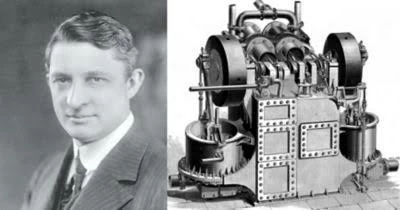
Electricity made the development of effective units possible. In 1901, American inventor Willis H. Carrier built what is considered the first modern electrical air conditioning unit. [27] [28] [29] [30] In 1902, he installed his first air-conditioning system, in the Sackett-Wilhelms Lithographing & Publishing Company in Brooklyn, New York . [31] His invention controlled both the temperature and humidity, which helped maintain consistent paper dimensions and ink alignment at the printing plant. Later, together with six other employees, Carrier formed The Carrier Air Conditioning Company of America , a business that in 2020 employed 53,000 people and was valued at $18.6 billion. [32] [33]
In 1906, Stuart W. Cramer of Charlotte, North Carolina , was exploring ways to add moisture to the air in his textile mill. Cramer coined the term "air conditioning", by it in a patent claim he filed that year as analogous to "water conditioning", then a well-known process for making textiles easier to process. He combined moisture with ventilation to "condition" and change the air in the factories; thus, controlling the humidity that is necessary in textile plants. Willis Carrier adopted the term and incorporated it into the name of his company. [34]
Domestic air conditioning soon took off. In 1914, the first domestic air conditioning was installed in Minneapolis in the home of Charles Gilbert Gates . It is, however, possible that the considerable device (c. 2.1 m × 1.8 m × 6.1 m; 7 ft × 6 ft × 20 ft) was never used, as the house remained uninhabited [23] (Gates had already died in October 1913).
In 1906, Stuart W. Cramer of Charlotte, North Carolina , was exploring ways to add moisture to the air in his textile mill. Cramer coined the term "air conditioning", by it in a patent claim he filed that year as analogous to "water conditioning", then a well-known process for making textiles easier to process. He combined moisture with ventilation to "condition" and change the air in the factories; thus, controlling the humidity that is necessary in textile plants. Willis Carrier adopted the term and incorporated it into the name of his company. [34]
Domestic air conditioning soon took off. In 1914, the first domestic air conditioning was installed in Minneapolis in the home of Charles Gilbert Gates . It is, however, possible that the considerable device (c. 2.1 m × 1.8 m × 6.1 m; 7 ft × 6 ft × 20 ft) was never used, as the house remained uninhabited [23] (Gates had already died in October 1913).


| 120,000 mlx | |
| 17 | |
| 6 |