The Hittite Empire (red) at the height of its power in ca…

6 reactions
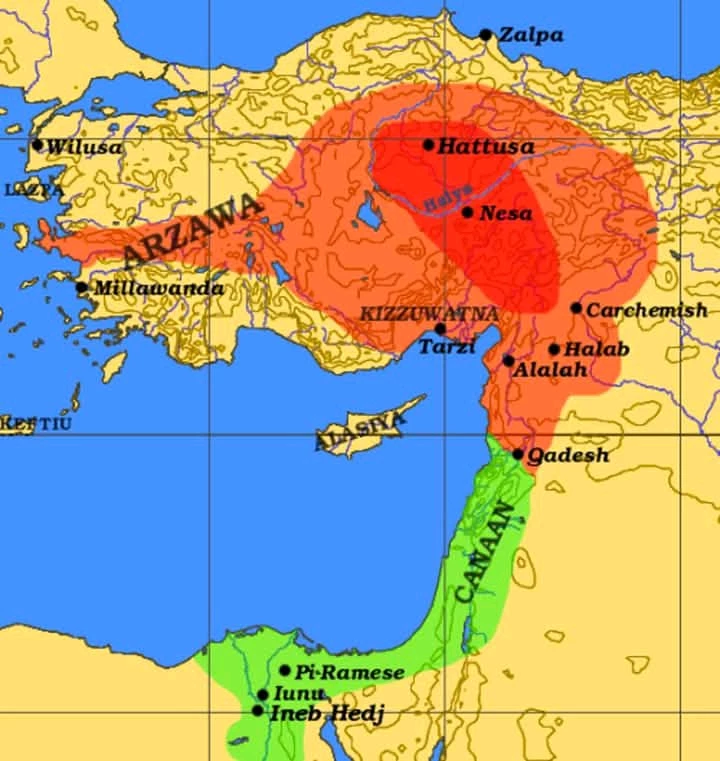
The Hittite Empire (red) at the height of its power in ca. 1290 BC, bordering on the Egyptian Empire (green)
Around 1290 BC, the Hittite Empire (red) and the Egyptian Empire (green) were at the height of their power, bordering each other, and their rivalry led to conflicts like the Battle of Kadesh.
Here's a more detailed look at their relationship:
The Hittite Empire:
The Hittites were an Indo-European group who formed an empire in Anatolia (modern-day Turkey) around 1600 BCE.
They were known for their military prowess, particularly their use of chariots and iron technology.
By the mid-1300s BCE, the Hittite Empire reached its peak, controlling much of Asia Minor and parts of the northern Levant and Upper Mesopotamia.
The Hittites used cuneiform script, but in their own Indo-European language.
The Egyptian Empire:
During the New Kingdom period, the Egyptian Empire reached its height, under rulers like Seti I and Ramesses II.
They also expanded their influence into regions bordering the Hittite Empire, leading to conflicts and eventual negotiations.
The Battle of Kadesh:
The Battle of Kadesh, fought around 1274 BCE, was a major clash between the Egyptian forces of Ramesses II and the Hittite forces of Muwatalli II.
Both sides claimed victory, and the battle ultimately led to a peace treaty between the two empires, marking a period of relative stability.
The Egyptian-Hittite Peace Treaty:
The Treaty of Kadesh, signed around 1258 BCE, was a landmark agreement that established a lasting peace between the two empires.
This treaty was significant because it represented a shift from conflict to diplomacy and cooperation between these two major powers.
Later Interactions:
Despite the peace treaty, there were still some tensions and conflicts between the two empires, particularly in Syria.
However, the treaty established a framework for peaceful coexistence, and the two empires maintained a "cold war" relationship for a period.
The Fall of the Hittite Empire:
Around 1180 BCE, the Hittite Empire collapsed, and the region fragmented into smaller city-states.
This collapse is often attributed to a combination of factors, including internal strife, external invasions, and climate change.
map from wikipedia
#atlasofturkey #turkey
Around 1290 BC, the Hittite Empire (red) and the Egyptian Empire (green) were at the height of their power, bordering each other, and their rivalry led to conflicts like the Battle of Kadesh.
Here's a more detailed look at their relationship:
The Hittite Empire:
The Hittites were an Indo-European group who formed an empire in Anatolia (modern-day Turkey) around 1600 BCE.
They were known for their military prowess, particularly their use of chariots and iron technology.
By the mid-1300s BCE, the Hittite Empire reached its peak, controlling much of Asia Minor and parts of the northern Levant and Upper Mesopotamia.
The Hittites used cuneiform script, but in their own Indo-European language.
The Egyptian Empire:
During the New Kingdom period, the Egyptian Empire reached its height, under rulers like Seti I and Ramesses II.
They also expanded their influence into regions bordering the Hittite Empire, leading to conflicts and eventual negotiations.
The Battle of Kadesh:
The Battle of Kadesh, fought around 1274 BCE, was a major clash between the Egyptian forces of Ramesses II and the Hittite forces of Muwatalli II.
Both sides claimed victory, and the battle ultimately led to a peace treaty between the two empires, marking a period of relative stability.
The Egyptian-Hittite Peace Treaty:
The Treaty of Kadesh, signed around 1258 BCE, was a landmark agreement that established a lasting peace between the two empires.
This treaty was significant because it represented a shift from conflict to diplomacy and cooperation between these two major powers.
Later Interactions:
Despite the peace treaty, there were still some tensions and conflicts between the two empires, particularly in Syria.
However, the treaty established a framework for peaceful coexistence, and the two empires maintained a "cold war" relationship for a period.
The Fall of the Hittite Empire:
Around 1180 BCE, the Hittite Empire collapsed, and the region fragmented into smaller city-states.
This collapse is often attributed to a combination of factors, including internal strife, external invasions, and climate change.
map from wikipedia
#atlasofturkey #turkey


6
| 13,000 mlx | |
| 16 | |
| 6 |