1930 Yakima Valley, Washington. When orchard worker Daniel…
5 reactions
1930 Yakima Valley, Washington.
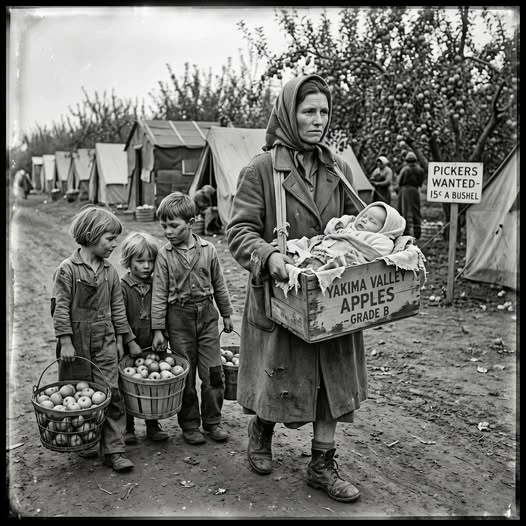
When orchard worker Daniel Kovacs died beneath a collapsing ladder during harvest season, his wife Anna was left alone with a newborn baby and three children in a migrant apple camp.
The family had no crib.
No money.
No winter coats.
So Anna lined an apple crate with cotton scraps and carried the baby through the orchards while picking fruit ten hours a day. The older children worked beside her filling baskets almost too heavy to lift.
One freezing morning, Anna discovered another migrant mother hiding tears because her own infant hadn’t eaten in two days.
That night, Anna traded half the family’s apples for goat milk and split it between both babies.
Soon women across the camp started pooling food together — apples, potatoes, dried beans — so no child went hungry alone.
The babies survived the winter.
Years later, Anna’s youngest son became a union organizer for farm workers in Washington State. During speeches, he often carried the same wooden apple crate onto stage beside him.
Reporters once asked why.
He answered:
“Because this box carried more hope than most banks.” #wilgman
When orchard worker Daniel Kovacs died beneath a collapsing ladder during harvest season, his wife Anna was left alone with a newborn baby and three children in a migrant apple camp.
The family had no crib.
No money.
No winter coats.
So Anna lined an apple crate with cotton scraps and carried the baby through the orchards while picking fruit ten hours a day. The older children worked beside her filling baskets almost too heavy to lift.
One freezing morning, Anna discovered another migrant mother hiding tears because her own infant hadn’t eaten in two days.
That night, Anna traded half the family’s apples for goat milk and split it between both babies.
Soon women across the camp started pooling food together — apples, potatoes, dried beans — so no child went hungry alone.
The babies survived the winter.
Years later, Anna’s youngest son became a union organizer for farm workers in Washington State. During speeches, he often carried the same wooden apple crate onto stage beside him.
Reporters once asked why.
He answered:
“Because this box carried more hope than most banks.” #wilgman


1

1

1

1

1
| 9,000 mlx | |
| 10 | |
| 5 |