
0 reactions
#News
Subscribe me for daily news updates
Titanic sub incident
Titanic sub search: two robot diving craft deployed as oxygen supplies feared to be exhausted – live
Experts say it is unclear whether missing vessel is on the surface or on the seabed amid warnings search could take weeks
Full report: rescuers intensify search amid concerns over oxygen supply
Léonie Chao-Fong (now); Sam Jones and Royce Kurmelovs (earlier)
Thu 22 Jun 2023 13.38 BST
Live feed
From 36m ago
13.02 BST
Robot vehicles deployed as Titan's oxygen supplies estimate to be exhausted
Here’s a look at the main developments of the morning:
Two remotely operated vehicles have been deployed as part of the search effort
According to US coast guard estimates, Titan’s 96 hours of breathable oxygen supplies are thought to be exhausted – although these are just estimates and much will depend on measure the passengers have taken to conserve air
Experts say it’s still unclear whether the submersible is on the surface on the seabed, and warn “weeks of intense survey” may be required to locate it
A British submariner and equipment from a UK firm will help the search for the missing submersible
Updated at 13.12 BST
Key events
17m ago
Search teams 'remain hopeful at this point', says US Coast Guard
53m ago
Robot vehicles deployed as Titan's oxygen supplies estimate to be exhausted
1h ago
Two remote-controlled deep-sea diving vehicles deployed
3h ago
Experts caution against giving precise estimate of when breathable air may run out
4h ago
Experts warn time is running out with search area still vast
8h ago
Opening Summary
Show key events only
17m ago
13.38 BST
Search teams 'remain hopeful at this point', says US Coast Guard
Rescue teams are continuing to carry out “an active search and rescue operation” for the missing Titan submersible, US Coast Guard officials said.
Rear Adm John Mauger , speaking to Sky News, said teams were making the most of the “favourable” weather conditions. He said:
While we’re cognizant of the time, and we’ve factored in a lot of data and information into the search, this is still an active search and rescue at this point.
We’re using the equipment that we have on at the bottom of the ROVS to expand our search capabilities.
Asked when rescuers might consider the situation is “beyond all hope”, Mauger said “there is a time and place for that discussion” but that the focus of the unified command team was “on using the capability that we have now on site to locate the people and the submersible”.
Rear Admiral John Mauger, First District Commander for the US Coast Guard, tells
"We remain hopeful" https://t.co/4560YhOK6P
📺 Sky 501, Virgin 602, Freeview 233 and YouTube pic.twitter.com/7GmvloNX6E
— Sky News (
41m ago
13.13 BST
Severin Carrell
Suleman Dawood, one of the five men missing on the submersible dive to visit the Titanic, has been identified as a university student in Glasgow.
The University of Strathclyde confirmed that Dawood, 19, was one of its students with Strathclyde Business School, and had just completed his first year.
“We are deeply concerned about Suleman, his father and the others involved in this incident,” a university spokesperson said.
Our thoughts are with their families and loved ones and we continue to hope for a positive outcome.
Shahzada Dawood and his son Suleman. Photograph: DAWOOD HERCULES CORPORATION/AFP/Getty Images
Dawood is the son of Shahzada Dawood, 48, a billionaire businessman who lives in Surbiton, south-west London, who is originally from Pakistan but now has British citizenship.
Suleman Dawood has a sister, Alina, and his mother has been named as Christine. The family had been living in Canada for several weeks before the dive.
Earlier this week a family statement described Suleman as a “big fan of science fiction literature and learning new things”, who was also keen on Rubik’s cubes and playing volleyball.
He had recently graduated from ACS International School Cobham in Surrey.
Support the Guardian
Fiercely independent journalism shapes a fairer world. At the Guardian, we have no billionaire owner, so we’re free to report rigorously on world events, never manipulated or silenced by outside influence.
This live blog is no different, and is a great way to understand every single minute of a story as it unfolds. We’ve been publishing our live blogs for more than two decades – covering huge political moments, conflict and war, natural disasters, sports matches and so much more.
And they have been read by millions, because we keep Guardian journalism open and free for everyone. We all deserve to read trustworthy information to better understand our world’s people, power and politics.
But to fund this vital work, we rely on the generosity of readers who are in a position to pay for news. If you can, support us today from just $1 – it takes less than a minute. Thank you.
Continue
Remind me in August
53m ago
13.02 BST
Robot vehicles deployed as Titan's oxygen supplies estimate to be exhausted
Here’s a look at the main developments of the morning:
Two remotely operated vehicles have been deployed as part of the search effort
According to US coast guard estimates, Titan’s 96 hours of breathable oxygen supplies are thought to be exhausted – although these are just estimates and much will depend on measure the passengers have taken to conserve air
Experts say it’s still unclear whether the submersible is on the surface on the seabed, and warn “weeks of intense survey” may be required to locate it
A British submariner and equipment from a UK firm will help the search for the missing submersible
Updated at 13.12 BST
1h ago
12.50 BST
Two remote-controlled deep-sea diving vehicles deployed
According to the US Coast Guard, two remotely operated vehicles have just been deployed in the search effort
The French vessel L'Atalante has just deployed their ROV. #Titanic
— USCGNortheast (
The Canadian vessel Horizon Arctic has deployed an ROV that has reached the sea floor and began its search for the missing sub. #Titanic
— USCGNortheast (
Updated at 12.58 BST
1h ago
12.41 BST
Ryan Ramsey, a former Royal Navy submarine captain, has described the current situation as “bleak” as the search-and-rescue operation continues for Titan after oxygen is thought to have run out aboard the submersible.
He told the PA news agency:
The outlook is bleak, that’s the only word for it, as this tragic event unfolds and almost the closing stages of where this changes from rescue to a salvage mission.
That doesn’t mean to say that the current ships and forces deployed won’t continue to keep looking.
They won’t stop for many days, I imagine, but the reality is if you base it off oxygen alone, then they’re out of oxygen.
Carbon dioxide is also a critical element to it as well as the cold. It would be a miracle if there were survivors from it.
2h ago
12.03 BST
Update: the ship carrying the Victor 6000 deep-sea robot has arrived at the Titan search zone , according to Ifremer, the state-run French ocean research institute that operates the robot. The research vessel Atalante is first using an echo-sounder to accurately map the seabed in order for the robot’s search to be more targeted, Ifremer said.
Updated at 12.09 BST
2h ago
11.55 BST
A British submariner and equipment from a UK firm will help the search for the missing Titan submersible, Downing Street has said.
A No 10 spokesman said: “At the request of US Coastguard, the UK has embedded a Royal Navy submariner to assist the search and rescue effort for the missing submarine.
The officer, Lt Cmdr Richard Kantharia, “has significant knowledge of submarine warfare and dived operations and so he will obviously be bringing that experience to the search and rescue team”.
The officer was on exchange with the US navy and has been seconded to the search and rescue team.
A British C-17 aircraft will transport “specialist commercial equipment” provided by Magellan to St John’s in Newfoundland to assist with the search-and-rescue effort.
(Via PA)
Updated at 12.01 BST
2h ago
11.49 BST
More on Victor 6000, the French robot that is on its way to help find Titan
View of the underwater robot Victor 6000
A view shows the ROV (Remotely Operated underwater Vehicle) Victor 6000 in this undated photograph released by Ifremer. Olivier Dugornay - Ifremer - CCBY/Handout via REUTERS Photograph: Olivier Dugornay/IFREMER/Reuters
The unmanned robot can dive deeper than other equipment now at the site in the North Atlantic and has arms that can be remotely controlled to cut cables or perform other manoeuvres to release a stuck vessel, the machine’s operator said.
“Victor is not capable of lifting the submarine up on its own,” said Olivier Lefort, the head of naval operations at Ifremer, the state-run French ocean research institute which operates the robot. But he told Reuters the robot could help hook Titan to a ship with the capacity to lift it to the surface.
“Victor is able to do visual exploration with all the video equipment it has. It is also equipped with manipulating arms which could be used to extricate the sub, such as by sectioning cables or things that would be blocking it at the bottom,” he said.
Ifremer sent the Atalante ship with its robot at the request of the US navy. “This is the logic of seafarers. Our attitude was: We are close, we have to go,” Lefort said.
The robot is operated by a 25-strong crew. “We can work non-stop for up to 72 hours, we don’t need to stop at night,” he said.
Lefort added:
We don’t know what happened. The noises that were heard give us hope the submarine is on the seabed and that people are still alive, but other scenarios are possible. Even if hope is slim, we’ll go all the way.
(Via Reuters)
3h ago
11.11 BST
Experts caution against giving precise estimate of when breathable air may run out
Although calculations suggest Titan’s 96-hour supply of breathable air is about to run out, experts have emphasised that it is an imprecise estimate and could be extended if passengers have taken measures to conserve breathable air. It is also not known if they are still alive after the sub disappeared on Sunday morning.
Frank Owen, a submarine search-and-rescue expert, said the oxygen supply figure was a useful “target” for searchers but is only based on a “nominal amount of consumption”.
Owen said the diver on board the Titan was likely to be advising passengers to “do anything to reduce your metabolic levels so that you can actually extend this”.
Rescuers have rushed more ships and vessels to the site of the disappearance, hoping underwater sounds they detected for a second straight day might help narrow their search in the urgent, international mission.
But many obstacles still remain: from pinpointing the vessel’s location, to reaching it with rescue equipment, to bringing it to the surface – assuming it’s still intact. And all that has to happen before the passengers’ oxygen supply runs out. (Via AP)
Updated at 11.44 BST
4h ago
10.21 BST
The Atalante vessel, a research and survey ship, in this undated photograph released by Ifremer. Stephane Lesbats – Ifremer/Handout via Reuters Photograph: Stephane Lesbats/Ifremer/Reuters
A French research vessel carrying a deep-sea diving robot slowed down as it reached the search area for a missing submersible that was exploring the wreck of the Titanic, according to the Marine Traffic app.
Marine Traffic data showed the Atalante had slowed to a speed of 6 nautical knots and was located about 20km to 30km from the Polar Prince vessel, which had carried the missing Titan submersible to waters above the Titanic wreck.
The French Research Institute for Exploitation of the Sea (Ifremer), which operates the ship, had earlier said that the Atalante would arrive at 0800 GMT after being urgently dispatched from France on Tuesday.
The ship carries the Victor 6000, a remotely operated underwater vehicle (ROV) capable of descending to a depth of 6,000 metres.
(Via Reuters and AFP)
Updated at 10.58 BST
4h ago
09.46 BST
Experts warn time is running out with search area still vast
I’ve just been listening in to a very useful briefing from the Science Media Centre, in which the speakers were Prof Alistair Greig, professor of marine engineering at University College London, Dr Jamie Pringle, reader in Forensic Geosciences at Keele University and, Dr Rob Larter, a marine geophysicist with the British Antarctic Survey.
Asked about the huge size of the search area , Larter said: “We’ve all seen the reports of these sounds that have been detected, but the fact that the search areas still seems to be so large would seem to indicate that nobody thinks they have confidently been able to locate where those sounds are coming from.”
Given the lack of information from the seabed, said Greig, “I’d say we’re still pretty much where we were on Monday really, in terms of the search I guess”.
Asked about how long it could take to bring the sub to the surface were it found, Greig said: “I don’t know how long it would take but in a normal operating scenario, I think it takes about two hours to get down to depth … and about two hours again [to come up].”
Asked about his assessment of the chances of a successful rescue mission , Greig said: “I think the key thing is that they can find it … but it’s not going to be instantaneous; every step takes time – this is the problem. And we’re running out of time.”
Pringle said: “There’s always hope with these things but you know about the ‘golden first 24 hours’ – and we’re well past that stage. There’s always a chance – it’s never zero – but I think obviously in the long run, the longer the time that elapses, the lower the chances of success. That’s with anything from earthquake survival to searches. When it goes from a rescue to a recovery, I guess the coastguards will make that choice. But that will happen at some point.”
Larter said: “It’s just a desperate situation. It’s kind of unimaginable if people are alive, trapped in a submersible with oxygen supplies running down. It doesn’t bear thinking about. An objective assessment of where things are at the moment? It doesn’t look good. But I think as Jamie said, you have to try to stay optimistic for as long as possible.”
Asked how long it could take to find Titan , Larter said: “How long is a piece of string? To find an object of this size in 3,800-metre water depth, it potentially could take weeks of intense survey. It very much depends on how tightly the area that has to be searched is defined.”
Asked whether the disappearance of Titan could spell the end of deep sea tourism , Larter said: “I think when people look at it afterwards, this will no doubt trigger an investigation and I think this may prove to be a key moment in thinking about how such activities are regulated in the future. It’s clear from the reports I’ve read that there is a lack of regulation governing what people can put in the water.”
Greig added: “I think there are two issues here: there’s the regulation issue we’ve just heard about but there’s also the potential customer base – it may put people off wanting to pay to go on these trips.”
Asked if we were any closer to knowing what had gone wrong , Greig said: “I think the only thing we know that went wrong is that they lost communications. Beyond that, we don’t know. We’re not even sure yet whether it’s on the surface or the seabed, which is complicating the search.”
Updated at 11.45 BST
6h ago
08.23 BST
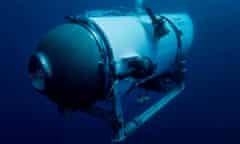
File photo of the missing Titan submarine. Photograph: EyePress News/Shutterstock
Updated at 08.57 BST
6h ago
08.15 BST
Dr David Gallo, a deep sea explorer, has stressed that it will take hours to rescue the submersible once it has been found – if indeed it turns out that the repetitive banging noises detected are coming from the lost sub.
Speaking to Good Morning Britain on Thursday, he said:
In this case, the noises are repetitive, every half hour I believe.
Three different aircraft heard them in their sensors at the same time and it went on for two days-plus.
It’s still going on apparently. There’s not a lot in the natural world we can think of that would do that every 30-minute cycle.
We have to, at this point, assume that that’s the submarine and move quickly to that spot, locate it and get robots down there to verify that is where the submarine is.
They’ve got to go fully ready as if that was the sub because it takes a while to locate it and get it up to the surface, it takes hours.
(Via PA)
6h ago
08.07 BST
Donna Lu
Eric Fusil , a submarine expert at the University of Adelaide, has shared some thoughts on what is required to ensure the seaworthiness of submersibles. He writes, in a piece for the Conversation :
For the Titan, fitness for purpose could be summarised by the ability to safely launch from a mothership on the water’s surface, operate autonomously down to 4,000m (the approximate depth of the Titanic shipwreck), and resurface for recovery by the mothership after a dive of a few hours …
The Titan is made of a composite carbon fibre-titanium hull. It is extremely complicated to design and structurally assess these materials, compared to metallic material only.
For deep-sea submersibles, minor malfunctions at the surface can pose serious risks at depth. For that reason, many of these vessels have redundancy built into their design, with back-ups in case one or multiple systems fail.
According to Fusil, in practical terms that means having:
a reserve of oxygen (such as while waiting for a rescue party) reliable main power sources and back-up systems another power source (such as hydraulic) in case of power loss – this would help, for example, to release safety leads to get positive buoyancy and rise back to the surface.
Ron Allum , a deep-sea engineer and explorer who designed the Deepsea Challenger vessel James Cameron used to reach Earth’s deepest-known point in 2012, told the Guardian:
The Deepsea Challenger was all about redundancy. We had almost three independent systems … backed up on different power supplies. We conducted fire tests. We literally made the batteries burn.
The vessel itself also underwent methodical testing prior to the expedition:
We tested and tested our descent weight. We did it at pressure. We did it hundreds of times, mounted to a forklift. It became almost monotonous.
Updated at 08.57 BST
6h ago
07.59 BST
The shadow of a Royal Canadian Air Force CP-140 Aurora maritime surveillance aircraft of 14 Wing forms on cloud cover as it flies a search pattern for the missing OceanGate submersible. Photograph: Canadian Forces/Reuters
View from over the shoulder of a Royal Canadian Air Force pilot participating in the search for the Titan. Photograph: Canadian Forces/Reuters
A crew member of a Royal Canadian Air Force CP-140 Aurora maritime surveillance aircraft of 14 Wing drops sonar buoys as it flies a search pattern for the missing OceanGate submersible. Photograph: Canadian Forces/Reuters
A shot over the wing of a Royal Canadian Air Force CP-140 Aurora maritime surveillance aircraft with a search vessel insight. Photograph: Canadian Forces/Reuters
Updated at
08 .58
BST
6 h ago
0 7.50
BST
If you’re just joining us here is where rescue efforts stand:
Vessels and specialist equipment has been sent from the US, UK, Canada and France to join the search for the Titan in a race against time.The Polar Prince - the research vessel the Titan was launched from - will remain the command centre for the search, sitting near the Titanic wreck siteOfficials are still holding out hope of a rescue even as the vessel nears the theoretical limit of its oxygen supplyThe actual oxygen supply in the vessel depends largely on a range of factors, according to experts, such as the breathing rate of those on board, their level of physical activity and whether they remain calm
For more details, we have put together a summary of what we know so far as the search enters its critical phase.
Titanic sub: rescuers intensify search as fears grow over Titan’s remaining oxygen supply
Read more
6h ago
07.40 BST
Rescue teams searching for the missing Titan submersible saw reason for optimism on Wednesday after they reported hearing underwater noises in the Atlantic.
While stressing that the sounds were “inconclusive” and not confirmation the crew was still alive, the news did raise the question of what happens if the sub is located – and what equipment will be necessary to retrieve it.
As the search enters its critical phase, Jonathan Yerushalmy has taken a look at the vessels and remote operated deep-sea vessels that are being deployed.
Robot subs and an 8km winch: the equipment being deployed in search for Titan
Read more
1
of
2
Next
Oldest
Topics
Titanic sub incident
Pakistan
Canada
US military
Reuse this content
More on this story
Titanic sub: rescuers intensify search as fears grow over Titan’s remaining oxygen supply
2h ago
Titanic sub search team still hearing underwater noises, says US Coast Guard
19h ago
Titanic submersible: documents reveal multiple concerns raised over safety of vessel
1d ago
Experts say rescuing Titan submersible ‘a very difficult task’
20h ago
Titan submersible: timeline of missing vessel’s voyage
11h ago
‘How dangerous the ocean can be’: Canadian city rallies for Titan rescue
1d ago
Titanic submarine: what do we know about the people onboard?
2d ago
Best and worst case scenarios to explain Titan’s loss of contact with surface
2d ago
Most vi ewed
World
Europe
US
America s
Asia
Austral ia
Middle East
Africa
Inequal ity
Global development
News
Opinion
Sport
Culture
Lifesty le
Original reporting and incisive analysis, direct from the Guardian every morning
Sign up for our email
Help
Complai nts & corrections
SecureD rop
Work fo r us
Privacy settings
Privacy policy
Cookie policy
Terms & conditions
Contact us
All top ics
All wri ters
Digital newspaper archive
Faceboo k
YouTube
Instagr am
LinkedI n
Twitter
Newslet ters
Adverti se with us
Search UK jobs
Back to top
© 2023 Guardian News & Media Limited or its affiliated companies. All rights reserved. (modern)
Close t his banner
All bet s are off
The Guardian is announcing it will no longer accept gambling ads. We want to offer a safe and enjoyable space for all our readers to enjoy our coverage. Thanks to our supporters, we can remain fiercely independent and free to make bold decisions like this.
If th is is work you’d like to fund, please give once from $1, or better yet, power us every month with a little more. Thank you.
Contr ibution frequency
Singl e
Monthly
Annual
Contr ibution amount
$3 pe r month
$6 per month
Other
Conti nue
Subscribe me for daily news updates
Titanic sub incident
Titanic sub search: two robot diving craft deployed as oxygen supplies feared to be exhausted – live
Experts say it is unclear whether missing vessel is on the surface or on the seabed amid warnings search could take weeks
Full report: rescuers intensify search amid concerns over oxygen supply
Léonie Chao-Fong (now); Sam Jones and Royce Kurmelovs (earlier)
Thu 22 Jun 2023 13.38 BST
Live feed
From 36m ago
13.02 BST
Robot vehicles deployed as Titan's oxygen supplies estimate to be exhausted
Here’s a look at the main developments of the morning:
Two remotely operated vehicles have been deployed as part of the search effort
According to US coast guard estimates, Titan’s 96 hours of breathable oxygen supplies are thought to be exhausted – although these are just estimates and much will depend on measure the passengers have taken to conserve air
Experts say it’s still unclear whether the submersible is on the surface on the seabed, and warn “weeks of intense survey” may be required to locate it
A British submariner and equipment from a UK firm will help the search for the missing submersible
Updated at 13.12 BST
Key events
17m ago
Search teams 'remain hopeful at this point', says US Coast Guard
53m ago
Robot vehicles deployed as Titan's oxygen supplies estimate to be exhausted
1h ago
Two remote-controlled deep-sea diving vehicles deployed
3h ago
Experts caution against giving precise estimate of when breathable air may run out
4h ago
Experts warn time is running out with search area still vast
8h ago
Opening Summary
Show key events only
17m ago
13.38 BST
Search teams 'remain hopeful at this point', says US Coast Guard
Rescue teams are continuing to carry out “an active search and rescue operation” for the missing Titan submersible, US Coast Guard officials said.
Rear Adm John Mauger , speaking to Sky News, said teams were making the most of the “favourable” weather conditions. He said:
While we’re cognizant of the time, and we’ve factored in a lot of data and information into the search, this is still an active search and rescue at this point.
We’re using the equipment that we have on at the bottom of the ROVS to expand our search capabilities.
Asked when rescuers might consider the situation is “beyond all hope”, Mauger said “there is a time and place for that discussion” but that the focus of the unified command team was “on using the capability that we have now on site to locate the people and the submersible”.
Rear Admiral John Mauger, First District Commander for the US Coast Guard, tells
"We remain hopeful" https://t.co/4560YhOK6P
📺 Sky 501, Virgin 602, Freeview 233 and YouTube pic.twitter.com/7GmvloNX6E
— Sky News (
41m ago
13.13 BST
Severin Carrell
Suleman Dawood, one of the five men missing on the submersible dive to visit the Titanic, has been identified as a university student in Glasgow.
The University of Strathclyde confirmed that Dawood, 19, was one of its students with Strathclyde Business School, and had just completed his first year.
“We are deeply concerned about Suleman, his father and the others involved in this incident,” a university spokesperson said.
Our thoughts are with their families and loved ones and we continue to hope for a positive outcome.
Shahzada Dawood and his son Suleman. Photograph: DAWOOD HERCULES CORPORATION/AFP/Getty Images
Dawood is the son of Shahzada Dawood, 48, a billionaire businessman who lives in Surbiton, south-west London, who is originally from Pakistan but now has British citizenship.
Suleman Dawood has a sister, Alina, and his mother has been named as Christine. The family had been living in Canada for several weeks before the dive.
Earlier this week a family statement described Suleman as a “big fan of science fiction literature and learning new things”, who was also keen on Rubik’s cubes and playing volleyball.
He had recently graduated from ACS International School Cobham in Surrey.
Support the Guardian
Fiercely independent journalism shapes a fairer world. At the Guardian, we have no billionaire owner, so we’re free to report rigorously on world events, never manipulated or silenced by outside influence.
This live blog is no different, and is a great way to understand every single minute of a story as it unfolds. We’ve been publishing our live blogs for more than two decades – covering huge political moments, conflict and war, natural disasters, sports matches and so much more.
And they have been read by millions, because we keep Guardian journalism open and free for everyone. We all deserve to read trustworthy information to better understand our world’s people, power and politics.
But to fund this vital work, we rely on the generosity of readers who are in a position to pay for news. If you can, support us today from just $1 – it takes less than a minute. Thank you.
Continue
Remind me in August
53m ago
13.02 BST
Robot vehicles deployed as Titan's oxygen supplies estimate to be exhausted
Here’s a look at the main developments of the morning:
Two remotely operated vehicles have been deployed as part of the search effort
According to US coast guard estimates, Titan’s 96 hours of breathable oxygen supplies are thought to be exhausted – although these are just estimates and much will depend on measure the passengers have taken to conserve air
Experts say it’s still unclear whether the submersible is on the surface on the seabed, and warn “weeks of intense survey” may be required to locate it
A British submariner and equipment from a UK firm will help the search for the missing submersible
Updated at 13.12 BST
1h ago
12.50 BST
Two remote-controlled deep-sea diving vehicles deployed
According to the US Coast Guard, two remotely operated vehicles have just been deployed in the search effort
The French vessel L'Atalante has just deployed their ROV. #Titanic
— USCGNortheast (
The Canadian vessel Horizon Arctic has deployed an ROV that has reached the sea floor and began its search for the missing sub. #Titanic
— USCGNortheast (
Updated at 12.58 BST
1h ago
12.41 BST
Ryan Ramsey, a former Royal Navy submarine captain, has described the current situation as “bleak” as the search-and-rescue operation continues for Titan after oxygen is thought to have run out aboard the submersible.
He told the PA news agency:
The outlook is bleak, that’s the only word for it, as this tragic event unfolds and almost the closing stages of where this changes from rescue to a salvage mission.
That doesn’t mean to say that the current ships and forces deployed won’t continue to keep looking.
They won’t stop for many days, I imagine, but the reality is if you base it off oxygen alone, then they’re out of oxygen.
Carbon dioxide is also a critical element to it as well as the cold. It would be a miracle if there were survivors from it.
2h ago
12.03 BST
Update: the ship carrying the Victor 6000 deep-sea robot has arrived at the Titan search zone , according to Ifremer, the state-run French ocean research institute that operates the robot. The research vessel Atalante is first using an echo-sounder to accurately map the seabed in order for the robot’s search to be more targeted, Ifremer said.
Updated at 12.09 BST
2h ago
11.55 BST
A British submariner and equipment from a UK firm will help the search for the missing Titan submersible, Downing Street has said.
A No 10 spokesman said: “At the request of US Coastguard, the UK has embedded a Royal Navy submariner to assist the search and rescue effort for the missing submarine.
The officer, Lt Cmdr Richard Kantharia, “has significant knowledge of submarine warfare and dived operations and so he will obviously be bringing that experience to the search and rescue team”.
The officer was on exchange with the US navy and has been seconded to the search and rescue team.
A British C-17 aircraft will transport “specialist commercial equipment” provided by Magellan to St John’s in Newfoundland to assist with the search-and-rescue effort.
(Via PA)
Updated at 12.01 BST
2h ago
11.49 BST
More on Victor 6000, the French robot that is on its way to help find Titan
View of the underwater robot Victor 6000
A view shows the ROV (Remotely Operated underwater Vehicle) Victor 6000 in this undated photograph released by Ifremer. Olivier Dugornay - Ifremer - CCBY/Handout via REUTERS Photograph: Olivier Dugornay/IFREMER/Reuters
The unmanned robot can dive deeper than other equipment now at the site in the North Atlantic and has arms that can be remotely controlled to cut cables or perform other manoeuvres to release a stuck vessel, the machine’s operator said.
“Victor is not capable of lifting the submarine up on its own,” said Olivier Lefort, the head of naval operations at Ifremer, the state-run French ocean research institute which operates the robot. But he told Reuters the robot could help hook Titan to a ship with the capacity to lift it to the surface.
“Victor is able to do visual exploration with all the video equipment it has. It is also equipped with manipulating arms which could be used to extricate the sub, such as by sectioning cables or things that would be blocking it at the bottom,” he said.
Ifremer sent the Atalante ship with its robot at the request of the US navy. “This is the logic of seafarers. Our attitude was: We are close, we have to go,” Lefort said.
The robot is operated by a 25-strong crew. “We can work non-stop for up to 72 hours, we don’t need to stop at night,” he said.
Lefort added:
We don’t know what happened. The noises that were heard give us hope the submarine is on the seabed and that people are still alive, but other scenarios are possible. Even if hope is slim, we’ll go all the way.
(Via Reuters)
3h ago
11.11 BST
Experts caution against giving precise estimate of when breathable air may run out
Although calculations suggest Titan’s 96-hour supply of breathable air is about to run out, experts have emphasised that it is an imprecise estimate and could be extended if passengers have taken measures to conserve breathable air. It is also not known if they are still alive after the sub disappeared on Sunday morning.
Frank Owen, a submarine search-and-rescue expert, said the oxygen supply figure was a useful “target” for searchers but is only based on a “nominal amount of consumption”.
Owen said the diver on board the Titan was likely to be advising passengers to “do anything to reduce your metabolic levels so that you can actually extend this”.
Rescuers have rushed more ships and vessels to the site of the disappearance, hoping underwater sounds they detected for a second straight day might help narrow their search in the urgent, international mission.
But many obstacles still remain: from pinpointing the vessel’s location, to reaching it with rescue equipment, to bringing it to the surface – assuming it’s still intact. And all that has to happen before the passengers’ oxygen supply runs out. (Via AP)
Updated at 11.44 BST
4h ago
10.21 BST
The Atalante vessel, a research and survey ship, in this undated photograph released by Ifremer. Stephane Lesbats – Ifremer/Handout via Reuters Photograph: Stephane Lesbats/Ifremer/Reuters
A French research vessel carrying a deep-sea diving robot slowed down as it reached the search area for a missing submersible that was exploring the wreck of the Titanic, according to the Marine Traffic app.
Marine Traffic data showed the Atalante had slowed to a speed of 6 nautical knots and was located about 20km to 30km from the Polar Prince vessel, which had carried the missing Titan submersible to waters above the Titanic wreck.
The French Research Institute for Exploitation of the Sea (Ifremer), which operates the ship, had earlier said that the Atalante would arrive at 0800 GMT after being urgently dispatched from France on Tuesday.
The ship carries the Victor 6000, a remotely operated underwater vehicle (ROV) capable of descending to a depth of 6,000 metres.
(Via Reuters and AFP)
Updated at 10.58 BST
4h ago
09.46 BST
Experts warn time is running out with search area still vast
I’ve just been listening in to a very useful briefing from the Science Media Centre, in which the speakers were Prof Alistair Greig, professor of marine engineering at University College London, Dr Jamie Pringle, reader in Forensic Geosciences at Keele University and, Dr Rob Larter, a marine geophysicist with the British Antarctic Survey.
Asked about the huge size of the search area , Larter said: “We’ve all seen the reports of these sounds that have been detected, but the fact that the search areas still seems to be so large would seem to indicate that nobody thinks they have confidently been able to locate where those sounds are coming from.”
Given the lack of information from the seabed, said Greig, “I’d say we’re still pretty much where we were on Monday really, in terms of the search I guess”.
Asked about how long it could take to bring the sub to the surface were it found, Greig said: “I don’t know how long it would take but in a normal operating scenario, I think it takes about two hours to get down to depth … and about two hours again [to come up].”
Asked about his assessment of the chances of a successful rescue mission , Greig said: “I think the key thing is that they can find it … but it’s not going to be instantaneous; every step takes time – this is the problem. And we’re running out of time.”
Pringle said: “There’s always hope with these things but you know about the ‘golden first 24 hours’ – and we’re well past that stage. There’s always a chance – it’s never zero – but I think obviously in the long run, the longer the time that elapses, the lower the chances of success. That’s with anything from earthquake survival to searches. When it goes from a rescue to a recovery, I guess the coastguards will make that choice. But that will happen at some point.”
Larter said: “It’s just a desperate situation. It’s kind of unimaginable if people are alive, trapped in a submersible with oxygen supplies running down. It doesn’t bear thinking about. An objective assessment of where things are at the moment? It doesn’t look good. But I think as Jamie said, you have to try to stay optimistic for as long as possible.”
Asked how long it could take to find Titan , Larter said: “How long is a piece of string? To find an object of this size in 3,800-metre water depth, it potentially could take weeks of intense survey. It very much depends on how tightly the area that has to be searched is defined.”
Asked whether the disappearance of Titan could spell the end of deep sea tourism , Larter said: “I think when people look at it afterwards, this will no doubt trigger an investigation and I think this may prove to be a key moment in thinking about how such activities are regulated in the future. It’s clear from the reports I’ve read that there is a lack of regulation governing what people can put in the water.”
Greig added: “I think there are two issues here: there’s the regulation issue we’ve just heard about but there’s also the potential customer base – it may put people off wanting to pay to go on these trips.”
Asked if we were any closer to knowing what had gone wrong , Greig said: “I think the only thing we know that went wrong is that they lost communications. Beyond that, we don’t know. We’re not even sure yet whether it’s on the surface or the seabed, which is complicating the search.”
Updated at 11.45 BST
6h ago
08.23 BST
File photo of the missing Titan submarine. Photograph: EyePress News/Shutterstock
Updated at 08.57 BST
6h ago
08.15 BST
Dr David Gallo, a deep sea explorer, has stressed that it will take hours to rescue the submersible once it has been found – if indeed it turns out that the repetitive banging noises detected are coming from the lost sub.
Speaking to Good Morning Britain on Thursday, he said:
In this case, the noises are repetitive, every half hour I believe.
Three different aircraft heard them in their sensors at the same time and it went on for two days-plus.
It’s still going on apparently. There’s not a lot in the natural world we can think of that would do that every 30-minute cycle.
We have to, at this point, assume that that’s the submarine and move quickly to that spot, locate it and get robots down there to verify that is where the submarine is.
They’ve got to go fully ready as if that was the sub because it takes a while to locate it and get it up to the surface, it takes hours.
(Via PA)
6h ago
08.07 BST
Donna Lu
Eric Fusil , a submarine expert at the University of Adelaide, has shared some thoughts on what is required to ensure the seaworthiness of submersibles. He writes, in a piece for the Conversation :
For the Titan, fitness for purpose could be summarised by the ability to safely launch from a mothership on the water’s surface, operate autonomously down to 4,000m (the approximate depth of the Titanic shipwreck), and resurface for recovery by the mothership after a dive of a few hours …
The Titan is made of a composite carbon fibre-titanium hull. It is extremely complicated to design and structurally assess these materials, compared to metallic material only.
For deep-sea submersibles, minor malfunctions at the surface can pose serious risks at depth. For that reason, many of these vessels have redundancy built into their design, with back-ups in case one or multiple systems fail.
According to Fusil, in practical terms that means having:
a reserve of oxygen (such as while waiting for a rescue party) reliable main power sources and back-up systems another power source (such as hydraulic) in case of power loss – this would help, for example, to release safety leads to get positive buoyancy and rise back to the surface.
Ron Allum , a deep-sea engineer and explorer who designed the Deepsea Challenger vessel James Cameron used to reach Earth’s deepest-known point in 2012, told the Guardian:
The Deepsea Challenger was all about redundancy. We had almost three independent systems … backed up on different power supplies. We conducted fire tests. We literally made the batteries burn.
The vessel itself also underwent methodical testing prior to the expedition:
We tested and tested our descent weight. We did it at pressure. We did it hundreds of times, mounted to a forklift. It became almost monotonous.
Updated at 08.57 BST
6h ago
07.59 BST
The shadow of a Royal Canadian Air Force CP-140 Aurora maritime surveillance aircraft of 14 Wing forms on cloud cover as it flies a search pattern for the missing OceanGate submersible. Photograph: Canadian Forces/Reuters
View from over the shoulder of a Royal Canadian Air Force pilot participating in the search for the Titan. Photograph: Canadian Forces/Reuters
A crew member of a Royal Canadian Air Force CP-140 Aurora maritime surveillance aircraft of 14 Wing drops sonar buoys as it flies a search pattern for the missing OceanGate submersible. Photograph: Canadian Forces/Reuters
A shot over the wing of a Royal Canadian Air Force CP-140 Aurora maritime surveillance aircraft with a search vessel insight. Photograph: Canadian Forces/Reuters
Updated at
08 .58
BST
6 h ago
0 7.50
BST
If you’re just joining us here is where rescue efforts stand:
Vessels and specialist equipment has been sent from the US, UK, Canada and France to join the search for the Titan in a race against time.The Polar Prince - the research vessel the Titan was launched from - will remain the command centre for the search, sitting near the Titanic wreck siteOfficials are still holding out hope of a rescue even as the vessel nears the theoretical limit of its oxygen supplyThe actual oxygen supply in the vessel depends largely on a range of factors, according to experts, such as the breathing rate of those on board, their level of physical activity and whether they remain calm
For more details, we have put together a summary of what we know so far as the search enters its critical phase.
Titanic sub: rescuers intensify search as fears grow over Titan’s remaining oxygen supply
Read more
6h ago
07.40 BST
Rescue teams searching for the missing Titan submersible saw reason for optimism on Wednesday after they reported hearing underwater noises in the Atlantic.
While stressing that the sounds were “inconclusive” and not confirmation the crew was still alive, the news did raise the question of what happens if the sub is located – and what equipment will be necessary to retrieve it.
As the search enters its critical phase, Jonathan Yerushalmy has taken a look at the vessels and remote operated deep-sea vessels that are being deployed.
Robot subs and an 8km winch: the equipment being deployed in search for Titan
Read more
1
of
2
Next
Oldest
Topics
Titanic sub incident
Pakistan
Canada
US military
Reuse this content
Titanic sub: rescuers intensify search as fears grow over Titan’s remaining oxygen supply
2h ago
Titanic sub search team still hearing underwater noises, says US Coast Guard
19h ago
Titanic submersible: documents reveal multiple concerns raised over safety of vessel
1d ago
Experts say rescuing Titan submersible ‘a very difficult task’
20h ago
Titan submersible: timeline of missing vessel’s voyage
11h ago
‘How dangerous the ocean can be’: Canadian city rallies for Titan rescue
1d ago
Titanic submarine: what do we know about the people onboard?
2d ago
Best and worst case scenarios to explain Titan’s loss of contact with surface
2d ago
Most vi ewed
World
Europe
US
America s
Asia
Austral ia
Middle East
Africa
Inequal ity
Global development
News
Opinion
Sport
Culture
Lifesty le
Original reporting and incisive analysis, direct from the Guardian every morning
Sign up for our email
Help
Complai nts & corrections
SecureD rop
Work fo r us
Privacy settings
Privacy policy
Cookie policy
Terms & conditions
Contact us
All top ics
All wri ters
Digital newspaper archive
Faceboo k
YouTube
Instagr am
LinkedI n
Newslet ters
Adverti se with us
Search UK jobs
Back to top
© 2023 Guardian News & Media Limited or its affiliated companies. All rights reserved. (modern)
Close t his banner
All bet s are off
The Guardian is announcing it will no longer accept gambling ads. We want to offer a safe and enjoyable space for all our readers to enjoy our coverage. Thanks to our supporters, we can remain fiercely independent and free to make bold decisions like this.
If th is is work you’d like to fund, please give once from $1, or better yet, power us every month with a little more. Thank you.
Contr ibution frequency
Singl e
Monthly
Annual
Contr ibution amount
$3 pe r month
$6 per month
Other
Conti nue


| 2,000 mlx | |
| 59 | |
| 0 |