Did you know that the Rubik's Cube has…

2 reactions
Did you know that the Rubik's Cube has 43,252,003,274,489,856,000 possible combinations?
Rubik's Cube
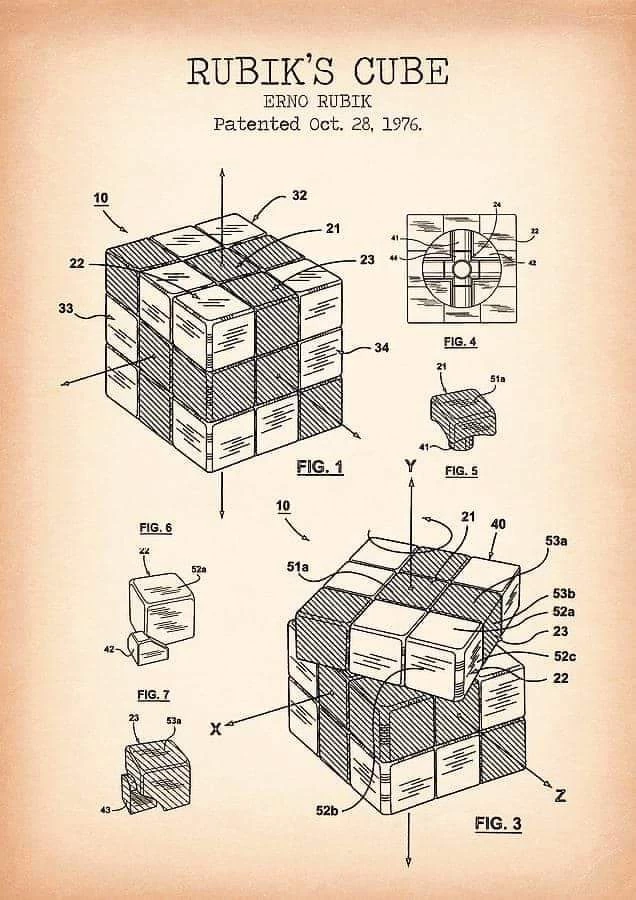
In 1974, Erno Rubik, architect, sculptor and designer, lived with his mother in a modest two-room apartment in Budapest, the capital of Hungary. One spring day, he decided to take small blocks of wood and tie them together with bungee cords. He was looking for hands-on teaching tools to help students understand three-dimensional movements. And that led to the birth of the Cube.
When the strings broke, Rubik applied some simple engineering to get the pieces to move independently without the mechanism falling apart. He cut and sanded the small blocks, assembled them, and marked each side of the Cube with a different colored adhesive. And, immediately afterward, he began to spin them. Once the prototype was ready, it was obvious that it encapsulated a problem to be solved like a puzzle, he notes. "It was wonderful to see how, after a few spins, the colors mixed together. After a while, I decided it was time to put the cubes back in order. And, at that moment, I found myself face to face with the great challenge: What was the way back?"
No matter how much the then 29-year-old Hungarian professor turned his invention, the colors became more and more mixed. He admits that at first, he didn't even know if the problem had a solution, and describes it as being faced with a scripture written in a secret code that he couldn't read. After more than a month, and after trying different sequences of movements, Rubik was able to show his mother a Cube with its colors in order. "I remember how proud I was when I showed it to him," he says. "And she was very happy, hoping that, from then on, she wouldn't work so hard on it."
#RubikCube #Puzzles #OutoftheBox
Rubik's Cube
In 1974, Erno Rubik, architect, sculptor and designer, lived with his mother in a modest two-room apartment in Budapest, the capital of Hungary. One spring day, he decided to take small blocks of wood and tie them together with bungee cords. He was looking for hands-on teaching tools to help students understand three-dimensional movements. And that led to the birth of the Cube.
When the strings broke, Rubik applied some simple engineering to get the pieces to move independently without the mechanism falling apart. He cut and sanded the small blocks, assembled them, and marked each side of the Cube with a different colored adhesive. And, immediately afterward, he began to spin them. Once the prototype was ready, it was obvious that it encapsulated a problem to be solved like a puzzle, he notes. "It was wonderful to see how, after a few spins, the colors mixed together. After a while, I decided it was time to put the cubes back in order. And, at that moment, I found myself face to face with the great challenge: What was the way back?"
No matter how much the then 29-year-old Hungarian professor turned his invention, the colors became more and more mixed. He admits that at first, he didn't even know if the problem had a solution, and describes it as being faced with a scripture written in a secret code that he couldn't read. After more than a month, and after trying different sequences of movements, Rubik was able to show his mother a Cube with its colors in order. "I remember how proud I was when I showed it to him," he says. "And she was very happy, hoping that, from then on, she wouldn't work so hard on it."
#RubikCube #Puzzles #OutoftheBox


1

1
| 9,000 mlx | |
| 7 | |
| 2 |