The Polish Tax Paradox: How a system built on heavy labor…
0 reactions
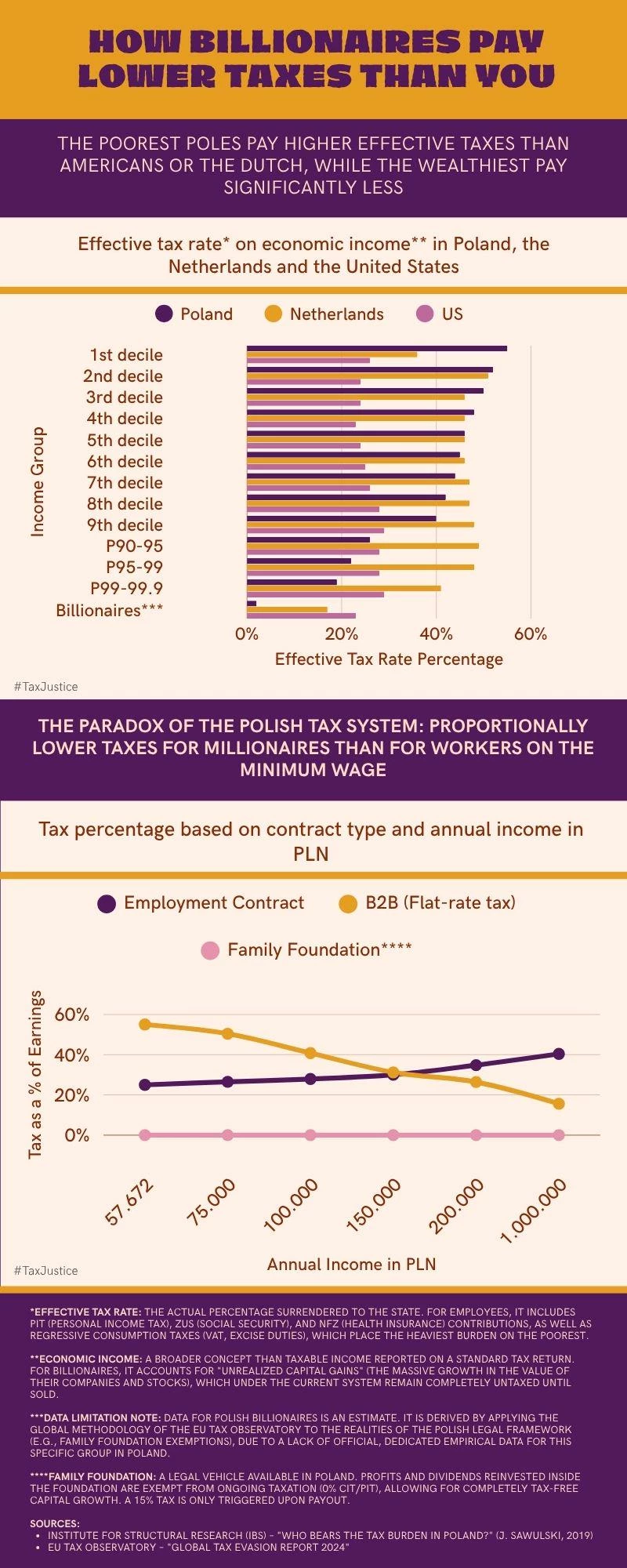
The Polish Tax Paradox: How a system built on heavy labor and consumption taxes allows billionaires to pay an effective rate of <2% compared to ~55% for the poorest citizens.
I put together this infographic mapping out the structural regressivity of the Polish tax system, placing it side-by-side with data from the US and the Netherlands using the EU Tax Observatory's "economic income" methodology.
In Poland, standard employment (*Umowa o pracę*) hits an effective tax ceiling quite early due to flat-rate health and social security caps. However, the real divergence happens at the top: the upper-middle class heavily shifts to B2B flat-rate structures, and the ultra-wealthy utilize the recently introduced **Polish Family Foundation** (*Fundacja rodzinna*). This vehicle allows corporate dividends and capital gains to be reinvested at a 0% immediate tax rate, creating a massive "billionaire cliff."
As a result, the growth of vast economic wealth remains practically untouched by the state, while consumption taxes (VAT/excise) and linear labor contributions extract over half the economic income of the bottom 10%.
*Full sources and data limitations are noted at the bottom of the graphic.*
#local
I put together this infographic mapping out the structural regressivity of the Polish tax system, placing it side-by-side with data from the US and the Netherlands using the EU Tax Observatory's "economic income" methodology.
In Poland, standard employment (*Umowa o pracę*) hits an effective tax ceiling quite early due to flat-rate health and social security caps. However, the real divergence happens at the top: the upper-middle class heavily shifts to B2B flat-rate structures, and the ultra-wealthy utilize the recently introduced **Polish Family Foundation** (*Fundacja rodzinna*). This vehicle allows corporate dividends and capital gains to be reinvested at a 0% immediate tax rate, creating a massive "billionaire cliff."
As a result, the growth of vast economic wealth remains practically untouched by the state, while consumption taxes (VAT/excise) and linear labor contributions extract over half the economic income of the bottom 10%.
*Full sources and data limitations are noted at the bottom of the graphic.*
#local


| 4,000 mlx | |
| 6 | |
| 0 |