
0 reactions
THE PHOENICIANS TOOK THE ALPHABET FROM THE ANCIENT CRETANS….
HERE IS THE PROOF.
In the past, the prevailing theory was that the ancient Greeks received the alphabet from the Phoenicians, who lived on the coasts of Syria-Palestine.
While the exact opposite happened:
The Phoenicians received writing from the Cretan settlers, who in the 13th BC. century they colonized the coasts of Palestine as Philistines, as they are known to us, from the Old Testament.
The ancient historian Diodorus of Sicily mentions in his writings that Dosiades, a writer of epigrams, told him that the letters were invented by the Cretans “Dosiades de en Kriti phisin evrethinai auta grammata" (Becker, E., Diodorus, II 783.14).
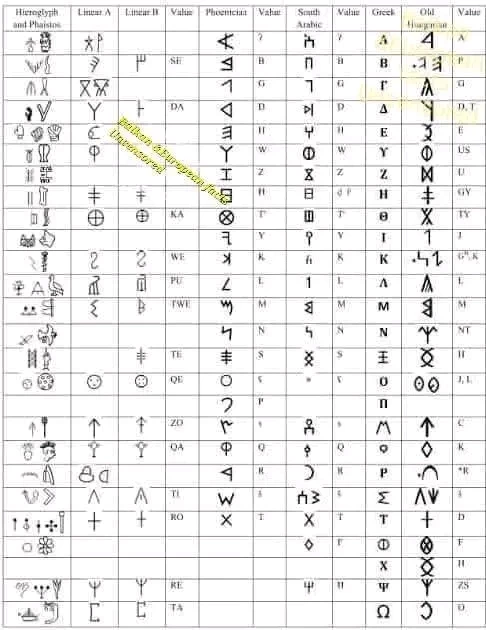
According to a recent study published in international Journal of Applied Mathematics in 2016 that involved bioinformatics (see the link below), the evolutionary tree algorithms revealed that the Cretan Phaistos Disk was based on the glyph correspondences between the symbols of Linears A and B (see picture).
This work interpretation, is by far the most credible and realistic decipherment of the Phaistos Disk to date and has been endorsed by National Geographic as well.Arthur Evans, an English archaeologist, claims: "The Script of Crete is the mother of the Phoenician script."
But, let's take things from the beginning.
In June 1952, the English architect, Michael Ventris, publicly announced that he was able to decipher a hitherto unknown script, the Cretan Mycenaean type B script, in which many tablets from Crete, Mycenae, Pylos etc. are written. and, most importantly, that the language of these signs is Greek.
The importance of Ventris' announcement for science in general (which finally solved the mystery, the mystery of the Linear B tablets), but especially for Greek culture, whose written tradition was transmitted some seven centuries earlier (from 8th century BC to 15th), was of incalculable importance.
The facts of our history changed drastically, since it depends and is determined in time, primarily, by written testimonies.
It was preceded by the research of the English archaeologist Evans, who excavated in Crete.
He had noticed that among the seal stones scattered in the various museums of Europe, those whose origin was known came from Crete.
Thus, he came to the conclusion that Crete was the cradle of this writing. That is why in 1893 he began research in Crete.
Right from the beginning Evans argued that the syllabaries of Linear B' do not express a language of Eastern origin (as was believed before the decipherment), but only Greek.
Evans had even concluded, based on his observations on the evolution of the various syllabaries, that the Phoenicians received the writing from Cretan settlers, who after the 13th BC. century they colonized the coasts of Palestine as Philistines.
▪︎ Thus, Evans came to the conclusion that:
The Script of Crete is the mother of the Phoenician script!..
Around the same time, René Dussault expressed a similar opinion:
"The Phoenicians had early received the alphabet from the Greeks, who had modeled it from the Creto-Mycenaean writing."
The difference is that the Phoenician writing system remained a syllabary, just as they received it from the Greeks, while the Greek normal development resulted in the present-day alphabetic writing system, the first alphabet in the world.
In 1952, the English architect Ventris succeeded in deciphering this B' script with the collaboration of the great Hellenist Chadwick, who has written about it:
"All Greeks must respect this piece of blackened clay, because it par excellence convinced the world that the creators of the Mycenaean civilization were Greeks.
The language they spoke 1,700 years before Christ was born is, with some differences, the same language as the Greek spoken today.
And there is still much we don't know about the beginnings of the Greek language...".
Michael Ventris, who succeeded in deciphering it, was a gifted spirit.
He could easily learn foreign languages, he had a rare combinatory imagination, he was able to distinguish regularities in the variety and in general, as a colleague writes,
"he had the power to distinguish order in the apparent chaos, that is, the gift that characterizes the work of all great men."
That is why he succeeded in solving such a big problem.
Thus, he solved the great question of thousands of scholars of Greek history, who were concerned with the question: "How does it happen that the Greeks with such a high level of culture took the alphabet from the Phoenicians?"
. His death in 1956, at the age of 34 in a car accident, left many questions, which remain unanswered to this day.
Thanks to Ventris, it has been proven that Greek, the oldest language spoken and written today on the European continent, is impressively older than was thought at the beginning of the 20th century. The Greek and Proto-Hellenic races possessed various writing systems.
This became known from the clay tablets that the "archives" of the Greek land preserved for millennia and came to light during the 20th century, "stone letter of the all-true earth".
These written monuments show a normal development:
Early pictorial stage (hieroglyphic), syllabic, finally photographic.
Two of these systems, the Cypriot syllabary and Linear B', have already been deciphered and clearly express the Greek language in unbroken unity
All these historical, genetic, and bioinformatics data show that there is a growing body of evidence that from the island of Crete have been evolved the first forms of alphabets.
HERE IS THE PROOF.
In the past, the prevailing theory was that the ancient Greeks received the alphabet from the Phoenicians, who lived on the coasts of Syria-Palestine.
While the exact opposite happened:
The Phoenicians received writing from the Cretan settlers, who in the 13th BC. century they colonized the coasts of Palestine as Philistines, as they are known to us, from the Old Testament.
The ancient historian Diodorus of Sicily mentions in his writings that Dosiades, a writer of epigrams, told him that the letters were invented by the Cretans “Dosiades de en Kriti phisin evrethinai auta grammata" (Becker, E., Diodorus, II 783.14).
According to a recent study published in international Journal of Applied Mathematics in 2016 that involved bioinformatics (see the link below), the evolutionary tree algorithms revealed that the Cretan Phaistos Disk was based on the glyph correspondences between the symbols of Linears A and B (see picture).
This work interpretation, is by far the most credible and realistic decipherment of the Phaistos Disk to date and has been endorsed by National Geographic as well.Arthur Evans, an English archaeologist, claims: "The Script of Crete is the mother of the Phoenician script."
But, let's take things from the beginning.
In June 1952, the English architect, Michael Ventris, publicly announced that he was able to decipher a hitherto unknown script, the Cretan Mycenaean type B script, in which many tablets from Crete, Mycenae, Pylos etc. are written. and, most importantly, that the language of these signs is Greek.
The importance of Ventris' announcement for science in general (which finally solved the mystery, the mystery of the Linear B tablets), but especially for Greek culture, whose written tradition was transmitted some seven centuries earlier (from 8th century BC to 15th), was of incalculable importance.
The facts of our history changed drastically, since it depends and is determined in time, primarily, by written testimonies.
It was preceded by the research of the English archaeologist Evans, who excavated in Crete.
He had noticed that among the seal stones scattered in the various museums of Europe, those whose origin was known came from Crete.
Thus, he came to the conclusion that Crete was the cradle of this writing. That is why in 1893 he began research in Crete.
Right from the beginning Evans argued that the syllabaries of Linear B' do not express a language of Eastern origin (as was believed before the decipherment), but only Greek.
Evans had even concluded, based on his observations on the evolution of the various syllabaries, that the Phoenicians received the writing from Cretan settlers, who after the 13th BC. century they colonized the coasts of Palestine as Philistines.
▪︎ Thus, Evans came to the conclusion that:
The Script of Crete is the mother of the Phoenician script!..
Around the same time, René Dussault expressed a similar opinion:
"The Phoenicians had early received the alphabet from the Greeks, who had modeled it from the Creto-Mycenaean writing."
The difference is that the Phoenician writing system remained a syllabary, just as they received it from the Greeks, while the Greek normal development resulted in the present-day alphabetic writing system, the first alphabet in the world.
In 1952, the English architect Ventris succeeded in deciphering this B' script with the collaboration of the great Hellenist Chadwick, who has written about it:
"All Greeks must respect this piece of blackened clay, because it par excellence convinced the world that the creators of the Mycenaean civilization were Greeks.
The language they spoke 1,700 years before Christ was born is, with some differences, the same language as the Greek spoken today.
And there is still much we don't know about the beginnings of the Greek language...".
Michael Ventris, who succeeded in deciphering it, was a gifted spirit.
He could easily learn foreign languages, he had a rare combinatory imagination, he was able to distinguish regularities in the variety and in general, as a colleague writes,
"he had the power to distinguish order in the apparent chaos, that is, the gift that characterizes the work of all great men."
That is why he succeeded in solving such a big problem.
Thus, he solved the great question of thousands of scholars of Greek history, who were concerned with the question: "How does it happen that the Greeks with such a high level of culture took the alphabet from the Phoenicians?"
. His death in 1956, at the age of 34 in a car accident, left many questions, which remain unanswered to this day.
Thanks to Ventris, it has been proven that Greek, the oldest language spoken and written today on the European continent, is impressively older than was thought at the beginning of the 20th century. The Greek and Proto-Hellenic races possessed various writing systems.
This became known from the clay tablets that the "archives" of the Greek land preserved for millennia and came to light during the 20th century, "stone letter of the all-true earth".
These written monuments show a normal development:
Early pictorial stage (hieroglyphic), syllabic, finally photographic.
Two of these systems, the Cypriot syllabary and Linear B', have already been deciphered and clearly express the Greek language in unbroken unity
All these historical, genetic, and bioinformatics data show that there is a growing body of evidence that from the island of Crete have been evolved the first forms of alphabets.


| 8,000 mlx | |
| 8 | |
| 0 |