

25 reactions
The Mary Rose was a carrack in the English Tudor navy of King Henry VIII . She was launched in 1511 and served for 33 years in several wars against France, Scotland and Brittany. After being substantially rebuilt in 1536, she saw her last action on 19 July, 1545. She led the attack on the galleys of a French invasion fleet but sank in the Solent , the strait north of the Isle of Wight .
The wreck of the Mary Rose was located in 1971 and was raised on 11 October 1982 by the Mary Rose Trust in one of the most complex and expensive maritime salvage projects in history. The surviving section of the ship and thousands of recovered artefacts are of great value as a Tudor period time capsule. The excavation and raising of the Mary Rose was a milestone in the field of maritime archaeology, comparable in complexity and cost to the raising of the 17th-century Swedish warship Vasa in 1961. The Mary Rose site is designated under the Protection of Wrecks Act 1973 by statutory instrument 1974/55. The wreck is a Protected Wreck managed by Historic England.
The finds include weapons, sailing equipment, naval supplies and a wide array of objects used by the crew. Many of the artefacts are unique to the Mary Rose and have provided insights into topics ranging from naval warfare to the history of musical instruments. The remains of the hull have been on display at the Portsmouth Historic Dockyard since the mid-1980s while undergoing restoration. An extensive collection of well-preserved artefacts is on display at the Mary Rose Museum , built to display the remains of the ship and its artefacts.
Mary Rose was one of the largest ships in the English navy through more than three decades of intermittent war and she was one of the earliest examples of a purpose-built sailing warship. She was armed with new types of heavy guns that could fire through the recently invented gun-ports. She was substantially rebuilt in 1536 and was also one of the earliest ships that could fire a broadside , although the line of battle tactics had not yet been developed. Several theories have sought to explain the demise of the Mary Rose , based on historical records, knowledge of 16th-century shipbuilding and modern experiments. The precise cause of her sinking is subject to conflicting testimonies and a lack of conclusive evidence...
Since the mid-1980s, the hull of the Mary Rose has been kept in a covered dry dock while undergoing conservation. Although the hull has been open to the public for viewing, the need for keeping the ship saturated first with water and later a polyethylene glycol (PEG) solution meant that, before 2013, visitors were separated from the hull by a glass barrier. By 2007, the specially built ship hall had been visited by over seven million visitors since it first opened on 4 October 1983, just under a year after it was successfully raised.
A separate Mary Rose Museum was housed in a structure called No. 5 Boathouse near the ship hall and was opened to the public on 9 July 1984, containing displays explaining the history of the ship and a small number of conserved artefacts, from entire bronze cannons to household items. In September 2009 the temporary Mary Rose display hall was closed to visitors to facilitate construction of the new £35 million museum building, which opened to the public on 31 May 2013. - more at Wikipedia .
For visitors: https://maryrose.org/
#iwasthere in the late 1980s/early 1990s. Fascinating to see the remains of the hull but, for me, to see the artifacts recovered from the wreck.
IMAGES:
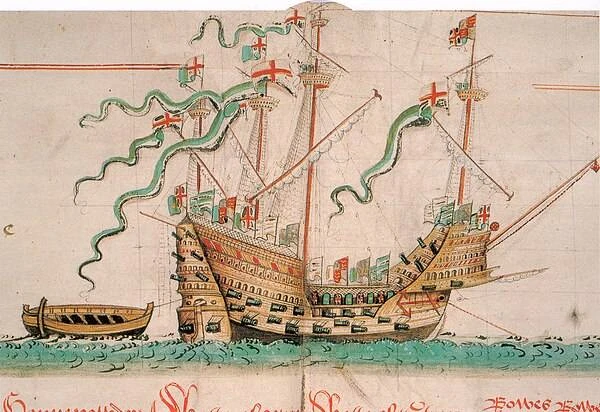
• The Mary Rose as depicted in the Anthony Roll . It has the distinct carrack profile with high "castles" fore and aft. Although the number of guns and gun ports is not exact, it is an overall accurate illustration of the ship as it appeared in the 1540s.
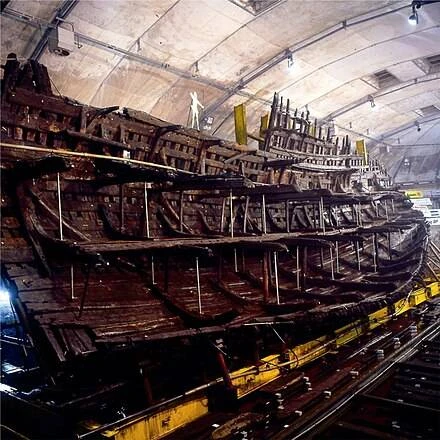
• The remains of the Mary Rose 's hull. All deck levels can be made out clearly, including the minor remnants of the sterncastle deck.
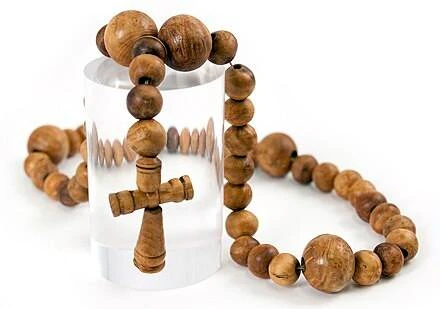
• One of the many rosaries found on the Mary Rose that once belonged to one of the lower-ranking crew members.
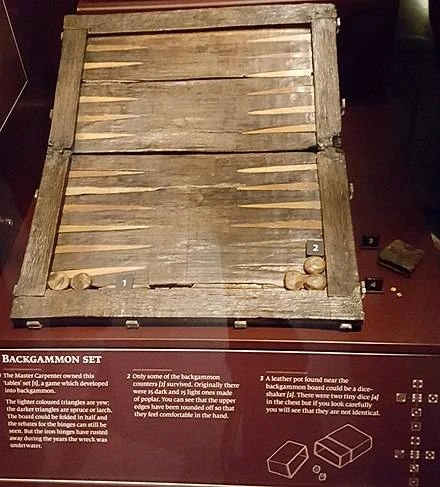
• A Ludus Anglicorum set (a predecessor of modern backgammon), owned by the master carpenter.
The wreck of the Mary Rose was located in 1971 and was raised on 11 October 1982 by the Mary Rose Trust in one of the most complex and expensive maritime salvage projects in history. The surviving section of the ship and thousands of recovered artefacts are of great value as a Tudor period time capsule. The excavation and raising of the Mary Rose was a milestone in the field of maritime archaeology, comparable in complexity and cost to the raising of the 17th-century Swedish warship Vasa in 1961. The Mary Rose site is designated under the Protection of Wrecks Act 1973 by statutory instrument 1974/55. The wreck is a Protected Wreck managed by Historic England.
The finds include weapons, sailing equipment, naval supplies and a wide array of objects used by the crew. Many of the artefacts are unique to the Mary Rose and have provided insights into topics ranging from naval warfare to the history of musical instruments. The remains of the hull have been on display at the Portsmouth Historic Dockyard since the mid-1980s while undergoing restoration. An extensive collection of well-preserved artefacts is on display at the Mary Rose Museum , built to display the remains of the ship and its artefacts.
Mary Rose was one of the largest ships in the English navy through more than three decades of intermittent war and she was one of the earliest examples of a purpose-built sailing warship. She was armed with new types of heavy guns that could fire through the recently invented gun-ports. She was substantially rebuilt in 1536 and was also one of the earliest ships that could fire a broadside , although the line of battle tactics had not yet been developed. Several theories have sought to explain the demise of the Mary Rose , based on historical records, knowledge of 16th-century shipbuilding and modern experiments. The precise cause of her sinking is subject to conflicting testimonies and a lack of conclusive evidence...
Since the mid-1980s, the hull of the Mary Rose has been kept in a covered dry dock while undergoing conservation. Although the hull has been open to the public for viewing, the need for keeping the ship saturated first with water and later a polyethylene glycol (PEG) solution meant that, before 2013, visitors were separated from the hull by a glass barrier. By 2007, the specially built ship hall had been visited by over seven million visitors since it first opened on 4 October 1983, just under a year after it was successfully raised.
A separate Mary Rose Museum was housed in a structure called No. 5 Boathouse near the ship hall and was opened to the public on 9 July 1984, containing displays explaining the history of the ship and a small number of conserved artefacts, from entire bronze cannons to household items. In September 2009 the temporary Mary Rose display hall was closed to visitors to facilitate construction of the new £35 million museum building, which opened to the public on 31 May 2013. - more at Wikipedia .
For visitors: https://maryrose.org/
#iwasthere in the late 1980s/early 1990s. Fascinating to see the remains of the hull but, for me, to see the artifacts recovered from the wreck.
IMAGES:
• The Mary Rose as depicted in the Anthony Roll . It has the distinct carrack profile with high "castles" fore and aft. Although the number of guns and gun ports is not exact, it is an overall accurate illustration of the ship as it appeared in the 1540s.
• The remains of the Mary Rose 's hull. All deck levels can be made out clearly, including the minor remnants of the sterncastle deck.
• One of the many rosaries found on the Mary Rose that once belonged to one of the lower-ranking crew members.
• A Ludus Anglicorum set (a predecessor of modern backgammon), owned by the master carpenter.


11

3

3

1

1
| 79,000 mlx | |
| 102 | |
| 25 |