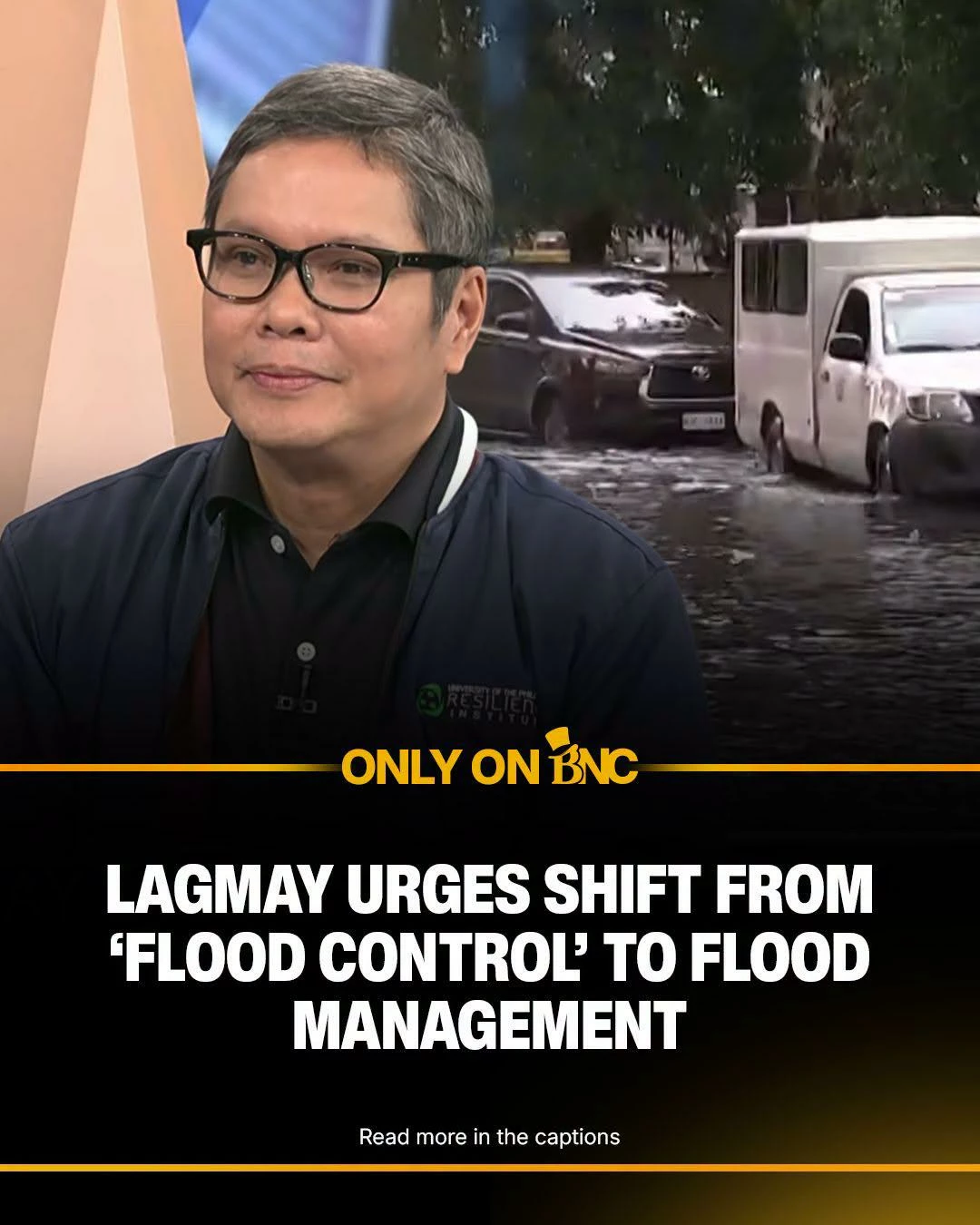
Lagmay urges shift from ‘flood control’ to flood…
0 reactions
Lagmay urges shift from ‘flood control’ to flood management - Bilyonaryo News Channel
**Full Interview at Bilyonaryo News Channel** https://www.youtube.com/watch?v=dfCZRZdIM4A
The Philippines needs to look beyond dikes and other concrete structures in managing floods, Project NOAH Executive Director Mahar Lagmay said, pointing to watershed management, water storage, river management, nature-based measures and other interventions.
“We can probably use technologies – better technologies – to become smarter in the way we manage floods, not control floods,” Lagmay said on BNC’s “Business 360.”
“Because if we say flood control, we’re mistaken. Because we can never tame nature. We can never be better than nature.”
“We can manage floods.”
Lagmay said the Philippines must account for its natural conditions when planning how to manage floods.
“Well, because we’re in the typhoon belt. We have to live with the natural lay of the land, with the conditions that the Philippines is suffering not just now – or has suffered not just now – but a long, long time ago.”
Lagmay said he, CP David and Academician Glenn Tabios are members of an advisory committee to the Department of Public Works and Highways (DPWH).
“Your guests yesterday were CP David and Academician Glenn Tabios. We are three in the advisory committee of DPWH.”
He said the DPWH secretary regularly consults the group as officials consider alternatives to dike construction.
“The Secretary consults us all the time. And we’re trying to bring in other solutions besides the construction of dikes.”
Among the measures Lagmay cited are watershed management, forest restoration and river water management.
“We can do watershed management. We can restore the forest. We can do river water management.”
He also said water pathways need to be considered in development.
“We should ensure that the conveyance of water is properly addressed. We don’t build on top of creeks and streams. We’ve been building subdivisions all over without consideration of the presence of these pathways of water when there’s heavy rain.”
Other possible measures include mini-dams, water storage, retention basins, nature-based solutions and stormwater management.
“We can do structural control. We can build a lot of mini-dams. We can do storage. We can do retention basins. There are a lot of nature-based solutions. There is what we call stormwater management.”
Lagmay also cited dredging in specific scientifically approved areas and pumping stations where they are needed.
“All of this dredging that needs to be done in specific areas that are scientifically approved. Pumping stations where they matter.”
Infrastructure can also be designed to reduce vulnerability in places that regularly flood, he said.
“And, of course, we should build, like, for example, resilient structures to reduce vulnerability.”
“If we know that that place gets flooded all the time, maybe we should address it by making designs of houses in a better way, with stilts or whatever.”
Lagmay said these measures can be used before additional protection measures such as dikes are built.
“And after investing in all of those, we have what we call residual risk, where we have lowered the water levels already. And that is the time we build all of these protection measures like dikes, which become more effective because the water level has already been reduced.”
He said the DPWH has been receptive to considering measures beyond concrete.
“Yes, for the first time. For the first time, I believe that DPWH is very responsive.”
“There are many interventions possible that are less costly. All of these things that I’ve mentioned – I can mention probably 20 or more. And we invest in them.”
He said science should be used to determine whether an infrastructure project or other intervention will work before money is spent.
“And we use science as well to determine whether a certain type of infrastructure or intervention will work or not, even before we spend money on them.”
For immediate flood threats, Lagmay said the priority should be moving people away from danger.
“The short-term solutions would be to move people out of harm’s way.”
“We can forecast well – we have improved our forecasting.”
Over the longer term, he said nature-based measures can contribute to flood management.
“All of these interventions – like nature-based solutions, planting trees, not destroying forests, restoring the ecosystem – all of these contribute to flood management.”
Lagmay also said water can be stored during periods of heavy rainfall and used during drought.
“And if we are able to manage it well – not think of water as our enemy, but our friend – we can store the water when it’s raining and then use it when there is drought.”
He also defended the concept of resilience as part of planning for adversity and continuity.
“No, that’s wrong. Because we should not demonize the word resilience.”
“But there’s another meaning of resilience, which is about building back better, which is about trying to resist adversity, trying to be able to adapt to a lot of changes in the environment, and be able to have business continuity. That is resilience, which is actually good planning and smart planning.”
Source: **Bilyonaryo News Channel** https://bnc.bilyonaryo.com/lagmay-urges-shift-from-flood-control-to-flood-management/business/
#current_events #local
**Full Interview at Bilyonaryo News Channel** https://www.youtube.com/watch?v=dfCZRZdIM4A
The Philippines needs to look beyond dikes and other concrete structures in managing floods, Project NOAH Executive Director Mahar Lagmay said, pointing to watershed management, water storage, river management, nature-based measures and other interventions.
“We can probably use technologies – better technologies – to become smarter in the way we manage floods, not control floods,” Lagmay said on BNC’s “Business 360.”
“Because if we say flood control, we’re mistaken. Because we can never tame nature. We can never be better than nature.”
“We can manage floods.”
Lagmay said the Philippines must account for its natural conditions when planning how to manage floods.
“Well, because we’re in the typhoon belt. We have to live with the natural lay of the land, with the conditions that the Philippines is suffering not just now – or has suffered not just now – but a long, long time ago.”
Lagmay said he, CP David and Academician Glenn Tabios are members of an advisory committee to the Department of Public Works and Highways (DPWH).
“Your guests yesterday were CP David and Academician Glenn Tabios. We are three in the advisory committee of DPWH.”
He said the DPWH secretary regularly consults the group as officials consider alternatives to dike construction.
“The Secretary consults us all the time. And we’re trying to bring in other solutions besides the construction of dikes.”
Among the measures Lagmay cited are watershed management, forest restoration and river water management.
“We can do watershed management. We can restore the forest. We can do river water management.”
He also said water pathways need to be considered in development.
“We should ensure that the conveyance of water is properly addressed. We don’t build on top of creeks and streams. We’ve been building subdivisions all over without consideration of the presence of these pathways of water when there’s heavy rain.”
Other possible measures include mini-dams, water storage, retention basins, nature-based solutions and stormwater management.
“We can do structural control. We can build a lot of mini-dams. We can do storage. We can do retention basins. There are a lot of nature-based solutions. There is what we call stormwater management.”
Lagmay also cited dredging in specific scientifically approved areas and pumping stations where they are needed.
“All of this dredging that needs to be done in specific areas that are scientifically approved. Pumping stations where they matter.”
Infrastructure can also be designed to reduce vulnerability in places that regularly flood, he said.
“And, of course, we should build, like, for example, resilient structures to reduce vulnerability.”
“If we know that that place gets flooded all the time, maybe we should address it by making designs of houses in a better way, with stilts or whatever.”
Lagmay said these measures can be used before additional protection measures such as dikes are built.
“And after investing in all of those, we have what we call residual risk, where we have lowered the water levels already. And that is the time we build all of these protection measures like dikes, which become more effective because the water level has already been reduced.”
He said the DPWH has been receptive to considering measures beyond concrete.
“Yes, for the first time. For the first time, I believe that DPWH is very responsive.”
“There are many interventions possible that are less costly. All of these things that I’ve mentioned – I can mention probably 20 or more. And we invest in them.”
He said science should be used to determine whether an infrastructure project or other intervention will work before money is spent.
“And we use science as well to determine whether a certain type of infrastructure or intervention will work or not, even before we spend money on them.”
For immediate flood threats, Lagmay said the priority should be moving people away from danger.
“The short-term solutions would be to move people out of harm’s way.”
“We can forecast well – we have improved our forecasting.”
Over the longer term, he said nature-based measures can contribute to flood management.
“All of these interventions – like nature-based solutions, planting trees, not destroying forests, restoring the ecosystem – all of these contribute to flood management.”
Lagmay also said water can be stored during periods of heavy rainfall and used during drought.
“And if we are able to manage it well – not think of water as our enemy, but our friend – we can store the water when it’s raining and then use it when there is drought.”
He also defended the concept of resilience as part of planning for adversity and continuity.
“No, that’s wrong. Because we should not demonize the word resilience.”
“But there’s another meaning of resilience, which is about building back better, which is about trying to resist adversity, trying to be able to adapt to a lot of changes in the environment, and be able to have business continuity. That is resilience, which is actually good planning and smart planning.”
Source: **Bilyonaryo News Channel** https://bnc.bilyonaryo.com/lagmay-urges-shift-from-flood-control-to-flood-management/business/
#current_events #local


| 1,000 mlx | |
| 2 | |
| 0 |