
4 reactions
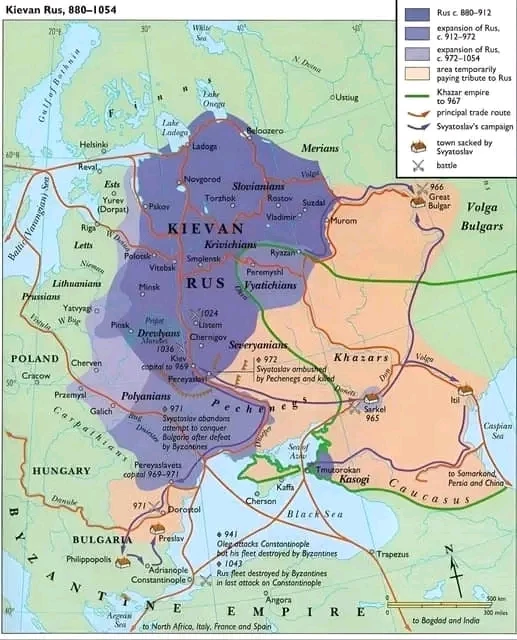
Expansion of the Kyievan Rus 880 - 1054.
The Kyievan Rus' was founded by Norse Vikings, known as the Varangians, who traveled along the river routes of Eastern Europe, blending their Scandinavian roots with Slavic cultures to establish a powerful medieval state centered in Kyiv.
* Origins and Foundation (c. 880)
The traditional founding of the Kyievan Rus' is often dated to around 882 (close to your 880 starting point), when the Varangian prince Oleg of Novgorod captured Kyiv. According to the *Primary Chronicle* (a key historical source compiled by the monk Nestor in the early 12th century), Oleg moved his base from Novgorod, a northern trading hub, to Kyiv, declaring it "the mother of Rus' cities." This marked the unification of the northern and southern Slavic territories under a single ruler, laying the foundation for the Kyievan Rus'. The Varangians, led by figures like Oleg and his predecessor Rurik (who founded the Rurikid dynasty), brought organizational skills, trade networks, and military prowess, blending these with the local Slavic population.
* Early Expansion (880–912)
From 880 to Oleg’s death in 912, the Kyievan Rus' began consolidating control over key trade routes, especially the "Route from the Varangians to the Greeks," which connected the Baltic Sea to the Black Sea and the Byzantine Empire. Oleg subdued neighboring East Slavic tribes, such as the Drevlians, Severians, and Radimichians, extracting tribute and incorporating them into the growing state. His reign also saw military campaigns against the Khazars and a famous expedition against Constantinople (Byzantium) in 907, resulting in a favorable trade treaty with the Byzantine Empire in 911. This early expansion established Kyiv as a thriving economic and political hub.
* Growth Under Igor and Olga (912–964)
Oleg’s successor, Igor (reigned 912–945), continued expanding the Rus' influence, though with mixed success. He maintained pressure on the tribes and launched raids against Byzantium (941 and 944), securing another trade agreement. However, his reign ended with his murder by the Drevlians during a tribute collection gone wrong. His widow, Olga (reigned as regent 945–964 for their son Sviatoslav), consolidated power, avenged Igor’s death by crushing the Drevlians, and centralized authority. Olga’s visit to Constantinople in 957 and her conversion to Christianity (though not yet widespread in Rus') laid cultural groundwork for later developments.
* Territorial Peak Under Sviatoslav (964–972)
Sviatoslav I (reigned 964–972), Igor and Olga’s son, was a warrior-prince whose campaigns significantly expanded the Kyievan Rus'. He destroyed the Khazar Khaganate (c. 965–969), a major power in the steppe region, gaining control over parts of the Volga trade route. He also campaigned against the Bulgars on the Danube and clashed with Byzantium, briefly occupying territory in the Balkans. While Sviatoslav’s conquests stretched the Rus' borders, his focus on military campaigns left Kyiv vulnerable, and he died in an ambush by the Pechenegs in 972, leading to a period of instability.
* Golden Age Under Vladimir the Great (980–1015)
After a succession struggle, Vladimir I (reigned 980–1015), Sviatoslav’s son, emerged as ruler and ushered in a golden age. He expanded the Rus' through military campaigns and diplomacy, subduing tribes like the Vyatichi and Radimichians and securing the western borders against the Poles. Vladimir’s most enduring legacy was his conversion to Christianity in 988, following his baptism and marriage to a Byzantine princess, Anna. He Christianized the Rus', aligning it culturally and politically with Byzantium. This period saw Kyiv grow into a major city, with monumental architecture like the Church of the Tithes, and the Rus' territory stretched from the Baltic to the Black Sea, encompassing modern-day Ukraine, Belarus, and parts of Russia.
* Yaroslav the Wise and Peak Prosperity (1019–1054)
Vladimir’s son, Yaroslav the Wise (reigned 1019–1054), brought the Kyievan Rus' to its cultural and territorial zenith. After another succession war, he solidified control and expanded influence through dynastic marriages, linking the Rus' to European royal houses (e.g., his daughter Anna married the King of France). Yaroslav defeated the Pechenegs in 1036, ending their threat, and oversaw the construction of Kyiv’s Saint Sophia Cathedral, a symbol of the state’s wealth and sophistication. By 1054, the Kyievan Rus' spanned a vast area, from Novgorod in the north to the Black Sea coast in the south, and from the Carpathians in the west to the upper Volga in the east.
The Kyievan Rus' was founded by Norse Vikings, known as the Varangians, who traveled along the river routes of Eastern Europe, blending their Scandinavian roots with Slavic cultures to establish a powerful medieval state centered in Kyiv.
* Origins and Foundation (c. 880)
The traditional founding of the Kyievan Rus' is often dated to around 882 (close to your 880 starting point), when the Varangian prince Oleg of Novgorod captured Kyiv. According to the *Primary Chronicle* (a key historical source compiled by the monk Nestor in the early 12th century), Oleg moved his base from Novgorod, a northern trading hub, to Kyiv, declaring it "the mother of Rus' cities." This marked the unification of the northern and southern Slavic territories under a single ruler, laying the foundation for the Kyievan Rus'. The Varangians, led by figures like Oleg and his predecessor Rurik (who founded the Rurikid dynasty), brought organizational skills, trade networks, and military prowess, blending these with the local Slavic population.
* Early Expansion (880–912)
From 880 to Oleg’s death in 912, the Kyievan Rus' began consolidating control over key trade routes, especially the "Route from the Varangians to the Greeks," which connected the Baltic Sea to the Black Sea and the Byzantine Empire. Oleg subdued neighboring East Slavic tribes, such as the Drevlians, Severians, and Radimichians, extracting tribute and incorporating them into the growing state. His reign also saw military campaigns against the Khazars and a famous expedition against Constantinople (Byzantium) in 907, resulting in a favorable trade treaty with the Byzantine Empire in 911. This early expansion established Kyiv as a thriving economic and political hub.
* Growth Under Igor and Olga (912–964)
Oleg’s successor, Igor (reigned 912–945), continued expanding the Rus' influence, though with mixed success. He maintained pressure on the tribes and launched raids against Byzantium (941 and 944), securing another trade agreement. However, his reign ended with his murder by the Drevlians during a tribute collection gone wrong. His widow, Olga (reigned as regent 945–964 for their son Sviatoslav), consolidated power, avenged Igor’s death by crushing the Drevlians, and centralized authority. Olga’s visit to Constantinople in 957 and her conversion to Christianity (though not yet widespread in Rus') laid cultural groundwork for later developments.
* Territorial Peak Under Sviatoslav (964–972)
Sviatoslav I (reigned 964–972), Igor and Olga’s son, was a warrior-prince whose campaigns significantly expanded the Kyievan Rus'. He destroyed the Khazar Khaganate (c. 965–969), a major power in the steppe region, gaining control over parts of the Volga trade route. He also campaigned against the Bulgars on the Danube and clashed with Byzantium, briefly occupying territory in the Balkans. While Sviatoslav’s conquests stretched the Rus' borders, his focus on military campaigns left Kyiv vulnerable, and he died in an ambush by the Pechenegs in 972, leading to a period of instability.
* Golden Age Under Vladimir the Great (980–1015)
After a succession struggle, Vladimir I (reigned 980–1015), Sviatoslav’s son, emerged as ruler and ushered in a golden age. He expanded the Rus' through military campaigns and diplomacy, subduing tribes like the Vyatichi and Radimichians and securing the western borders against the Poles. Vladimir’s most enduring legacy was his conversion to Christianity in 988, following his baptism and marriage to a Byzantine princess, Anna. He Christianized the Rus', aligning it culturally and politically with Byzantium. This period saw Kyiv grow into a major city, with monumental architecture like the Church of the Tithes, and the Rus' territory stretched from the Baltic to the Black Sea, encompassing modern-day Ukraine, Belarus, and parts of Russia.
* Yaroslav the Wise and Peak Prosperity (1019–1054)
Vladimir’s son, Yaroslav the Wise (reigned 1019–1054), brought the Kyievan Rus' to its cultural and territorial zenith. After another succession war, he solidified control and expanded influence through dynastic marriages, linking the Rus' to European royal houses (e.g., his daughter Anna married the King of France). Yaroslav defeated the Pechenegs in 1036, ending their threat, and oversaw the construction of Kyiv’s Saint Sophia Cathedral, a symbol of the state’s wealth and sophistication. By 1054, the Kyievan Rus' spanned a vast area, from Novgorod in the north to the Black Sea coast in the south, and from the Carpathians in the west to the upper Volga in the east.


| 7,000 mlx | |
| 6 | |
| 4 |