#FlowerChallenge Lilium Lilium is a genus of herbaceous…
12 reactions
#FlowerChallenge
Lilium
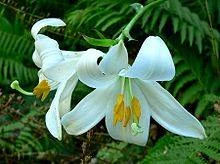
Lilium is a genus of herbaceous flowering plants growing from bulbs, all with large prominent flowers. They are the true lilies . Lilies are a group of flowering plants which are important in culture and literature in much of the world. Most species are native to the Northern Hemisphere and their range is temperate climates and extends into the subtropics . Many other plants have "lily" in their common names , but do not belong to the same genus and are therefore not true lilies.
Lilies are tall perennials ranging in height from 2–6 ft (60–180 cm). They form naked or tunicless scaly underground bulbs which are their organs of perennation . In some North American species the base of the bulb develops into rhizomes , on which numerous small bulbs are found. Some species develop stolons . Most bulbs are buried deep in the ground, but a few species form bulbs near the soil surface. Many species form stem-roots. With these, the bulb grows naturally at some depth in the soil, and each year the new stem puts out adventitious roots above the bulb as it emerges from the soil. These roots are in addition to the basal roots that develop at the base of the bulb, a number of species also produce contractile roots that move the bulbs deeper into the soil.
Lily, petal
The flowers are large, often fragrant, and come in a wide range of colors including whites, yellows, oranges, pinks, reds and purples. Markings include spots and brush strokes. The plants are late spring- or summer-flowering. Flowers are borne
in racemes or umbels at the tip of the stem, with six tepals spreading or reflexed, to give flowers varying from funnel shape to a "Turk's cap". The tepals are free from each other, and bear a nectary at the base of each flower. The ovary is 'superior', borne above the point of attachment of the anthers . The fruit is a three-celled capsule.
Seeds ripen in late summer. They exhibit varying and sometimes complex germination patterns, many adapted to cool temperate climates.
Most cool temperate species are deciduous and dormant in winter in their native environment. But a few species native to areas with hot summers and mild winters ( Lilium candidum , Lilium catesbaei , Lilium longiflorum ) lose their leaves and enter a short dormant period in summer or autumn, sprout from autumn to winter, forming dwarf stems bearing a basal rosette of leaves until, after they have received sufficient chilling, the stem begins to elongate in warming weather.
Lilium candidum seeds
The basic chromosome number is twelve (n=12)
Lilium
Lilium is a genus of herbaceous flowering plants growing from bulbs, all with large prominent flowers. They are the true lilies . Lilies are a group of flowering plants which are important in culture and literature in much of the world. Most species are native to the Northern Hemisphere and their range is temperate climates and extends into the subtropics . Many other plants have "lily" in their common names , but do not belong to the same genus and are therefore not true lilies.
Lilies are tall perennials ranging in height from 2–6 ft (60–180 cm). They form naked or tunicless scaly underground bulbs which are their organs of perennation . In some North American species the base of the bulb develops into rhizomes , on which numerous small bulbs are found. Some species develop stolons . Most bulbs are buried deep in the ground, but a few species form bulbs near the soil surface. Many species form stem-roots. With these, the bulb grows naturally at some depth in the soil, and each year the new stem puts out adventitious roots above the bulb as it emerges from the soil. These roots are in addition to the basal roots that develop at the base of the bulb, a number of species also produce contractile roots that move the bulbs deeper into the soil.
Lily, petal
The flowers are large, often fragrant, and come in a wide range of colors including whites, yellows, oranges, pinks, reds and purples. Markings include spots and brush strokes. The plants are late spring- or summer-flowering. Flowers are borne
in racemes or umbels at the tip of the stem, with six tepals spreading or reflexed, to give flowers varying from funnel shape to a "Turk's cap". The tepals are free from each other, and bear a nectary at the base of each flower. The ovary is 'superior', borne above the point of attachment of the anthers . The fruit is a three-celled capsule.
Seeds ripen in late summer. They exhibit varying and sometimes complex germination patterns, many adapted to cool temperate climates.
Most cool temperate species are deciduous and dormant in winter in their native environment. But a few species native to areas with hot summers and mild winters ( Lilium candidum , Lilium catesbaei , Lilium longiflorum ) lose their leaves and enter a short dormant period in summer or autumn, sprout from autumn to winter, forming dwarf stems bearing a basal rosette of leaves until, after they have received sufficient chilling, the stem begins to elongate in warming weather.
Lilium candidum seeds
The basic chromosome number is twelve (n=12)


5

1

1

1

1
| 39,000 mlx | |
| 78 | |
| 12 |