
5 reactions
How the Earth and moon formed, explained
The Earth formed over 4.6 billion years ago out of a mixture of dust and gas around the young sun. It grew larger thanks to countless collisions between dust particles, asteroids, and other growing planets, including one last giant impact that threw enough rock, gas, and dust into space to form the moon.
Although the rocks that record the earliest parts of Earth’s history have been destroyed or deformed by more than four billion years of geology, scientists can use modern rocks, moon samples and meteorites to figure out when and how the Earth and moon formed, and what they might once have looked like.
Jump to a section:
How did the Earth and moon form?
How and when did the early Earth form?
How did the moon form?
When did the moon form?
What did the early Earth look like?
What did the early moon look like?
What questions remain?
How did the Earth and moon form?
The Earth, like all the other planets in the solar system, started out its life as a disc of dust and gas orbiting the young Sun. The dust particles were brought together by the forces of drag to form clumps of rock that grew into “planetesimals” tens to hundreds of miles across, and then to Mars-sized “protoplanets” by colliding with each other.
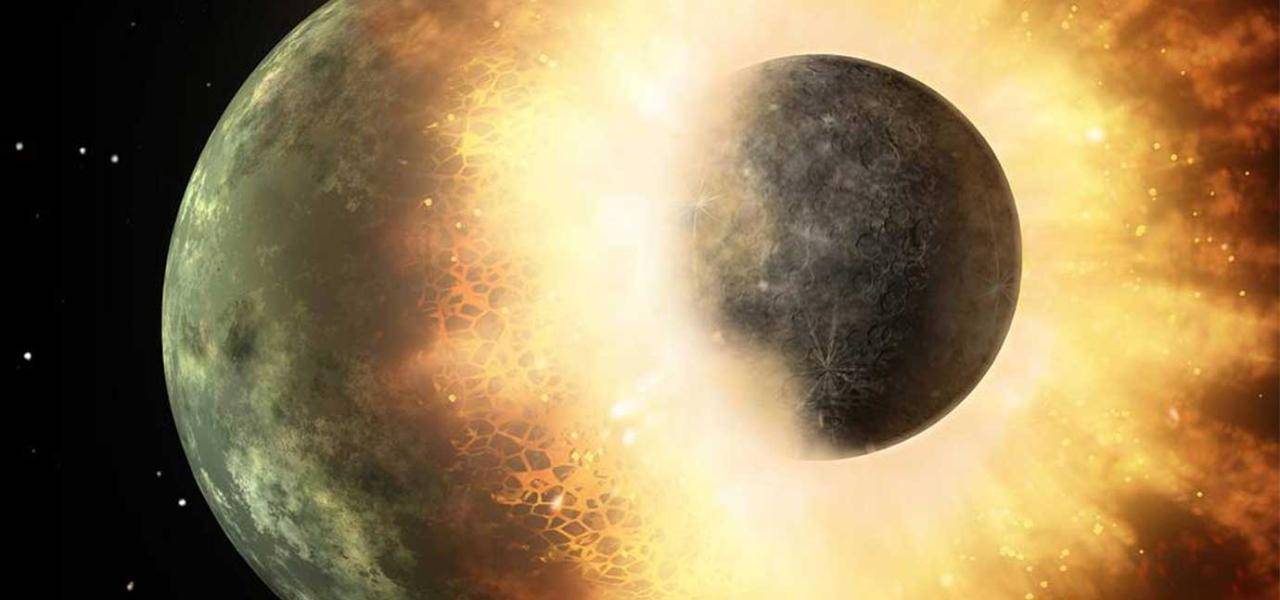
Earth grew to its final size through one last major collision with another Mars-sized object. This last collision, also known as the “moon-forming impact”, was so large that—in addition to adding lots of material to the Earth—there was enough energy to vaporize some of the rock and metal from both the proto-Earth and the impacting object. This vapor formed a disc around the Earth that eventually cooled and clumped together to become the moon.
We know this thanks to rigorous studies of meteorites and rock samples, including at the University of Chicago, in the 20th and 21st centuries.
Understanding how the Earth and moon formed is important for piecing together the history of the solar system and answering questions like how long planets take to form, what planets are made of, and what makes a planet suitable for life. This also guides planetary scientists in their search for other habitable (or inhabited!) worlds in our solar system and beyond!
This artist's concept shows a very young star encircled by a disk of gas and dust, the raw materials from which rocky planets such as Earth are thought to form.
Image courtesy of NASA/JPL-Caltech
How and when did the early Earth form?
Scientists now think the Earth’s story began around 4.6 billion years ago in a disk-shaped cloud of dust and gas rotating around the early sun, made up of material left behind after the sun’s formation.
Within this disk, gas and dust particles of different sizes orbited the sun at slightly different speeds, allowing them to bump into each other and stick together. Eventually, they grew from tiny dust grains into boulders, then into larger “planetesimals” that ranged from miles to hundreds of miles in diameter.
Because these planetesimals were larger than the boulders, they had strong enough gravity to pull neighboring planetesimals out of orbits and absorb them through collisions, enabling some planetesimals to grow bigger and bigger until they reached thousands of miles in diameter—about the size of the moon and Mars.
How do we know?
The key is meteorites. Meteorites bring many different types of material from all over the solar system to Earth where scientists can study them. These materials include chondrules—tiny pieces of dust and rock that have survived from before the planets formed—and pieces of asteroids and planetesimals left behind by the planet-building process. Radioactive elements like uranium and hafnium are trapped inside the minerals that make up these objects when they form, which allows planetary scientists to tell how old they are.
Using these measurements, and simulations of the physics of dust and planetesimal collisions, planetary scientists and astronomers have established that the dust-to-protoplanet process takes tens of millions of years.
But the final stage of planet formation in our solar system may have taken much longer - up to a hundred million years or so. This was not only the last major addition of material to the Earth, but also the event that formed the moon—and it’s one of the most debated parts of the story.
How did the moon form?
Several different formation theories for the moon have been proposed by scientists, The story that is best supported by all the available data, however, is that the moon formed during a giant impact between the proto-Earth, and another protoplanet roughly the size of Mars, sometimes known as “Theia.”
In this theory, the moon formed from the impact debris—a mixture of molten rock and hot gas—flung out into space by the impact, potentially forming a disk of material known as a “lunar synestia.”
Alternate theories suggested by scientists include:
the moon broke away from the Earth (“Fission theory”)
the moon formed elsewhere in the solar system and was captured by Earth’s gravity (“Capture theory”)
the Earth and moon formed from the protoplanetary disk at the same time (“Co-formation”)
How do we know?
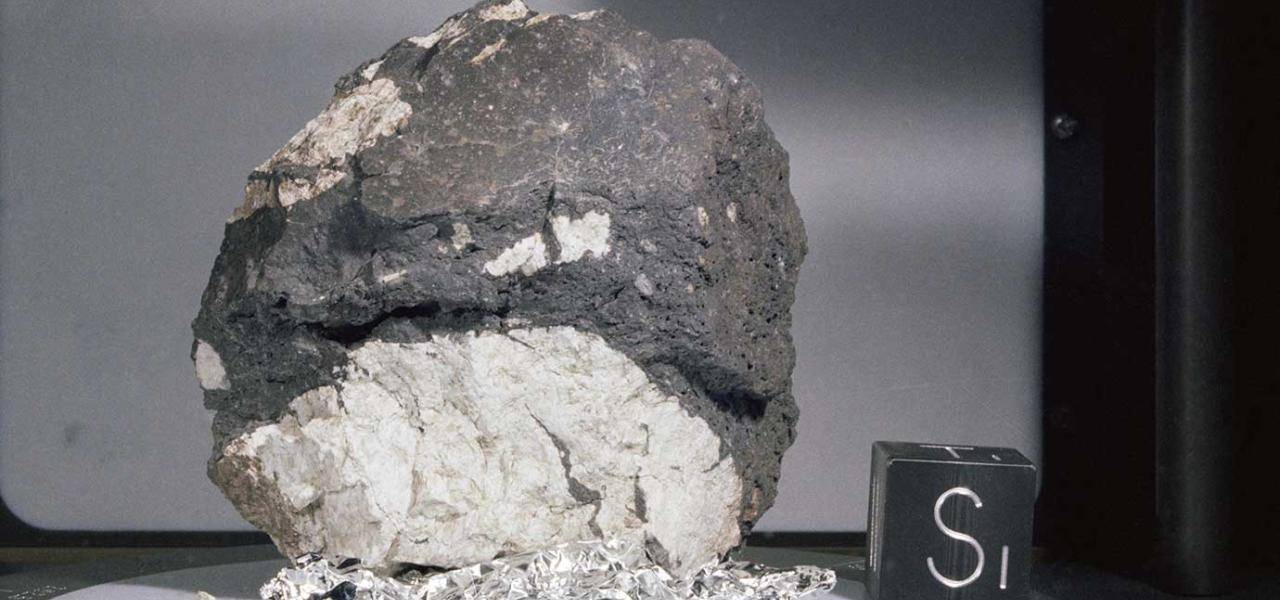
Samples of rock from the moon, brought to Earth by lunar meteorites and the Apollo moon landings, can be used to understand the history of the Moon and its relationship to the Earth through the chemistry of their minerals.
Planetary scientists like Prof. Nicolas Dauphas and Prof. Andy Davis in the Geophysical Sciences Department at the University of Chicago make precise measurements of lunar samples to determine exactly what they’re made of, and identify the chemical fingerprints of different geological processes like the melting and mixing of rocks and the evaporation of gasses.
The first big clue about where the moon came from comes from oxygen. Oxygen, like many other elements, is able to exist in multiple forms, known as isotopes. Different types of meteorites coming from the asteroids leftover in the Solar system after planet formation have different proportions of each of these oxygen isotopes. So, by measuring the oxygen isotopes of a given planet, planetary scientists can calculate the different types of asteroid that collided to form the planet. Lunar samples have a very similar oxygen isotope makeup to the Earth.


| 15,000 mlx | |
| 55 | |
| 5 |