0 reactions
Where are you confusing acceptance with agreement?
I have learned that one of the biggest misunderstandings about acceptance is believing it means agreement.
It does not.
Acceptance simply means I am willing to see reality exactly as it is instead of demanding that it be different before I move forward.
I can accept someone’s decision without agreeing with it. I can accept a difficult circumstance without liking it. I can accept disappointment, loss, change, or uncertainty without pretending any of it feels good.
Because the moment has already arrived.
Fighting reality does not change reality. It only creates internal conflict between what is and what I believe should be.
That conflict becomes interference.
This is where awareness becomes so important. I acknowledge what is happening. I accept what I cannot change. Then I take responsibility for what I can influence from this moment forward.
That is where my power returns.
Acceptance frees the energy I was wasting resisting yesterday and allows me to invest it into what I can do today.
You do not have to like where you are.
You simply have to stop fighting where you are long enough to decide where you are going next.
Your potential is not found by denying reality.
It is found by accepting reality and choosing your next action.
If this message spoke to you or something within it resonated, I invite you to check out my other ideas in my books sold on Amazon. They have already helped thousands worldwide.
– Coach Mike
EDIT Your GOALS
Every
Day
Internal
Thoughts
Guarantee
Our
Absolute
Life
Situations
#acceptance #powerful #power #go #agreement
Background Photo Credit:
Howen
I have learned that one of the biggest misunderstandings about acceptance is believing it means agreement.
It does not.
Acceptance simply means I am willing to see reality exactly as it is instead of demanding that it be different before I move forward.
I can accept someone’s decision without agreeing with it. I can accept a difficult circumstance without liking it. I can accept disappointment, loss, change, or uncertainty without pretending any of it feels good.
Because the moment has already arrived.
Fighting reality does not change reality. It only creates internal conflict between what is and what I believe should be.
That conflict becomes interference.
This is where awareness becomes so important. I acknowledge what is happening. I accept what I cannot change. Then I take responsibility for what I can influence from this moment forward.
That is where my power returns.
Acceptance frees the energy I was wasting resisting yesterday and allows me to invest it into what I can do today.
You do not have to like where you are.
You simply have to stop fighting where you are long enough to decide where you are going next.
Your potential is not found by denying reality.
It is found by accepting reality and choosing your next action.
If this message spoke to you or something within it resonated, I invite you to check out my other ideas in my books sold on Amazon. They have already helped thousands worldwide.
– Coach Mike
EDIT Your GOALS
Every
Day
Internal
Thoughts
Guarantee
Our
Absolute
Life
Situations
#acceptance #powerful #power #go #agreement
Background Photo Credit:
Howen



0 reactions
Are your facts and your truth the same?
When we communicate, we share content. Just words, ideas, beliefs, and experiences. But the person receiving those words does not hear them exactly as we intended. They filter everything through their own experiences, beliefs, emotions, and understanding of the world. That is their context.
This is why two people can hear the exact same message and walk away with completely different meanings. The content may be the same, but the context is different.
Many of the conflicts we experience are not about facts at all. They are about perspectives. We become so attached to our own truth that we forget it was shaped by our experiences, just as someone else’s truth was shaped by theirs. That does not mean every belief is factual, but it does mean there is value in being curious before becoming judgmental.
Awareness begins when we recognize that our perspective is not the only perspective. Compassion grows when we understand that people are often responding from their own story, not ours. You do not have to agree with someone to respect their experience.
Instead of arguing to prove who is right, become curious enough to understand why someone believes what they believe. The more you understand context, the more empathy, compassion, and wisdom you develop. That is where influence begins and where meaningful connection is created.
Your truth is yours. Their truth is theirs. Growth happens when we learn from both without losing ourselves in the process.
If this message spoke to you or something within it resonated, I invite you to check out my other ideas in my books sold on Amazon. They have already helped thousands worldwide.
– Coach Mike
EDIT Your GOALS
Every
Day
Internal
Thoughts
Guarantee
Our
Absolute
Life
Situations
#understanding #agreement #curiosity #judgement #truth
Background Photo Credit:
Unknown
When we communicate, we share content. Just words, ideas, beliefs, and experiences. But the person receiving those words does not hear them exactly as we intended. They filter everything through their own experiences, beliefs, emotions, and understanding of the world. That is their context.
This is why two people can hear the exact same message and walk away with completely different meanings. The content may be the same, but the context is different.
Many of the conflicts we experience are not about facts at all. They are about perspectives. We become so attached to our own truth that we forget it was shaped by our experiences, just as someone else’s truth was shaped by theirs. That does not mean every belief is factual, but it does mean there is value in being curious before becoming judgmental.
Awareness begins when we recognize that our perspective is not the only perspective. Compassion grows when we understand that people are often responding from their own story, not ours. You do not have to agree with someone to respect their experience.
Instead of arguing to prove who is right, become curious enough to understand why someone believes what they believe. The more you understand context, the more empathy, compassion, and wisdom you develop. That is where influence begins and where meaningful connection is created.
Your truth is yours. Their truth is theirs. Growth happens when we learn from both without losing ourselves in the process.
If this message spoke to you or something within it resonated, I invite you to check out my other ideas in my books sold on Amazon. They have already helped thousands worldwide.
– Coach Mike
EDIT Your GOALS
Every
Day
Internal
Thoughts
Guarantee
Our
Absolute
Life
Situations
#understanding #agreement #curiosity #judgement #truth
Background Photo Credit:
Unknown

0 reactions
What are you saying?
To anyone?
To yourself?
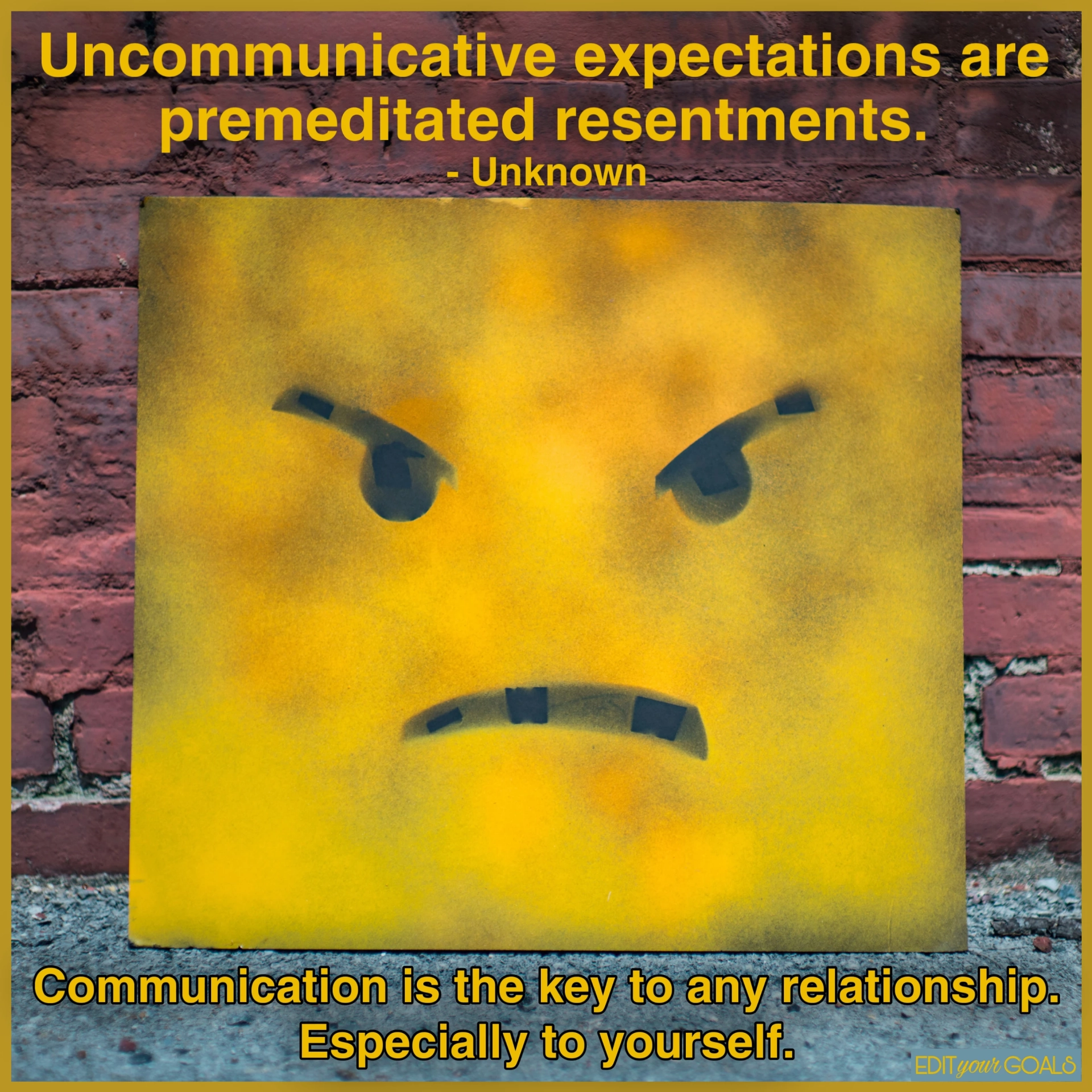
In any relationship, communication acts as the cornerstone of understanding and connection. The absence of communication can be a breeding ground for disappointment and resentment. When we fail to communicate, we leave our partners in the dark about our expectations, needs, and feelings. This lack of clarity can lead to misunderstandings and unmet expectations, setting the stage for disappointment.
Resentment often follows when one person unknowingly falls short of an unspoken standard or agreement. Without open dialogue, there is no opportunity for negotiation or compromise. Each partner might assume the other understands their needs and expectations, leading to frustration when these unvoiced desires are not met. Over time, this unaddressed frustration can fester, turning into deep-seated resentment.
Effective communication allows both parties to express their needs and work towards mutual agreements. It provides a platform for honest discussions, where both individuals can voice their expectations and negotiate terms that are acceptable to both. When agreements are openly discussed and made, they can be honored with integrity. If circumstances change or agreements are not upheld, open communication allows for renegotiation, preventing the buildup of negative emotions.
Conversely, in the absence of communication, we are likely to internalize our disappointment and let it grow into resentment. This is particularly true when the other party is unaware of the expectations they are failing to meet. Thus, fostering an environment of open, honest communication is crucial. It not only prevents misunderstandings but also ensures that both parties feel heard, respected, and valued, laying a foundation for a healthier, more resilient relationship. Even with yourself.
-Coach Mike
EDIT your GOALS
Every
Day
Internal
Thoughts
Guarantees
Our
Absolute
Life
Situations
#communication #agreement #expectations #resentment #relationships
Background Picture by
Andre Hunter
To anyone?
To yourself?
In any relationship, communication acts as the cornerstone of understanding and connection. The absence of communication can be a breeding ground for disappointment and resentment. When we fail to communicate, we leave our partners in the dark about our expectations, needs, and feelings. This lack of clarity can lead to misunderstandings and unmet expectations, setting the stage for disappointment.
Resentment often follows when one person unknowingly falls short of an unspoken standard or agreement. Without open dialogue, there is no opportunity for negotiation or compromise. Each partner might assume the other understands their needs and expectations, leading to frustration when these unvoiced desires are not met. Over time, this unaddressed frustration can fester, turning into deep-seated resentment.
Effective communication allows both parties to express their needs and work towards mutual agreements. It provides a platform for honest discussions, where both individuals can voice their expectations and negotiate terms that are acceptable to both. When agreements are openly discussed and made, they can be honored with integrity. If circumstances change or agreements are not upheld, open communication allows for renegotiation, preventing the buildup of negative emotions.
Conversely, in the absence of communication, we are likely to internalize our disappointment and let it grow into resentment. This is particularly true when the other party is unaware of the expectations they are failing to meet. Thus, fostering an environment of open, honest communication is crucial. It not only prevents misunderstandings but also ensures that both parties feel heard, respected, and valued, laying a foundation for a healthier, more resilient relationship. Even with yourself.
-Coach Mike
EDIT your GOALS
Every
Day
Internal
Thoughts
Guarantees
Our
Absolute
Life
Situations
#communication #agreement #expectations #resentment #relationships
Background Picture by
Andre Hunter