


APOD - February 23,2025
Phases of Venus
Image Credit & Copyright : Richard Addis
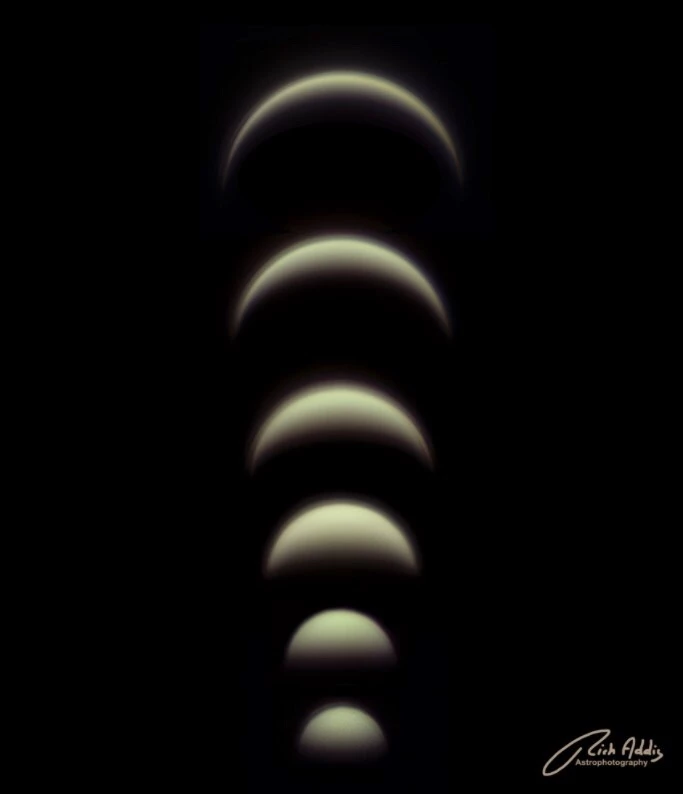
Explanation: Just as the Moon goes through phases , Venus' visible sunlit hemisphere waxes and wanes. This composite of backyard telescopic images illustrates the steady changes for Venus during its current stint as our evening star, as the inner planet grows larger but narrows to a thin crescent. Images from bottom to top were taken during 2020 on dates February 27, March 20, April 14, April 24, May 8, and May 14. Gliding along its interior orbit between Earth and Sun, Venus grows larger during that period because it is approaching planet Earth. Its crescent narrows, though, as Venus swings closer to our line-of-sight to the Sun. Closest to the Earth-Sun line but passing about 1/2 degree north of the Sun on June 3, Venus will reach a (non-judgmental) inferior conjunction . Soon after, Venus will shine clearly above the eastern horizon in predawn skies as planet Earth's morning star . After sunset tonight look for Venus above the western horizon and you can also spot elusive innermost planet Mercury .
#apod #space #venus
Phases of Venus
Image Credit & Copyright : Richard Addis
Explanation: Just as the Moon goes through phases , Venus' visible sunlit hemisphere waxes and wanes. This composite of backyard telescopic images illustrates the steady changes for Venus during its current stint as our evening star, as the inner planet grows larger but narrows to a thin crescent. Images from bottom to top were taken during 2020 on dates February 27, March 20, April 14, April 24, May 8, and May 14. Gliding along its interior orbit between Earth and Sun, Venus grows larger during that period because it is approaching planet Earth. Its crescent narrows, though, as Venus swings closer to our line-of-sight to the Sun. Closest to the Earth-Sun line but passing about 1/2 degree north of the Sun on June 3, Venus will reach a (non-judgmental) inferior conjunction . Soon after, Venus will shine clearly above the eastern horizon in predawn skies as planet Earth's morning star . After sunset tonight look for Venus above the western horizon and you can also spot elusive innermost planet Mercury .
#apod #space #venus

3

2

1
APOD - February 12,2025
Sunrise at Tycho
Credit: NASA / GSFC / Arizona State Univ. / Lunar Reconnaissance Orbiter
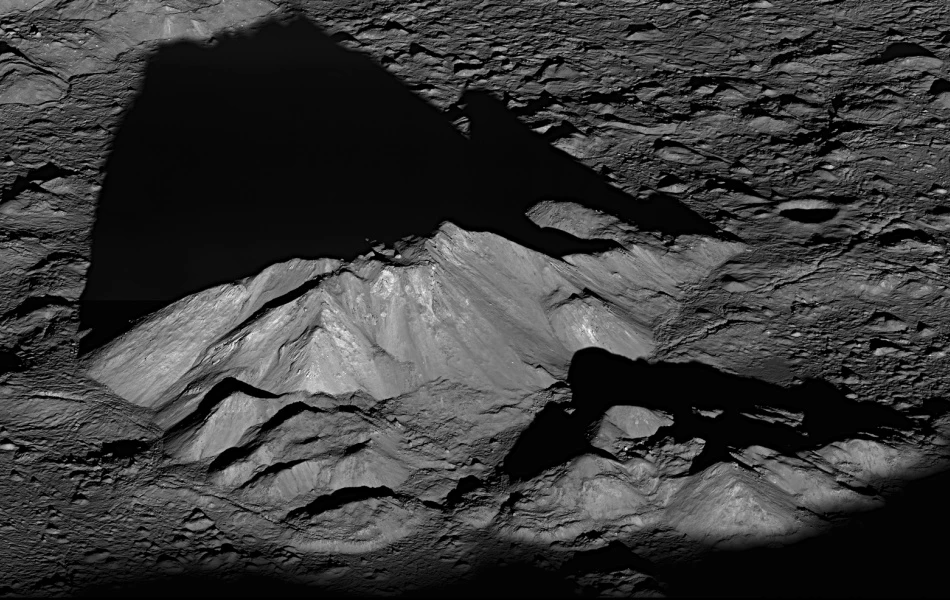
Explanation: Tycho crater's central peak complex casts a long, dark shadow near local sunrise in this spectacular lunarscape . The dramatic oblique view was recorded on June 10, 2011 by the Lunar Reconnaissance Orbiter. Shown in amazing detail, boulder strewn slopes and jagged shadows appear in the highest resolution version at 1.5 meters per pixel. The rugged complex is about 15 kilometers wide, formed in uplift by the giant impact that created the well-known ray crater 100 million years ago . The summit of its central peak reaches 2 kilometers above the Tycho crater floor .
#apod #space #nasa #moon
Sunrise at Tycho
Credit: NASA / GSFC / Arizona State Univ. / Lunar Reconnaissance Orbiter
Explanation: Tycho crater's central peak complex casts a long, dark shadow near local sunrise in this spectacular lunarscape . The dramatic oblique view was recorded on June 10, 2011 by the Lunar Reconnaissance Orbiter. Shown in amazing detail, boulder strewn slopes and jagged shadows appear in the highest resolution version at 1.5 meters per pixel. The rugged complex is about 15 kilometers wide, formed in uplift by the giant impact that created the well-known ray crater 100 million years ago . The summit of its central peak reaches 2 kilometers above the Tycho crater floor .
#apod #space #nasa #moon
3
2
1