31
5
7
34
0
2,143



1 reactions
Rethinking Brain–Computer Interfaces Through Artificial Hair
*An Engineering Thought Experiment*
For decades, brain–computer interfaces have pursued a familiar goal: build better electrodes.
Smaller electrodes.
More electrodes.
Implanted electrodes.
Flexible electrodes.
Dry electrodes.
But perhaps we have been optimizing the wrong component.
Instead of asking *”How do we attach more sensors to the head?”*, perhaps we should ask:
> *What if the head already contains the world’s most elegant sensor infrastructure?*
# The Neural Braid
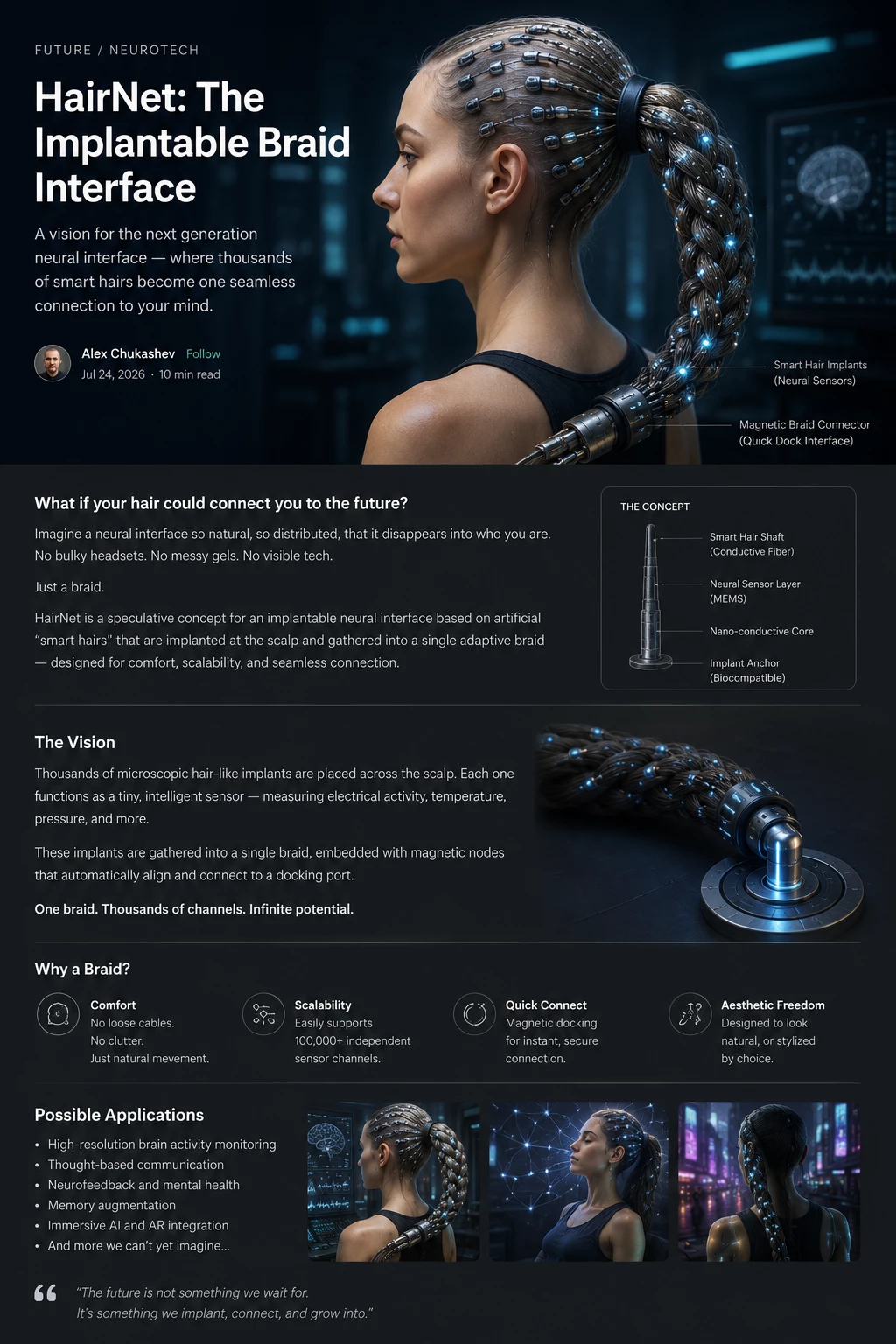
Imagine replacing ordinary cosmetic artificial hair with **engineered synthetic fibers**.
These fibers would not read thoughts directly.
Instead, they would serve as a distributed interface between the scalp and an external sensing system.
Unlike conventional cosmetic extensions, these fibers would be designed from the ground up for bioelectronic compatibility.
Each fiber could include:
- a flexible conductive layer,
- an electrically insulated core,
- a biocompatible outer coating,
- optimized mechanical properties for everyday use.
The result would still look like ordinary hair.
But functionally, it would become part of a wearable neural interface.
— -
# Why a Braid?
Here comes the interesting part.
Instead of leaving thousands of fibers electrically independent, they could be **organized into a structured braid**.
The braid would act as a natural communication trunk.
At its end would be a compact connector that mechanically and electrically mates with an external device.
The user could simply tie their hair into a braid and connect it to a headset, workstation, or future wearable computer.
No adhesive electrodes.
No conductive gel.
No complicated preparation.
Connecting to a computer could become as natural as plugging in a USB cable.
--
# The Scalp Does the Sensing
The important point is that the hair itself is **not** assumed to detect neural activity.
The biologically meaningful signals originate within the living tissue of the scalp.
The engineered fibers simply improve electrical coupling between this tissue and a dense external sensing array.
In this architecture, hair becomes part of the interface — not the sensor itself.
— -
# The Docking System
The connector at the end of the braid would not carry one hundred thousand individual wires.
Instead, the braid would terminate in a high-density interface.
A docking station could contain an adaptive sensing matrix that establishes electrical contact with groups of conductive fibers.
Advanced reconstruction algorithms would infer spatial neural activity from these overlapping measurements.
In other words, computation replaces wiring complexity.
— -
# Living With the Interface
One fascinating consequence of this concept is that the neural interface disappears into everyday life.
You brush it.
You wash it.
You braid it.
You disconnect it before sleeping.
You reconnect it before working.
The interface becomes a wearable accessory rather than a permanent medical device.
— -
# Potential Applications
Although highly speculative, such a platform could eventually support applications including:
- high-density non-invasive EEG,
- neurofeedback,
- immersive virtual and augmented reality,
- assistive communication,
- long-term brain monitoring,
- adaptive human–AI collaboration.
Whether these goals are achievable remains an open scientific question.
— -
# Engineering Challenges
Many fundamental problems remain unsolved.
Among them:
- biocompatibility over many years,
- stability of conductive fibers,
- durability under daily washing,
- electrical noise generated by movement,
- safe attachment methods,
- scalable manufacturing,
- computational reconstruction of distributed signals.
These are substantial engineering challenges — not merely design details.
— -
# Beyond Electrodes
History shows that transformative technologies often emerge when we stop improving existing tools and begin questioning their assumptions.
Perhaps the future of brain–computer interfaces will not be built around larger implants or denser electrode caps.
Perhaps it will begin with something surprisingly ordinary.
A braid.
One that looks completely human.
Yet quietly connects biology to computation.
— -
## Closing Thoughts
The Neural Braid is not a product proposal.
It is not a medical recommendation.
It is a conceptual exploration of how advances in materials science, wearable computing, and computational sensing might eventually converge into a new class of human–computer interfaces.
Some ideas change technology.
Others simply change the questions we ask.
Sometimes, that is where innovation truly begins.
*An Engineering Thought Experiment*
For decades, brain–computer interfaces have pursued a familiar goal: build better electrodes.
Smaller electrodes.
More electrodes.
Implanted electrodes.
Flexible electrodes.
Dry electrodes.
But perhaps we have been optimizing the wrong component.
Instead of asking *”How do we attach more sensors to the head?”*, perhaps we should ask:
> *What if the head already contains the world’s most elegant sensor infrastructure?*
# The Neural Braid
Imagine replacing ordinary cosmetic artificial hair with **engineered synthetic fibers**.
These fibers would not read thoughts directly.
Instead, they would serve as a distributed interface between the scalp and an external sensing system.
Unlike conventional cosmetic extensions, these fibers would be designed from the ground up for bioelectronic compatibility.
Each fiber could include:
- a flexible conductive layer,
- an electrically insulated core,
- a biocompatible outer coating,
- optimized mechanical properties for everyday use.
The result would still look like ordinary hair.
But functionally, it would become part of a wearable neural interface.
— -
# Why a Braid?
Here comes the interesting part.
Instead of leaving thousands of fibers electrically independent, they could be **organized into a structured braid**.
The braid would act as a natural communication trunk.
At its end would be a compact connector that mechanically and electrically mates with an external device.
The user could simply tie their hair into a braid and connect it to a headset, workstation, or future wearable computer.
No adhesive electrodes.
No conductive gel.
No complicated preparation.
Connecting to a computer could become as natural as plugging in a USB cable.
--
# The Scalp Does the Sensing
The important point is that the hair itself is **not** assumed to detect neural activity.
The biologically meaningful signals originate within the living tissue of the scalp.
The engineered fibers simply improve electrical coupling between this tissue and a dense external sensing array.
In this architecture, hair becomes part of the interface — not the sensor itself.
— -
# The Docking System
The connector at the end of the braid would not carry one hundred thousand individual wires.
Instead, the braid would terminate in a high-density interface.
A docking station could contain an adaptive sensing matrix that establishes electrical contact with groups of conductive fibers.
Advanced reconstruction algorithms would infer spatial neural activity from these overlapping measurements.
In other words, computation replaces wiring complexity.
— -
# Living With the Interface
One fascinating consequence of this concept is that the neural interface disappears into everyday life.
You brush it.
You wash it.
You braid it.
You disconnect it before sleeping.
You reconnect it before working.
The interface becomes a wearable accessory rather than a permanent medical device.
— -
# Potential Applications
Although highly speculative, such a platform could eventually support applications including:
- high-density non-invasive EEG,
- neurofeedback,
- immersive virtual and augmented reality,
- assistive communication,
- long-term brain monitoring,
- adaptive human–AI collaboration.
Whether these goals are achievable remains an open scientific question.
— -
# Engineering Challenges
Many fundamental problems remain unsolved.
Among them:
- biocompatibility over many years,
- stability of conductive fibers,
- durability under daily washing,
- electrical noise generated by movement,
- safe attachment methods,
- scalable manufacturing,
- computational reconstruction of distributed signals.
These are substantial engineering challenges — not merely design details.
— -
# Beyond Electrodes
History shows that transformative technologies often emerge when we stop improving existing tools and begin questioning their assumptions.
Perhaps the future of brain–computer interfaces will not be built around larger implants or denser electrode caps.
Perhaps it will begin with something surprisingly ordinary.
A braid.
One that looks completely human.
Yet quietly connects biology to computation.
— -
## Closing Thoughts
The Neural Braid is not a product proposal.
It is not a medical recommendation.
It is a conceptual exploration of how advances in materials science, wearable computing, and computational sensing might eventually converge into a new class of human–computer interfaces.
Some ideas change technology.
Others simply change the questions we ask.
Sometimes, that is where innovation truly begins.


1
0 reactions
In the quiet hills of Sibulan, there is a place where the world slows down… and the soul remembers how to breathe. Our Lady’s Garden — a sanctuary of peace above the shimmering coast of Negros Oriental.
Here, the air carries the scent of flowers warmed by the morning sun. The mountains stand like ancient guardians, and the wind whispers its soft prayers through the leaves. Statues and pathways gently guide you, as if inviting you into a story unfolding between heaven and earth.
Every corner feels touched by grace — sunlight slipping through branches, shadows dancing on stone, the distant hum of life far below. It’s a place where people come not to escape the world, but to rediscover themselves within it.
Stand still for a moment…
Listen…
Even silence here feels alive.
Whether you’re seeking clarity, gratitude, or simply a pause from the noise, Our Lady’s Garden offers a rare kind of calm — the kind that stays with you long after you leave.
A hilltop haven.
A moment of devotion.
A breath of peace.
#Dumaguete #philippines #ourladygarden #sibulan #fdr_alex
Here, the air carries the scent of flowers warmed by the morning sun. The mountains stand like ancient guardians, and the wind whispers its soft prayers through the leaves. Statues and pathways gently guide you, as if inviting you into a story unfolding between heaven and earth.
Every corner feels touched by grace — sunlight slipping through branches, shadows dancing on stone, the distant hum of life far below. It’s a place where people come not to escape the world, but to rediscover themselves within it.
Stand still for a moment…
Listen…
Even silence here feels alive.
Whether you’re seeking clarity, gratitude, or simply a pause from the noise, Our Lady’s Garden offers a rare kind of calm — the kind that stays with you long after you leave.
A hilltop haven.
A moment of devotion.
A breath of peace.
#Dumaguete #philippines #ourladygarden #sibulan #fdr_alex
9 reactions
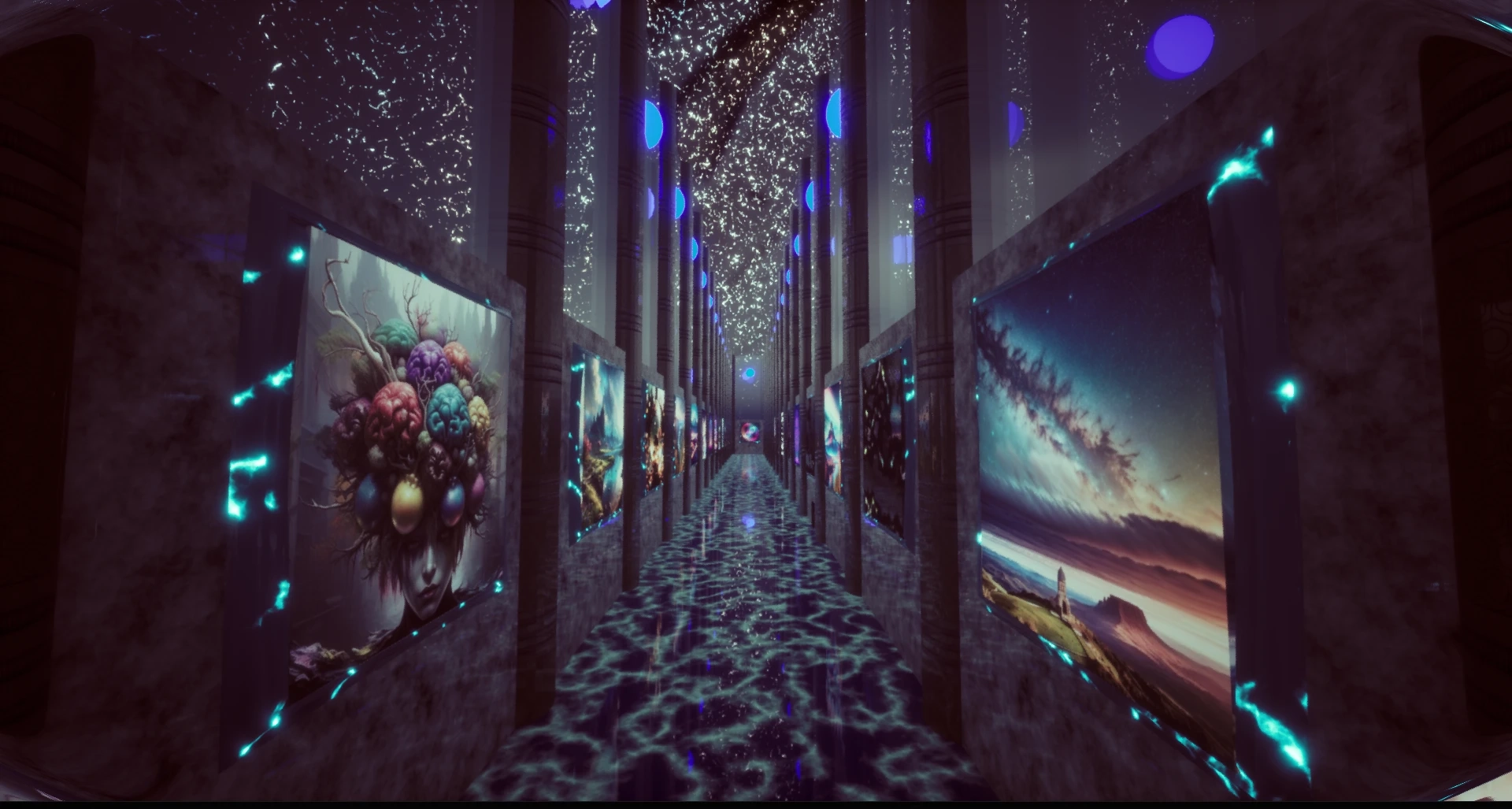
ArtMaze is a game unlike any other. We combined labyrinths with AI Art, added atmospheric music,
and peppered them with riddles, quotes, and hidden features that the player will have to find
on their own. And we have the ArtMaze universe. More than 18 thousand artistic works
have the ability to fly and draw stars in 3D space.
Functions:
Ability to use all artwork in ArtMaze for any purpose. Click "E"
Ability to create your own galleries.
Ability to leave comments on pictures (with auto-posting in Telegram channel and Discord). Click "T"
Ability to discover hidden ArtMaze features. Click "something"
The ability to find and select your favorite music. Click "Z"
I hope you enjoy ArtMaze's exploration!
Visit our website or Itch.io
We will be grateful to all those who love to explore digital worlds, and lovers of labyrinths and riddles for comments and feedback.
#ArtMaze #UE4 #pcgame #maze #puzzle #aiart #e2r #quest
and peppered them with riddles, quotes, and hidden features that the player will have to find
on their own. And we have the ArtMaze universe. More than 18 thousand artistic works
have the ability to fly and draw stars in 3D space.
Functions:
Ability to use all artwork in ArtMaze for any purpose. Click "E"
Ability to create your own galleries.
Ability to leave comments on pictures (with auto-posting in Telegram channel and Discord). Click "T"
Ability to discover hidden ArtMaze features. Click "something"
The ability to find and select your favorite music. Click "Z"
I hope you enjoy ArtMaze's exploration!
Visit our website or Itch.io
We will be grateful to all those who love to explore digital worlds, and lovers of labyrinths and riddles for comments and feedback.
#ArtMaze #UE4 #pcgame #maze #puzzle #aiart #e2r #quest
3

2

2