I built a free browser tool to fly through the observable…
0 reactions
I built a free browser tool to fly through the observable universe using real catalog data — would love feedback from people who actually know the sky
Hi all,
I've spent the last few months building a visualization tool and I think this crowd will either enjoy it or tear it apart, both are useful to me
The idea: one continuous scene from the Earth's surface out to \~13.8 billion light years, on a logarithmic scale, in the browser. No install.
Everything you see is placed from real data:
\- Solar System bodies from NASA/JPL Keplerian elements, real-time, with a time slider. Earth, Moon and Mars use actual imagery (Blue Marble / VIIRS, LRO, Viking MDIM); the rest are procedural.
\- 109,000 stars from the HYG catalog (Hipparcos + Yale BSC + Gliese), real parallaxes, spectral types and colours. Each star has a plausible (procedural, clearly labelled as such) planetary system.
\- Milky Way structure, 55 real galaxies (Andromeda, M87, Sombrero, LMC/SMC...) at NED/SIMBAD distances, and a cosmic web beyond.
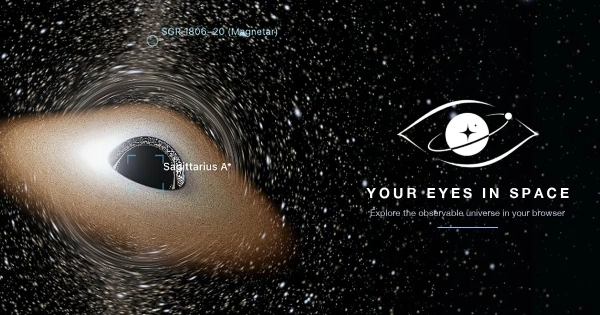
\- 14 real black holes: Sgr A\* with S2/S38/S55 on their GRAVITY/Keck orbital elements, M87\*, Cygnus X-1, Gaia BH1, etc., with lensing and shadow rendered.
\- Pulsars (Crab, Vela, Geminga, SGR 1806−20) with their actual spin periods and beam geometry.
\- Deep-sky objects at real positions: Orion and Tarantula nebulae, Pleiades, Omega Centauri, SN 1987A, R136a1.
\- Spacecraft (Voyager 1/2, Pioneer, New Horizons, Parker, JWST...) at their current positions.
There's also a mission planner that does Lambert transfers and gravity assists between Solar System bodies for a chosen launch window, and lets you follow the ship.
Things I already know are approximations and would appreciate being called out on if I got them wrong: distances are log-scaled so angular sizes between "zoom levels" aren't physical; galaxy shapes are sprites, not resolved structure; exoplanet systems are generated, not real (I'd love to add the NASA Exoplanet Archive next).
It's open source (MIT) with every data source and licence listed.
If something looks wrong — a star in the wrong place, an orbit tilted oddly, a distance that doesn't match the literature — tell me. That's exactly the feedback I'm after.
Works on phones too, but it's much better on a desktop with a GPU.
#space
Hi all,
I've spent the last few months building a visualization tool and I think this crowd will either enjoy it or tear it apart, both are useful to me
The idea: one continuous scene from the Earth's surface out to \~13.8 billion light years, on a logarithmic scale, in the browser. No install.
Everything you see is placed from real data:
\- Solar System bodies from NASA/JPL Keplerian elements, real-time, with a time slider. Earth, Moon and Mars use actual imagery (Blue Marble / VIIRS, LRO, Viking MDIM); the rest are procedural.
\- 109,000 stars from the HYG catalog (Hipparcos + Yale BSC + Gliese), real parallaxes, spectral types and colours. Each star has a plausible (procedural, clearly labelled as such) planetary system.
\- Milky Way structure, 55 real galaxies (Andromeda, M87, Sombrero, LMC/SMC...) at NED/SIMBAD distances, and a cosmic web beyond.
\- 14 real black holes: Sgr A\* with S2/S38/S55 on their GRAVITY/Keck orbital elements, M87\*, Cygnus X-1, Gaia BH1, etc., with lensing and shadow rendered.
\- Pulsars (Crab, Vela, Geminga, SGR 1806−20) with their actual spin periods and beam geometry.
\- Deep-sky objects at real positions: Orion and Tarantula nebulae, Pleiades, Omega Centauri, SN 1987A, R136a1.
\- Spacecraft (Voyager 1/2, Pioneer, New Horizons, Parker, JWST...) at their current positions.
There's also a mission planner that does Lambert transfers and gravity assists between Solar System bodies for a chosen launch window, and lets you follow the ship.
Things I already know are approximations and would appreciate being called out on if I got them wrong: distances are log-scaled so angular sizes between "zoom levels" aren't physical; galaxy shapes are sprites, not resolved structure; exoplanet systems are generated, not real (I'd love to add the NASA Exoplanet Archive next).
It's open source (MIT) with every data source and licence listed.
If something looks wrong — a star in the wrong place, an orbit tilted oddly, a distance that doesn't match the literature — tell me. That's exactly the feedback I'm after.
Works on phones too, but it's much better on a desktop with a GPU.
#space


| 2,000 mlx | |
| 3 | |
| 0 |