A lot of feuding in that meeting room: Context…
0 reactions
A lot of feuding in that meeting room:
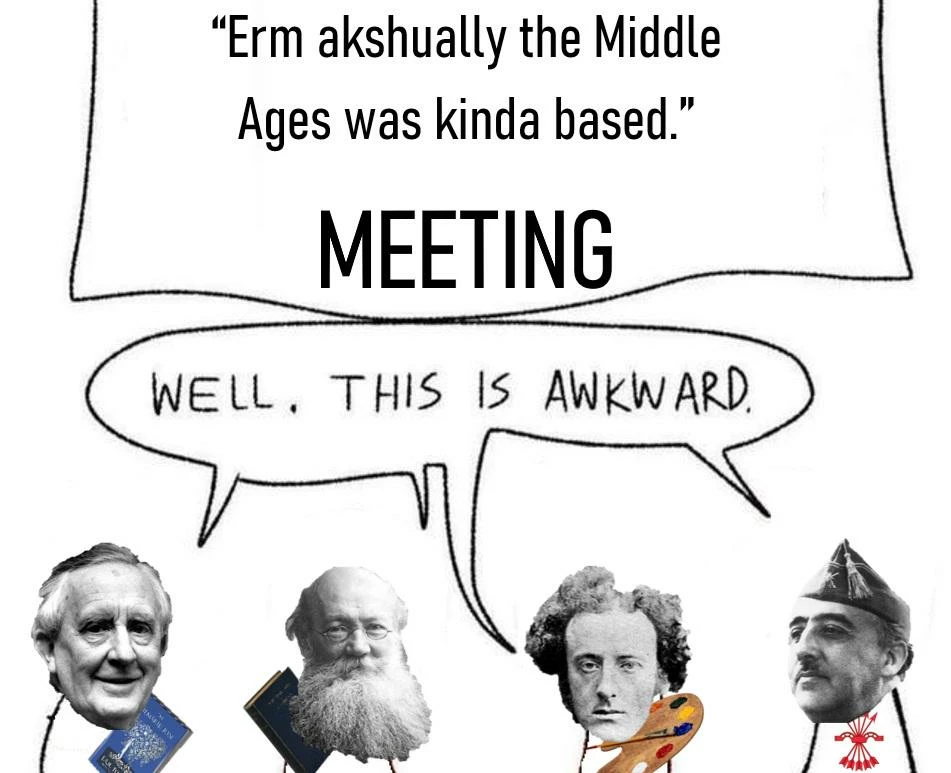
Context: Traditional Western narratives frequently portray the Millennium between the collapse of the Western Roman Empire and the beginning of Renaissance as a dark age, characterized by superstition, intellectual stagnation and tribalist feuding. Even when this narrative was still accepted, there were several notable individuals, political/artistic movements and schools of thought, often coined the umbrella term “Medievalists” that considered the middle ages a golden age and an era to be admired rather than avoided, all for very different reasons.
(Right to Left)
JRR Tolkien was a learned linguist and historian. With a specialty in Anglo-Saxon history. His experiences in WWI and seeing first hand how the rapid progress of the 20th century did great damage to the ecosystem, the community and to the individual. His most famous works *Lord of the Rings*, are heavily medievalist, pulling from *Nibelungenlied*, *Beowulf*, Norse mythology and Catholic teachings.
Peter Kropotkin was a notable philosopher and anarchist, of *Conquest of Bread* fame. Interestingly he tends to consider medieval society to be far more personal than the centralized Roman system that preceded it and the rise of the nation-state that followed. His works regularly highlight the distinctly interpersonal relationship that serfs had with their feudal lords as a positive trait.
The Pre-Raphaelite Movement (Represented here by John Everett Millais) was an English artistic counterculture movement that arose as a response to the rapid changes the industrial revolution had wrought on English society. It argued that all artforms after Raphael to be illegitimate and destructive to art, hence the name of the movement. Their works tended to focus on idyllic rural scenery and chivalric/Arthurian legends.
In many ways, the rise of Liberalism was not too kind to Spain. It first came to the sunny peninsula when Napoleon marched his forces across the kingdom, forcefully usurping the king for one of his family, igniting the Peninsula war, that absolutely devastated Spain (For reference, this war gave us the term “guerilla warfare” and Francisco Goya’s *Pinturas Negras*). The war also broke Spain’s ability to maintain control over her colonies, resulting in the subsequent Latin American wars for independence. Given this and Spain’s distinctly Medieval national narrative, and it’s easy to see why many Hispanists, Spanish nationalists and conservatives tend to look more fondly on the Middle Ages and more skeptically to modernity. This was particularly apparent during the Spanish Civil War in which the Nationalists (Represented here by Francisco Franco) sought to end democracy in the country and establish a Catholic state with an absolutist at its helm.
#history
Context: Traditional Western narratives frequently portray the Millennium between the collapse of the Western Roman Empire and the beginning of Renaissance as a dark age, characterized by superstition, intellectual stagnation and tribalist feuding. Even when this narrative was still accepted, there were several notable individuals, political/artistic movements and schools of thought, often coined the umbrella term “Medievalists” that considered the middle ages a golden age and an era to be admired rather than avoided, all for very different reasons.
(Right to Left)
JRR Tolkien was a learned linguist and historian. With a specialty in Anglo-Saxon history. His experiences in WWI and seeing first hand how the rapid progress of the 20th century did great damage to the ecosystem, the community and to the individual. His most famous works *Lord of the Rings*, are heavily medievalist, pulling from *Nibelungenlied*, *Beowulf*, Norse mythology and Catholic teachings.
Peter Kropotkin was a notable philosopher and anarchist, of *Conquest of Bread* fame. Interestingly he tends to consider medieval society to be far more personal than the centralized Roman system that preceded it and the rise of the nation-state that followed. His works regularly highlight the distinctly interpersonal relationship that serfs had with their feudal lords as a positive trait.
The Pre-Raphaelite Movement (Represented here by John Everett Millais) was an English artistic counterculture movement that arose as a response to the rapid changes the industrial revolution had wrought on English society. It argued that all artforms after Raphael to be illegitimate and destructive to art, hence the name of the movement. Their works tended to focus on idyllic rural scenery and chivalric/Arthurian legends.
In many ways, the rise of Liberalism was not too kind to Spain. It first came to the sunny peninsula when Napoleon marched his forces across the kingdom, forcefully usurping the king for one of his family, igniting the Peninsula war, that absolutely devastated Spain (For reference, this war gave us the term “guerilla warfare” and Francisco Goya’s *Pinturas Negras*). The war also broke Spain’s ability to maintain control over her colonies, resulting in the subsequent Latin American wars for independence. Given this and Spain’s distinctly Medieval national narrative, and it’s easy to see why many Hispanists, Spanish nationalists and conservatives tend to look more fondly on the Middle Ages and more skeptically to modernity. This was particularly apparent during the Spanish Civil War in which the Nationalists (Represented here by Francisco Franco) sought to end democracy in the country and establish a Catholic state with an absolutist at its helm.
#history


| 3,000 mlx | |
| 6 | |
| 0 |