I will never understand how this even became a "gotcha…
0 reactions
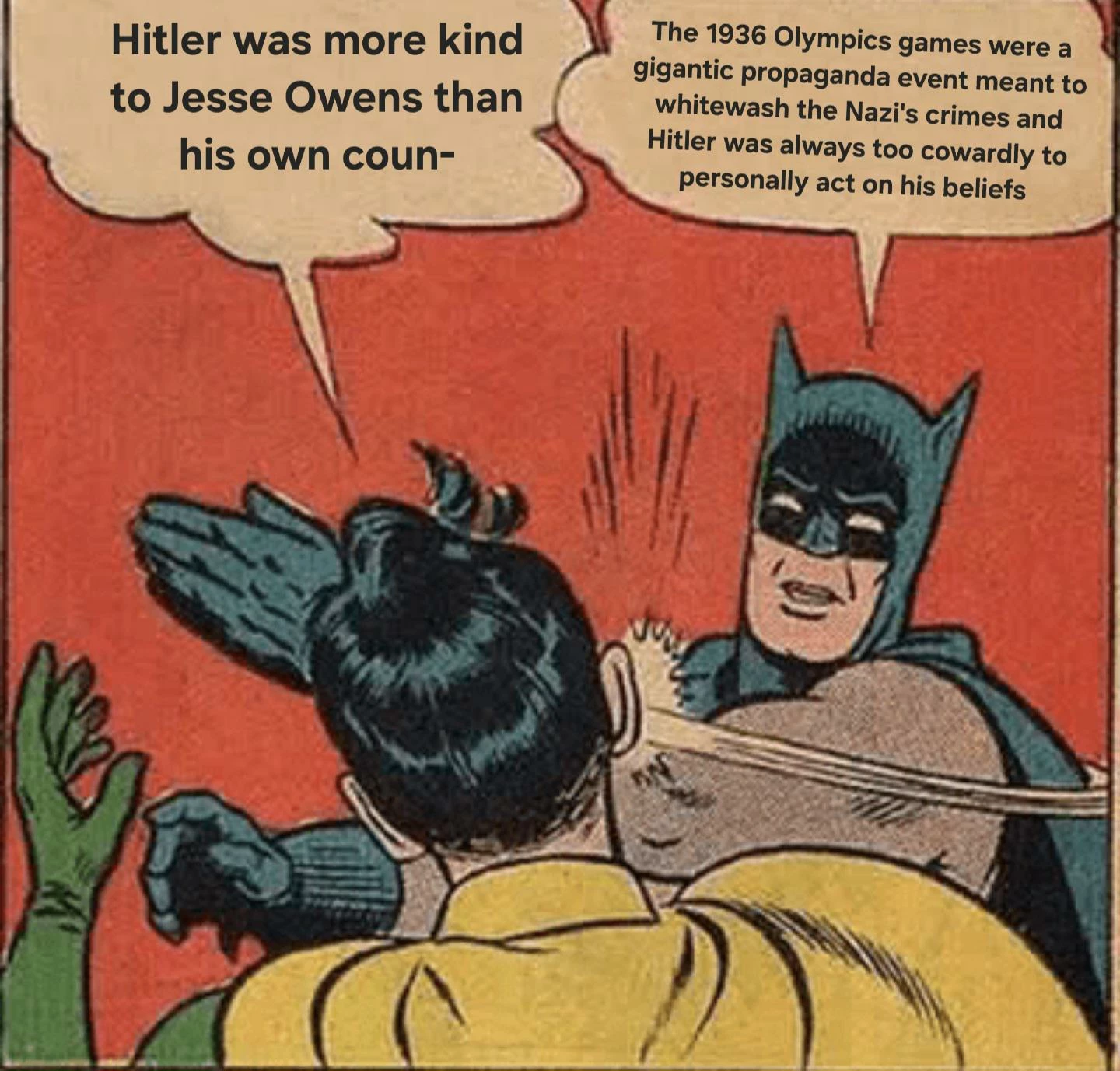
I will never understand how this even became a "gotcha moment" people use.
Context: The Nazis made elaborate preparations for the August 1–16 Summer Games. A huge sports complex was constructed, including a new stadium and state-of-the art Olympic village for housing the athletes. Olympic flags and swastikas bedecked the monuments and houses of a festive, crowded Berlin.
Most tourists were unaware that the Nazi regime had temporarily removed anti-Jewish signs, nor did they know of a police roundup of Roma in Berlin, ordered by the German Ministry of the Interior. On July 16, 1936, some 600 Roma residing in Berlin and its environs were arrested and interned under police guard in a special camp in Marzahn, a neighborhood on the outskirts of Berlin.
Nazi officials also ordered that foreign visitors should not be subjected to the criminal penalties of Paragraph 175 https://encyclopedia.ushmm.org/narrative/45421/en , a German statute that criminalized sexual relations between men.
Germany skillfully promoted the Olympics with colorful posters and magazine spreads. Athletic imagery drew a link between Nazi Germany and ancient Greece, symbolizing the Nazi racial myth that a superior German civilization was the rightful heir of an "Aryan" culture of classical antiquity. This vision of classical antiquity emphasized ideal "Aryan" racial types: heroic, blue-eyed blonds with finely chiseled features.
Concerted propaganda https://encyclopedia.ushmm.org/narrative/81/en efforts continued well after the Olympics with the international release in 1938 of *Olympia*, the controversial documentary directed by German filmmaker Leni Riefenstahl https://encyclopedia.ushmm.org/narrative/10824/en . Renowned for her earlier propaganda film, *Triumph of the Will* (1934) depicting Nazi Party rallies at Nuremberg, Riefenstahl was commissioned by the Nazi regime to produce this film about the 1936 Summer Games.
April 1933, an "Aryans only" policy was instituted in all German athletic organizations. "Non-Aryans"—Jews or individuals with Jewish parents and Roma https://encyclopedia.ushmm.org/narrative/10737/en (Gypsies)—were systematically excluded from German sports facilities and associations. The German Boxing Association expelled professional light heavyweight champion Erich Seelig in April 1933 because he was Jewish. (Seelig later resumed his boxing career in the United States.) Another Jewish athlete, Daniel Prenn—Germany's top-ranked tennis player—was removed from Germany's Davis Cup Team. Gretel Bergmann, a world-class high jumper, was expelled from her German club in 1933 and excluded from the German Olympic team in 1936.
Jewish athletes barred from German sports clubs flocked to separate Jewish associations, including the Maccabee and Shield groups, and to improvised segregated facilities. But these Jewish sports facilities were not comparable to well-funded German groups. Roma (Gypsies), including the Sinti boxer Johann Rukelie Trollmann, were also excluded from German sports.
As a token gesture to placate international opinion, German authorities allowed the star fencer Helene Mayer to represent Germany at the 1936 Olympic Games in Berlin. Mayer was viewed as a “non-Aryan” because her father was Jewish. She won a silver medal in women's individual fencing and, like all other medalists for Germany, gave the Nazi salute on the podium. No other Jewish athlete competed for Germany in the Summer Games that year.
Still, nine athletes who were Jewish or of Jewish parentage won medals in the 1936 Nazi Olympics, including Mayer and five Hungarians. Seven Jewish male athletes from the United States went to Berlin. Like some of the European Jewish competitors at the Olympics, many of these young men were pressured by Jewish organizations to boycott the Games. These athletes chose to compete for a variety of reasons. Most did not fully grasp at the time the extent and purpose of Nazi persecution of Jews and other groups.
August 1936, the Nazi regime tried to camouflage its violent racist https://encyclopedia.ushmm.org/narrative/3508/en policies while it hosted the Summer Olympics. Most anti-Jewish signs were temporarily removed and newspapers toned down their harsh rhetoric, in line with directives from the Propaganda Ministry, headed by Joseph Goebbels. Thus, the regime exploited the Olympic Games to present foreign spectators and journalists with a false image of a peaceful, tolerant Germany.
Germany emerged victorious from the XI Olympiad, both on the field and off. On the field, German athletes captured the most medals, and German hospitality and organization won the praises of visitors. Most newspaper accounts echoed the *New York Times* report that the Games put Germany "back in the fold of nations," and even made the Germans "more human again." Some even found reason to hope that this peaceable interlude would endure.
Only a few reporters, such as the American William Shirer https://encyclopedia.ushmm.org/narrative/32259/en , understood that the Berlin glitter was merely a facade hiding a racist and violently oppressive regime.
As post-Games reports were filed, Hitler pressed on with grandiose plans for German expansion. Persecution of Jews resumed. Two days after the Olympics, Captain Wolfgang Fuerstner, head of the Olympic village, killed himself when he was dismissed from military service because of his Jewish ancestry.
Germany invaded Poland https://encyclopedia.ushmm.org/narrative/2142/en on September 1, 1939. Within just three years of the Olympiad, the "hospitable" and "peaceable" sponsor of the Games unleashed World War II, a conflict that resulted in untold destruction. With the conclusion of the Games, Germany's expansionist policies and the persecution of Jews and other "enemies of the state" accelerated, culminating in the Holocaust.
https://encyclopedia.ushmm.org/content/en/article/the-nazi-olympics-berlin-1936
#history
Context: The Nazis made elaborate preparations for the August 1–16 Summer Games. A huge sports complex was constructed, including a new stadium and state-of-the art Olympic village for housing the athletes. Olympic flags and swastikas bedecked the monuments and houses of a festive, crowded Berlin.
Most tourists were unaware that the Nazi regime had temporarily removed anti-Jewish signs, nor did they know of a police roundup of Roma in Berlin, ordered by the German Ministry of the Interior. On July 16, 1936, some 600 Roma residing in Berlin and its environs were arrested and interned under police guard in a special camp in Marzahn, a neighborhood on the outskirts of Berlin.
Nazi officials also ordered that foreign visitors should not be subjected to the criminal penalties of Paragraph 175 https://encyclopedia.ushmm.org/narrative/45421/en , a German statute that criminalized sexual relations between men.
Germany skillfully promoted the Olympics with colorful posters and magazine spreads. Athletic imagery drew a link between Nazi Germany and ancient Greece, symbolizing the Nazi racial myth that a superior German civilization was the rightful heir of an "Aryan" culture of classical antiquity. This vision of classical antiquity emphasized ideal "Aryan" racial types: heroic, blue-eyed blonds with finely chiseled features.
Concerted propaganda https://encyclopedia.ushmm.org/narrative/81/en efforts continued well after the Olympics with the international release in 1938 of *Olympia*, the controversial documentary directed by German filmmaker Leni Riefenstahl https://encyclopedia.ushmm.org/narrative/10824/en . Renowned for her earlier propaganda film, *Triumph of the Will* (1934) depicting Nazi Party rallies at Nuremberg, Riefenstahl was commissioned by the Nazi regime to produce this film about the 1936 Summer Games.
April 1933, an "Aryans only" policy was instituted in all German athletic organizations. "Non-Aryans"—Jews or individuals with Jewish parents and Roma https://encyclopedia.ushmm.org/narrative/10737/en (Gypsies)—were systematically excluded from German sports facilities and associations. The German Boxing Association expelled professional light heavyweight champion Erich Seelig in April 1933 because he was Jewish. (Seelig later resumed his boxing career in the United States.) Another Jewish athlete, Daniel Prenn—Germany's top-ranked tennis player—was removed from Germany's Davis Cup Team. Gretel Bergmann, a world-class high jumper, was expelled from her German club in 1933 and excluded from the German Olympic team in 1936.
Jewish athletes barred from German sports clubs flocked to separate Jewish associations, including the Maccabee and Shield groups, and to improvised segregated facilities. But these Jewish sports facilities were not comparable to well-funded German groups. Roma (Gypsies), including the Sinti boxer Johann Rukelie Trollmann, were also excluded from German sports.
As a token gesture to placate international opinion, German authorities allowed the star fencer Helene Mayer to represent Germany at the 1936 Olympic Games in Berlin. Mayer was viewed as a “non-Aryan” because her father was Jewish. She won a silver medal in women's individual fencing and, like all other medalists for Germany, gave the Nazi salute on the podium. No other Jewish athlete competed for Germany in the Summer Games that year.
Still, nine athletes who were Jewish or of Jewish parentage won medals in the 1936 Nazi Olympics, including Mayer and five Hungarians. Seven Jewish male athletes from the United States went to Berlin. Like some of the European Jewish competitors at the Olympics, many of these young men were pressured by Jewish organizations to boycott the Games. These athletes chose to compete for a variety of reasons. Most did not fully grasp at the time the extent and purpose of Nazi persecution of Jews and other groups.
August 1936, the Nazi regime tried to camouflage its violent racist https://encyclopedia.ushmm.org/narrative/3508/en policies while it hosted the Summer Olympics. Most anti-Jewish signs were temporarily removed and newspapers toned down their harsh rhetoric, in line with directives from the Propaganda Ministry, headed by Joseph Goebbels. Thus, the regime exploited the Olympic Games to present foreign spectators and journalists with a false image of a peaceful, tolerant Germany.
Germany emerged victorious from the XI Olympiad, both on the field and off. On the field, German athletes captured the most medals, and German hospitality and organization won the praises of visitors. Most newspaper accounts echoed the *New York Times* report that the Games put Germany "back in the fold of nations," and even made the Germans "more human again." Some even found reason to hope that this peaceable interlude would endure.
Only a few reporters, such as the American William Shirer https://encyclopedia.ushmm.org/narrative/32259/en , understood that the Berlin glitter was merely a facade hiding a racist and violently oppressive regime.
As post-Games reports were filed, Hitler pressed on with grandiose plans for German expansion. Persecution of Jews resumed. Two days after the Olympics, Captain Wolfgang Fuerstner, head of the Olympic village, killed himself when he was dismissed from military service because of his Jewish ancestry.
Germany invaded Poland https://encyclopedia.ushmm.org/narrative/2142/en on September 1, 1939. Within just three years of the Olympiad, the "hospitable" and "peaceable" sponsor of the Games unleashed World War II, a conflict that resulted in untold destruction. With the conclusion of the Games, Germany's expansionist policies and the persecution of Jews and other "enemies of the state" accelerated, culminating in the Holocaust.
https://encyclopedia.ushmm.org/content/en/article/the-nazi-olympics-berlin-1936
#history


| 4,000 mlx | |
| 9 | |
| 0 |