The universe is a random immense unfolding of all…
0 reactions
The universe is a random immense unfolding of all possibilities. The “laws of physics” are stable patterns rather than fundamental laws of the universe.
**Arguments:**
* **P1.** The universe is a space of all possible states across infinite time compared to human scale.
* **P2.** Most possible states are unstable and do not persist over time.
* **P3.** A small subset of states exhibit stability and repeatable transitions.
* **P4.** An observer studying state space from inside one of the stable state of random universe will describe it laws of physics or science.
* **P5.** The observer himself is an inevitable outcome of true randomness in the universe.
The universe is an unbelievably vast state space. Time is not just long, it is effectively incomprehensible relative human scale. And within this, randomness is not something occasional; it is continuously happening. Every moment - including this one - is just one realization/state out of that vast space.
True randomness, when long enough, sometimes will show patterns of structure. And an observer, who himself is within those constrains of structured patterns, will feel these patterns as laws of physics and science. While they are nothing but a glimpse of organised configurations inside a vast possibilities of randomness unfolding for incomprehensible timespan.
>The universe is a random immense unfolding of all possibilities. So, nothing is being “built” in a deliberate sense. Things are simply appearing, one configuration at a time.
Almost all configurations vanish instantly. But some are long. A few, very few, stabilize enough to persist. These persistent configurations are what we experience as everything around us. As human, when we observe these stable patterns while being inside a stable strucutre in pure randomness. From within such a stable pattern:
* repetition looks like causality
* persistence feels like time
* stability appear like laws
But these are not fundamental in the absolute sense. They are just what stability, within randomness, feels like from the inside.
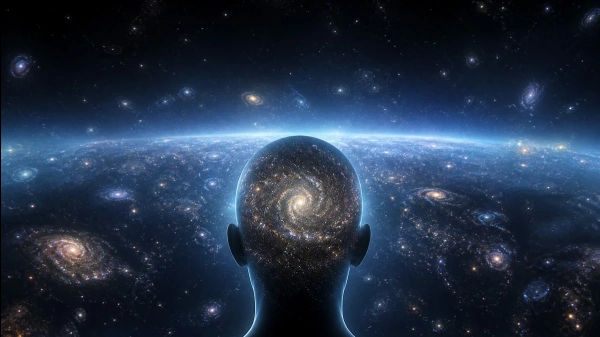
What we call matter is just a relatively stable arrangement. What we call life is a more complex, longer-lasting arrangement. And what we call consciousness is just a persistent pattern that can track its own persistence. Consciousness is not separate from randomness. It is randomness taking a form that can observe itself. It is the unfolding becoming aware of the unfolding, from within one of its temporary structures.
>Consciousness is a pattern inside the universe that not only persists, but tracks its own persistence. Consciousness is an unfolding becoming aware of the unfolding.
That means “we” are not fixed entities. We are a continuity that exists because the pattern holds long enough to remember, sometimes even compare and project.
Even this conversation, it is not special in origin. It is simply a highly structured configuration inside the universe that has stabilized long enough to eventually reflect on itself.
The laws of physics are, in this view, just the most stable recurring patterns. So stable that they appear universal from within our frame of reference and time. But they are still part of the same random unfolding of the universe.
Science is not uncovering some absolute foundation of reality. Absolute form of reality is absolute randomness. Science is what a self-aware pattern (us) does when it tries to map and compress the most stable patterns it can observe in this ongoing random process.
>You and I are a self-referential unfolding becoming aware of the immense unfolding of randomness across a vast state space called the universe.
**Conclusions:**
C1: The laws of physics are not fundamental governing principles of the entire universe, but descriptive regularities arising from rare stable patterns in the random patterns of the universe.
C2: An inevitable outcome of true randomness is not just chaos (e.g., thermodynamics) but also stable unfolding of events for a short time (e.g., laws of gravity).
**Objections:**
O1: Physical laws exhibit precise mathematical structure and universality, which suggests they are more than mere emergent patterns.
**Responses:**
R1: Precision and universality can arise from highly stable configurations inside randomness, given large enough number of possible state space and time of the universe. Some emergent systems (e.g., thermodynamics) also exhibit mathematical regularities without being fundamental. Therefore, mathematical structure alone does not establish that laws are governing entities. It does, however, establish that temporary mathematical structures are possible inside randomness. That's why some laws break in other state space (e.g., inside a black hole).
#science
**Arguments:**
* **P1.** The universe is a space of all possible states across infinite time compared to human scale.
* **P2.** Most possible states are unstable and do not persist over time.
* **P3.** A small subset of states exhibit stability and repeatable transitions.
* **P4.** An observer studying state space from inside one of the stable state of random universe will describe it laws of physics or science.
* **P5.** The observer himself is an inevitable outcome of true randomness in the universe.
The universe is an unbelievably vast state space. Time is not just long, it is effectively incomprehensible relative human scale. And within this, randomness is not something occasional; it is continuously happening. Every moment - including this one - is just one realization/state out of that vast space.
True randomness, when long enough, sometimes will show patterns of structure. And an observer, who himself is within those constrains of structured patterns, will feel these patterns as laws of physics and science. While they are nothing but a glimpse of organised configurations inside a vast possibilities of randomness unfolding for incomprehensible timespan.
>The universe is a random immense unfolding of all possibilities. So, nothing is being “built” in a deliberate sense. Things are simply appearing, one configuration at a time.
Almost all configurations vanish instantly. But some are long. A few, very few, stabilize enough to persist. These persistent configurations are what we experience as everything around us. As human, when we observe these stable patterns while being inside a stable strucutre in pure randomness. From within such a stable pattern:
* repetition looks like causality
* persistence feels like time
* stability appear like laws
But these are not fundamental in the absolute sense. They are just what stability, within randomness, feels like from the inside.
What we call matter is just a relatively stable arrangement. What we call life is a more complex, longer-lasting arrangement. And what we call consciousness is just a persistent pattern that can track its own persistence. Consciousness is not separate from randomness. It is randomness taking a form that can observe itself. It is the unfolding becoming aware of the unfolding, from within one of its temporary structures.
>Consciousness is a pattern inside the universe that not only persists, but tracks its own persistence. Consciousness is an unfolding becoming aware of the unfolding.
That means “we” are not fixed entities. We are a continuity that exists because the pattern holds long enough to remember, sometimes even compare and project.
Even this conversation, it is not special in origin. It is simply a highly structured configuration inside the universe that has stabilized long enough to eventually reflect on itself.
The laws of physics are, in this view, just the most stable recurring patterns. So stable that they appear universal from within our frame of reference and time. But they are still part of the same random unfolding of the universe.
Science is not uncovering some absolute foundation of reality. Absolute form of reality is absolute randomness. Science is what a self-aware pattern (us) does when it tries to map and compress the most stable patterns it can observe in this ongoing random process.
>You and I are a self-referential unfolding becoming aware of the immense unfolding of randomness across a vast state space called the universe.
**Conclusions:**
C1: The laws of physics are not fundamental governing principles of the entire universe, but descriptive regularities arising from rare stable patterns in the random patterns of the universe.
C2: An inevitable outcome of true randomness is not just chaos (e.g., thermodynamics) but also stable unfolding of events for a short time (e.g., laws of gravity).
**Objections:**
O1: Physical laws exhibit precise mathematical structure and universality, which suggests they are more than mere emergent patterns.
**Responses:**
R1: Precision and universality can arise from highly stable configurations inside randomness, given large enough number of possible state space and time of the universe. Some emergent systems (e.g., thermodynamics) also exhibit mathematical regularities without being fundamental. Therefore, mathematical structure alone does not establish that laws are governing entities. It does, however, establish that temporary mathematical structures are possible inside randomness. That's why some laws break in other state space (e.g., inside a black hole).
#science


| 4,000 mlx | |
| 5 | |
| 0 |