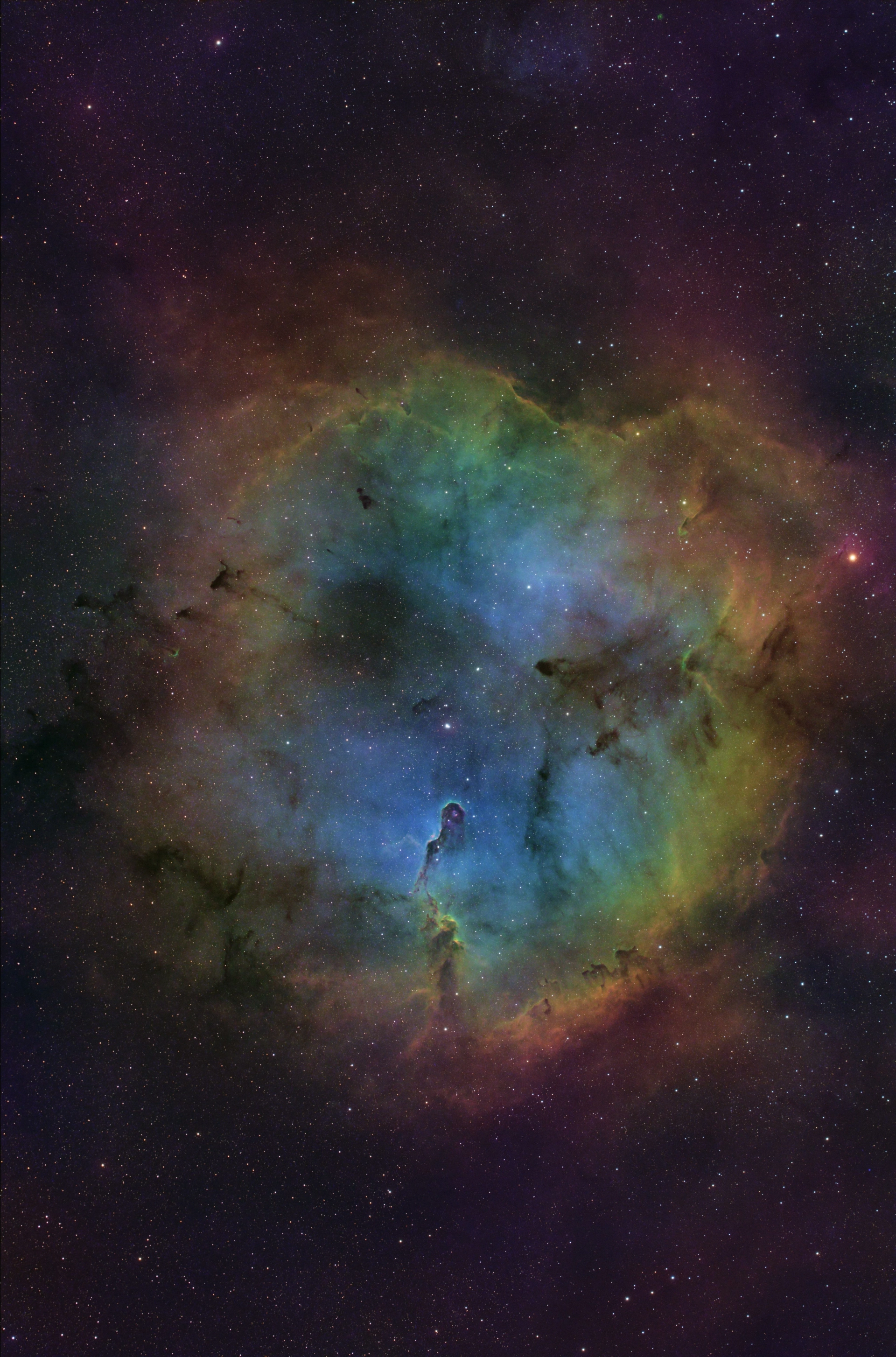
Elephant's Trunk Nebula - Farewall to the Backyard Astro…
0 reactions
Elephant's Trunk Nebula - Farewall to the Backyard Astro
This was one of the last projects to complete at my old house before moving. At the new house, we inherited a beautifully landscaped space with tons of shade trees and much less grass to cut, but practically no view of the sky. I guess I didn't have to buy a new house to justify sending a rig to a remote observatory, but it certainly help make the case for it. The rig used for this is still with me and will be used when we go out to the the local astronomical society's star parties.
**Location**: Central Texas - Bortle 7
2026-07-05 to 2026-07-11
**Total Integration**: 15h 10m
L-Ultimate: 5h 20m - 32 frames @ 600s
L-Synergy: 8h 50m - 53 frames @ 600s
L-2 UV/IR: 1h - 30 frames @ 120s
## The Rig
- Askar FRA300 - 300mm focal length @ f/5
- ZWO ASI2600MC Pro (Color)
- ZWO EFW 5x2"
- Filters
- Astronomik L2 UV/IR Cut Filter
- Optolong L-Ultimate - 3nm Ha-Oiii filter
- Optolong L-Synergy - 7nm Sii-Oiii filter
- Antlia Triband RGB Ultra II Filter
- Optolong L-Pro
- ToupTek AAF
- ML-Astro SAL-33 Mount
- Gemini Automatic Flat Panel 100mm
- Guiding:
- ToupTek OAG-L
- ZWO ASI220MM-Mini
- Mele Quieter 4C + NINA
- WandererAstro WandererBox PLUS V3
- NINA
## Processing
All processing done in PixInsight with the additions of:
- RC Astro's StarXTerminator, BlurXTerminator, and NoiseXTerminator https://www.rc-astro.com
- Seti Astro Star Stretch v2.6 https://www.setiastro.com/pjsr-scripts
- CosmicPhotons Image Blend https://cosmicphotons.com/scripts/
I used the L-Ultimate and L-Synergy dual-band filters to generate a true SHO palette. The L-Ultimate is a 3nm narrowband filter that gets Ha on the red channel and OIII on blue and green. The L-Synergy is 6nm with SII on red and OIII on blue and green.
Using ChannelExtraction, I split the the RGB channels from the two narrowband masters. I got the Ha and SII from the red channels. To get the OIII, I saved the blue and green channels from both original masters, then used the ImageIntegration tool to maximize signal. LinearFit was used to bring the weaker SII and OIII channels up to the Ha and then used ChannelCombination to combine the three to make the SHO palette.
The reason the gradient and color correction was different for the L-Synergy, it's because the MARS data doesn't cover SII currently. With that said, I still go back and forth on MGC. It's certainly easier, but I've found that depending on the data, it can be overly aggressive and remove valid signal that I can preserve with DBE.
I know I pushed the colors, particularly the red, a bit much. I often reach a point when I get tired of messing with CurvesTransformation that I just say, "Good enough", even though there's stuff that could be better. That is definitely the case here, but it's good enough.
### Individual Steps
- WBPP: Three masters
- L-Ultimate -> HaOiii
- L-Synergy -> SiiOiii
- L-2 UV/IR Cut -> RGB
- SPCC - HaOiii & RGB
- SPFC - HaOiii & RGB
- MuliscaleGradientCorrection - HaOiii & RGB
- DynamicBackgroundExtraction - SiiOiii (SII not available in the latest MARS data)
- BlurXterminator on all three masters
- StarXterminator on RGB -> Save stars as RGB_Stars
- NoiseXterminator on HaOiii & SiiOiii
- ChannelExtraction on HaOiii & SiiOiii
- Red from HaOiii -> Ha
- Red from SiiOiii -> Sii
- HaOiii_B, HaOiii_G, SiiOiii_B, SiiOiii_G saved to disk
- ImageIntegration on blues and greens to make Oiii
- LinearFit Sii & Oiii against Ha
- ChannelCombination -> SHO
- R - Sii
- G - Ha
- B - Oiii
- BackgroundNeutralization on SHO
- ColorCalibration on SHO
- MultiscaleAdaptiveStretch on SHO
- CurvesTransformation on non-linear SHO
- SetiAstro Star Stretch on RGB_Stars
- ImageBlend to combine SHO + RGB_Stars
#space
source
This was one of the last projects to complete at my old house before moving. At the new house, we inherited a beautifully landscaped space with tons of shade trees and much less grass to cut, but practically no view of the sky. I guess I didn't have to buy a new house to justify sending a rig to a remote observatory, but it certainly help make the case for it. The rig used for this is still with me and will be used when we go out to the the local astronomical society's star parties.
**Location**: Central Texas - Bortle 7
2026-07-05 to 2026-07-11
**Total Integration**: 15h 10m
L-Ultimate: 5h 20m - 32 frames @ 600s
L-Synergy: 8h 50m - 53 frames @ 600s
L-2 UV/IR: 1h - 30 frames @ 120s
## The Rig
- Askar FRA300 - 300mm focal length @ f/5
- ZWO ASI2600MC Pro (Color)
- ZWO EFW 5x2"
- Filters
- Astronomik L2 UV/IR Cut Filter
- Optolong L-Ultimate - 3nm Ha-Oiii filter
- Optolong L-Synergy - 7nm Sii-Oiii filter
- Antlia Triband RGB Ultra II Filter
- Optolong L-Pro
- ToupTek AAF
- ML-Astro SAL-33 Mount
- Gemini Automatic Flat Panel 100mm
- Guiding:
- ToupTek OAG-L
- ZWO ASI220MM-Mini
- Mele Quieter 4C + NINA
- WandererAstro WandererBox PLUS V3
- NINA
## Processing
All processing done in PixInsight with the additions of:
- RC Astro's StarXTerminator, BlurXTerminator, and NoiseXTerminator https://www.rc-astro.com
- Seti Astro Star Stretch v2.6 https://www.setiastro.com/pjsr-scripts
- CosmicPhotons Image Blend https://cosmicphotons.com/scripts/
I used the L-Ultimate and L-Synergy dual-band filters to generate a true SHO palette. The L-Ultimate is a 3nm narrowband filter that gets Ha on the red channel and OIII on blue and green. The L-Synergy is 6nm with SII on red and OIII on blue and green.
Using ChannelExtraction, I split the the RGB channels from the two narrowband masters. I got the Ha and SII from the red channels. To get the OIII, I saved the blue and green channels from both original masters, then used the ImageIntegration tool to maximize signal. LinearFit was used to bring the weaker SII and OIII channels up to the Ha and then used ChannelCombination to combine the three to make the SHO palette.
The reason the gradient and color correction was different for the L-Synergy, it's because the MARS data doesn't cover SII currently. With that said, I still go back and forth on MGC. It's certainly easier, but I've found that depending on the data, it can be overly aggressive and remove valid signal that I can preserve with DBE.
I know I pushed the colors, particularly the red, a bit much. I often reach a point when I get tired of messing with CurvesTransformation that I just say, "Good enough", even though there's stuff that could be better. That is definitely the case here, but it's good enough.
### Individual Steps
- WBPP: Three masters
- L-Ultimate -> HaOiii
- L-Synergy -> SiiOiii
- L-2 UV/IR Cut -> RGB
- SPCC - HaOiii & RGB
- SPFC - HaOiii & RGB
- MuliscaleGradientCorrection - HaOiii & RGB
- DynamicBackgroundExtraction - SiiOiii (SII not available in the latest MARS data)
- BlurXterminator on all three masters
- StarXterminator on RGB -> Save stars as RGB_Stars
- NoiseXterminator on HaOiii & SiiOiii
- ChannelExtraction on HaOiii & SiiOiii
- Red from HaOiii -> Ha
- Red from SiiOiii -> Sii
- HaOiii_B, HaOiii_G, SiiOiii_B, SiiOiii_G saved to disk
- ImageIntegration on blues and greens to make Oiii
- LinearFit Sii & Oiii against Ha
- ChannelCombination -> SHO
- R - Sii
- G - Ha
- B - Oiii
- BackgroundNeutralization on SHO
- ColorCalibration on SHO
- MultiscaleAdaptiveStretch on SHO
- CurvesTransformation on non-linear SHO
- SetiAstro Star Stretch on RGB_Stars
- ImageBlend to combine SHO + RGB_Stars
#space
source


| 1,000 mlx | |
| 3 | |
| 0 |