2,129
0
0
144
0
30,644
0 reactions
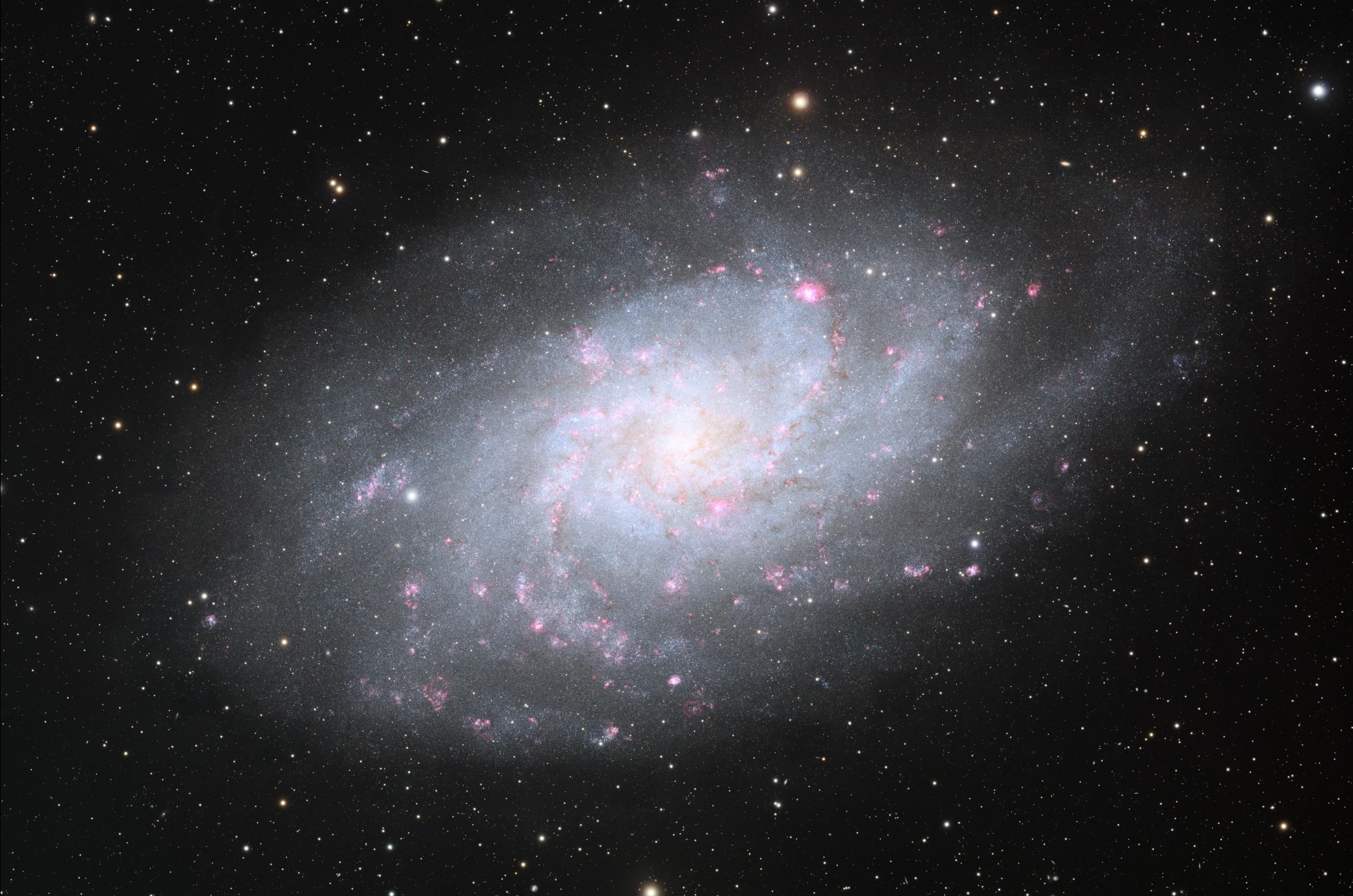
M33: Triangulum Galaxy in HaLRGB
Scope: ES127 Carbon Fiber Apo Triplet (952mm Focal Length), Camera ASI2600MM, Mount AM5N, guided. Filters are Baader.
**Software**: Capture in NINA, all processing in PixInsight
Basic PI Workflow: WBPP, ChannelCombination, BlurXterminator, SPCC, Continuum Subtraction on Ha, NoiseXterminator, StarXterminator, MAS, ImageBlend for Lum Layer, ImageBlend for Ha, ImageBlend for RGB Stars.
**Location**: Starfront Observatories in Rockwood Texas USA (Bortle 1 or 2)
**Acquisition Details:**
450″ X 95 Luminance
450″ X 50 Red
450″ X 50 Green
450″ X 52 Blue
600″ X 49 Hydrogen Alpha
**39 Hours Total Integration**
Acquisition Dates:
7 nights over October 6 – 12, 2026
You can see the full resolution image and annotated version here: https://www.forthier.space/m33/
#space
Scope: ES127 Carbon Fiber Apo Triplet (952mm Focal Length), Camera ASI2600MM, Mount AM5N, guided. Filters are Baader.
**Software**: Capture in NINA, all processing in PixInsight
Basic PI Workflow: WBPP, ChannelCombination, BlurXterminator, SPCC, Continuum Subtraction on Ha, NoiseXterminator, StarXterminator, MAS, ImageBlend for Lum Layer, ImageBlend for Ha, ImageBlend for RGB Stars.
**Location**: Starfront Observatories in Rockwood Texas USA (Bortle 1 or 2)
**Acquisition Details:**
450″ X 95 Luminance
450″ X 50 Red
450″ X 50 Green
450″ X 52 Blue
600″ X 49 Hydrogen Alpha
**39 Hours Total Integration**
Acquisition Dates:
7 nights over October 6 – 12, 2026
You can see the full resolution image and annotated version here: https://www.forthier.space/m33/
#space


0 reactions
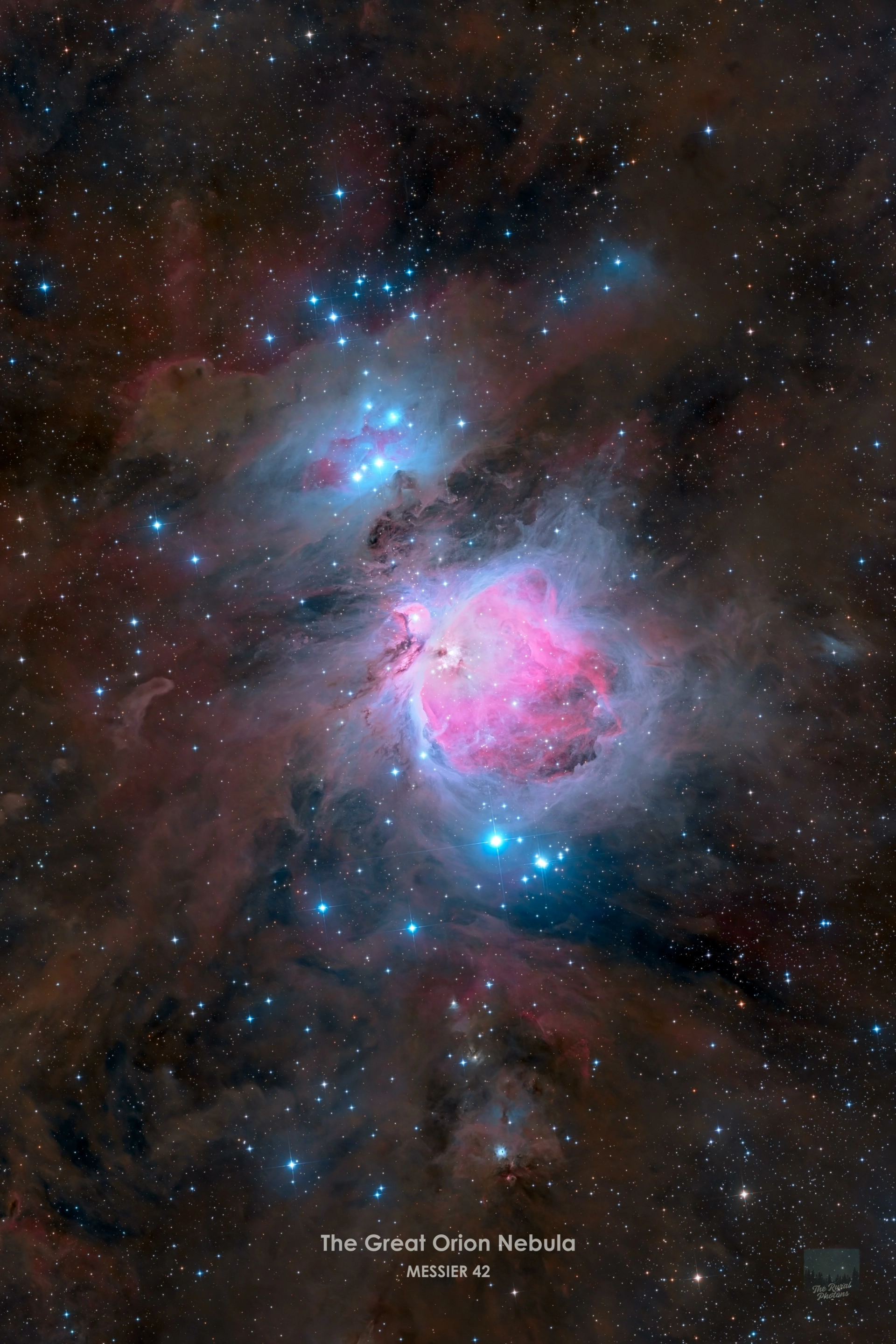
The Great Orion Nebula
Hello, everyone! Here’s my latest look at Orion, captured in just 102 minutes from my Bortle 4.5 backyard with the Sharpstar 13028 telescope and ToupTek 2600C astrophotography camera.
Do you notice anything different about this rendition? If you thought “white balance” that's exactly it! I went for SPCC of KV5 instead of Sb galaxy, or G2V or average spiral galaxy. This cooler white makes the Blue giants pop and add that contrast to the reddish hues of the nebula itself.
M42 is a stellar nursery, with young stars lighting up the gas around them. I love the detail in its bright centre, but this wider view gives the neighbouring objects some room too. Above M42 is the bluish Running Man Nebula. Its dust reflects light from nearby stars, while the darker gaps make up the figure that gave it its name.
Look near the bottom of the image for a much smaller blue glow: NGC 1999. Close-up images reveal a dark patch inside it shaped like a keyhole. Astronomers once thought it was a dense clump of dust blocking the light, but later observations showed it’s a cavity in the cloud. How that hole formed is still a mystery.
Clear skies,
Oleg
#space
source
Hello, everyone! Here’s my latest look at Orion, captured in just 102 minutes from my Bortle 4.5 backyard with the Sharpstar 13028 telescope and ToupTek 2600C astrophotography camera.
Do you notice anything different about this rendition? If you thought “white balance” that's exactly it! I went for SPCC of KV5 instead of Sb galaxy, or G2V or average spiral galaxy. This cooler white makes the Blue giants pop and add that contrast to the reddish hues of the nebula itself.
M42 is a stellar nursery, with young stars lighting up the gas around them. I love the detail in its bright centre, but this wider view gives the neighbouring objects some room too. Above M42 is the bluish Running Man Nebula. Its dust reflects light from nearby stars, while the darker gaps make up the figure that gave it its name.
Look near the bottom of the image for a much smaller blue glow: NGC 1999. Close-up images reveal a dark patch inside it shaped like a keyhole. Astronomers once thought it was a dense clump of dust blocking the light, but later observations showed it’s a cavity in the cloud. How that hole formed is still a mystery.
Clear skies,
Oleg
#space
source
0 reactions
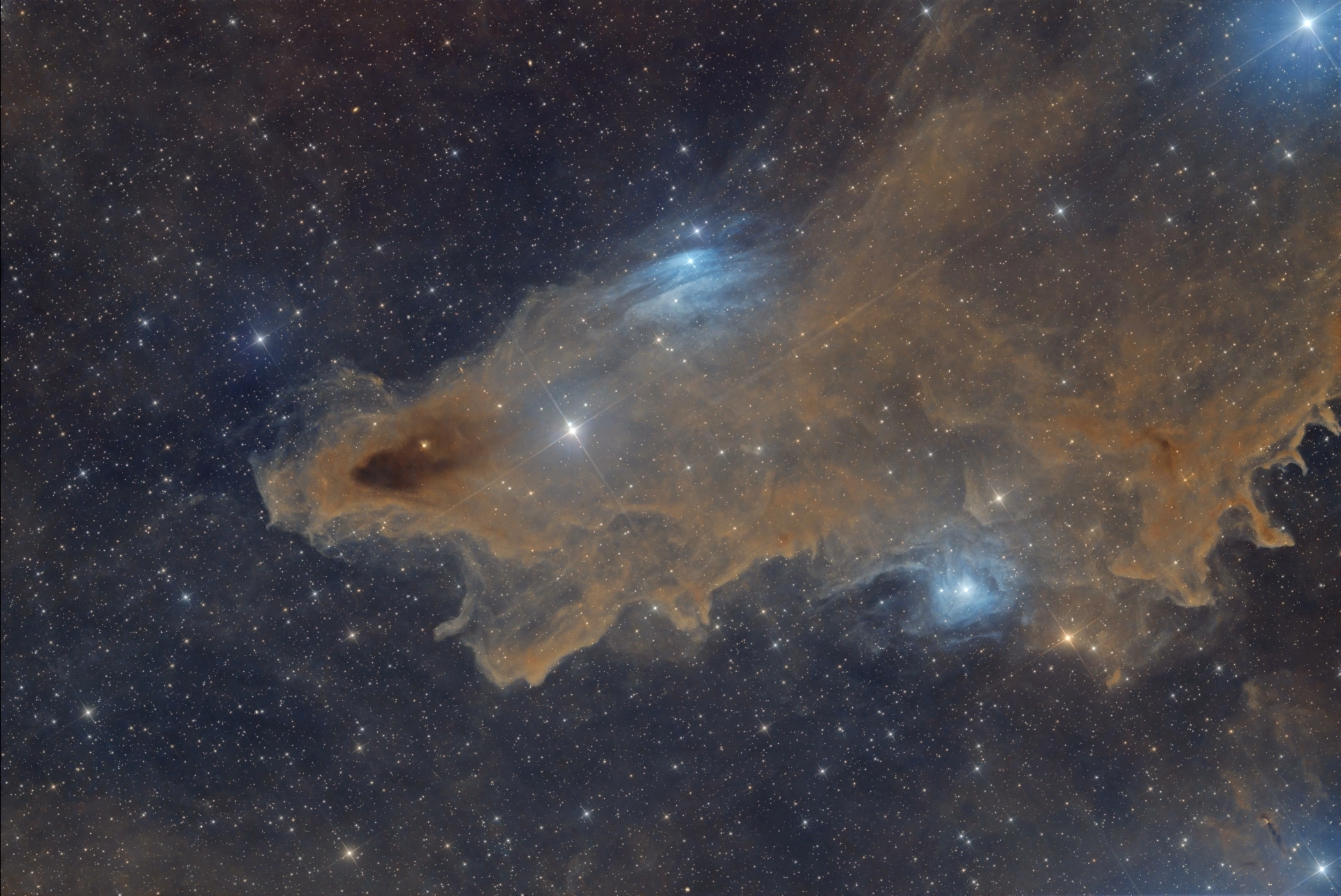
The Shark Nebula
My dark nebula safari continues! After imaging the Cosmic Bat (LDN 43) and the Giraffe Nebula (LDN 1295), I decided to go after one of the most famous shapes in the northern sky: LDN 1235, the Shark Nebula in the constellation Cepheus.
This is a massive dark molecular cloud, spanning about 15 light-years from head to tail. It doesn't emit light; instead, it blocks the starlight behind it. To capture the subtle brown dust and the faint blue reflection nebulae near the head (vdB 149/150), you cannot use narrowband filters. I shot this entirely unfiltered (Clear) to preserve the natural broadband colors.
The skies were quite dark, and with my fast f/3.4 optical system, the 104 exposures of 5 minutes yielded a very generous Signal-to-Noise ratio.
**Equipment:**
* **Telescope:** TS-ONTC Hypergraph 10″ (with 0.85x reducer, f/3.4)
* **Camera:** ZWO ASI2600MC DUO (-15°C)
* **Mount:** SkyWatcher EQ8R-Pro
* **Filter:** Optolong Clear (Broadband)
**Acquisition & Processing:**
* **Exposure:** 104 x 300s (Approx. 8h40m total integration).
* **Location:** Aveyron, France
* **Software:** N.I.N.A, PixInsight (DBE, SPCC, deconv, NXT, GHS), Affinity Photo.
Full HD image on my website: See first comment
#space
source
My dark nebula safari continues! After imaging the Cosmic Bat (LDN 43) and the Giraffe Nebula (LDN 1295), I decided to go after one of the most famous shapes in the northern sky: LDN 1235, the Shark Nebula in the constellation Cepheus.
This is a massive dark molecular cloud, spanning about 15 light-years from head to tail. It doesn't emit light; instead, it blocks the starlight behind it. To capture the subtle brown dust and the faint blue reflection nebulae near the head (vdB 149/150), you cannot use narrowband filters. I shot this entirely unfiltered (Clear) to preserve the natural broadband colors.
The skies were quite dark, and with my fast f/3.4 optical system, the 104 exposures of 5 minutes yielded a very generous Signal-to-Noise ratio.
**Equipment:**
* **Telescope:** TS-ONTC Hypergraph 10″ (with 0.85x reducer, f/3.4)
* **Camera:** ZWO ASI2600MC DUO (-15°C)
* **Mount:** SkyWatcher EQ8R-Pro
* **Filter:** Optolong Clear (Broadband)
**Acquisition & Processing:**
* **Exposure:** 104 x 300s (Approx. 8h40m total integration).
* **Location:** Aveyron, France
* **Software:** N.I.N.A, PixInsight (DBE, SPCC, deconv, NXT, GHS), Affinity Photo.
Full HD image on my website: See first comment
#space
source