Ghost of Cassiopeia IC 63, famously known as the "Ghost of…
0 reactions
Ghost of Cassiopeia
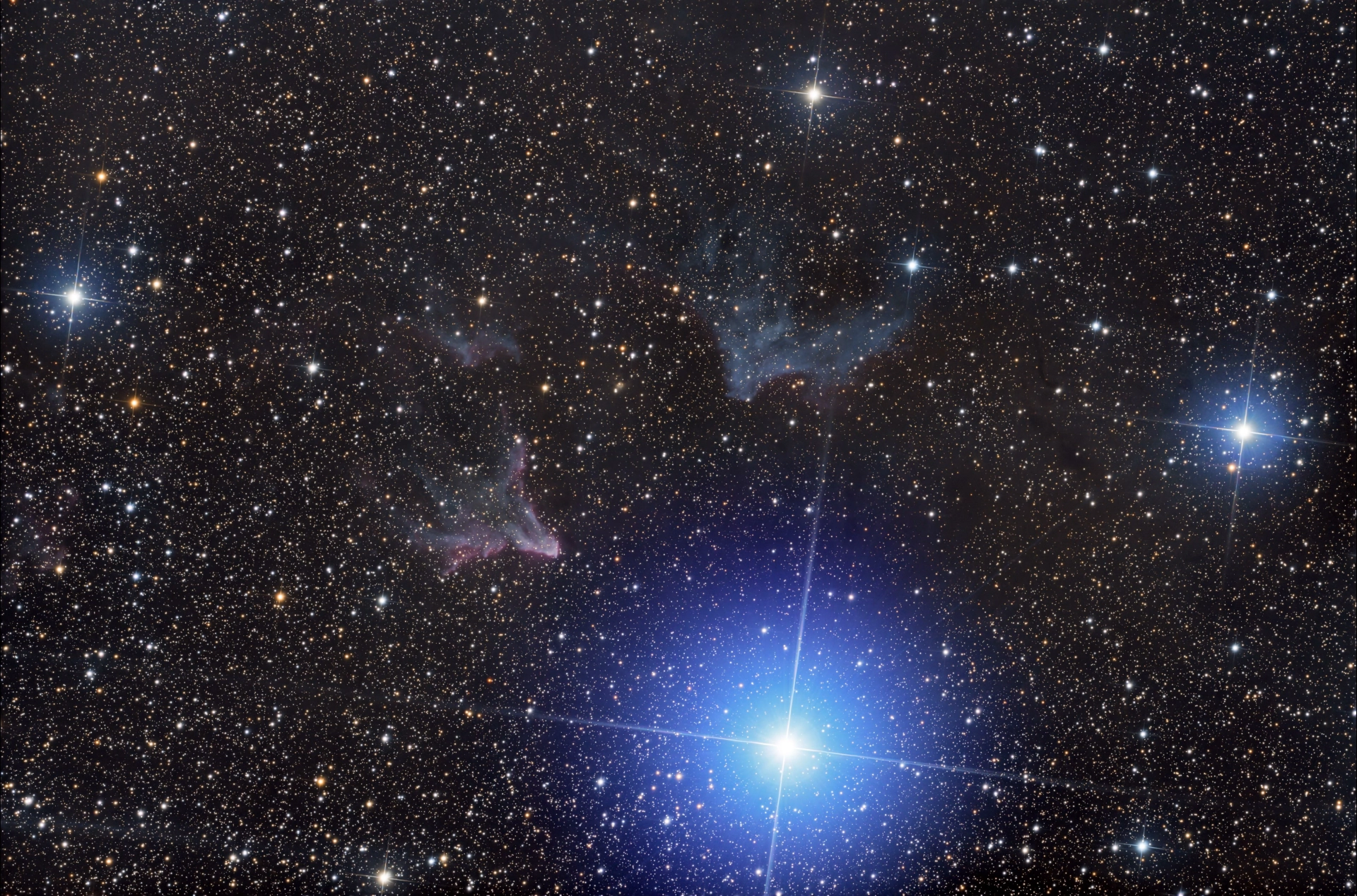
IC 63, famously known as the "Ghost of Cassiopeia," is a hauntingly beautiful nebula located roughly 550 light-years away in the constellation Cassiopeia. This target is a combination emission and reflection nebula. It is shaped like a ghostly arrow pointing directly at the violently bright, eruptive variable star **Gamma Cassiopeiae**, which sits just 3 to 4 light-years away from the gas clouds. The intense ultraviolet radiation from this massive blue star is actively blasting, ionizing, and slowly eroding the delicate hydrogen-alpha gas filaments of the nebula into deep space.
This image is a successful processing rescue of uncalibrated archival data captured during a 3-night session back in October 2023. Imaging a faint, ghostly structure right next to a blindingly bright magnitude 2 star presents an extreme challenge for an uncooled DSLR sensor, especially when processing without dark frames or flat fields
Telescope: Orion 8-inch f/3.9 Astrograph (Focuser drawtube custom-cut with a bandsaw to clear the light path, upcycled Celestron NexStar 8i dew shield, and a handmade primary mirror aperture mask ring to hide the factory mirror clips and force clean star spikes).
Camera: Unmodified, uncooled Canon 60D
Acquisition Details:
Integration Time: 9 hours 32 minutes
Frames: Lights-143 x 4-minutes subs ISO-1250
Location: Taken at the Backyard Country Observatory in Clarksdale Missouri
processing: Pixnlsight
Astrometric Solution: ImageSolver applied to the main integrated master to secure coordinates.
Star Isolation: StarXTerminator run on the raw linear data to split the image into independent Starlessand Stars-Only working layers.
Linear Extraction: Automatic Background Extraction (ABE) and SPCC color calibration executed strictly on the starless canvas, ensuring a mathematically perfect, flat sky with zero star boundary artifacts.
Targeted AI Enhancements: NoiseXTerminator run on the empty sky layer for a silky-smooth background, while BlurXTerminator was run on the stars-only layer to sharpen the dense core and tighten my engineered diffraction crosshairs.
Reassembly & Stretch: PixelMath used to recombine the layers before applying a careful, manual HistogramTransformation added light mask for curve saturations.
Photoshop CS5
Selective colors, levels, contrast, shadows and highlights.
#space
source
IC 63, famously known as the "Ghost of Cassiopeia," is a hauntingly beautiful nebula located roughly 550 light-years away in the constellation Cassiopeia. This target is a combination emission and reflection nebula. It is shaped like a ghostly arrow pointing directly at the violently bright, eruptive variable star **Gamma Cassiopeiae**, which sits just 3 to 4 light-years away from the gas clouds. The intense ultraviolet radiation from this massive blue star is actively blasting, ionizing, and slowly eroding the delicate hydrogen-alpha gas filaments of the nebula into deep space.
This image is a successful processing rescue of uncalibrated archival data captured during a 3-night session back in October 2023. Imaging a faint, ghostly structure right next to a blindingly bright magnitude 2 star presents an extreme challenge for an uncooled DSLR sensor, especially when processing without dark frames or flat fields
Telescope: Orion 8-inch f/3.9 Astrograph (Focuser drawtube custom-cut with a bandsaw to clear the light path, upcycled Celestron NexStar 8i dew shield, and a handmade primary mirror aperture mask ring to hide the factory mirror clips and force clean star spikes).
Camera: Unmodified, uncooled Canon 60D
Acquisition Details:
Integration Time: 9 hours 32 minutes
Frames: Lights-143 x 4-minutes subs ISO-1250
Location: Taken at the Backyard Country Observatory in Clarksdale Missouri
processing: Pixnlsight
Astrometric Solution: ImageSolver applied to the main integrated master to secure coordinates.
Star Isolation: StarXTerminator run on the raw linear data to split the image into independent Starlessand Stars-Only working layers.
Linear Extraction: Automatic Background Extraction (ABE) and SPCC color calibration executed strictly on the starless canvas, ensuring a mathematically perfect, flat sky with zero star boundary artifacts.
Targeted AI Enhancements: NoiseXTerminator run on the empty sky layer for a silky-smooth background, while BlurXTerminator was run on the stars-only layer to sharpen the dense core and tighten my engineered diffraction crosshairs.
Reassembly & Stretch: PixelMath used to recombine the layers before applying a careful, manual HistogramTransformation added light mask for curve saturations.
Photoshop CS5
Selective colors, levels, contrast, shadows and highlights.
#space
source


| 3,000 mlx | |
| 6 | |
| 0 |