It is crazy how Whitewashed the practice of roman slavery…
0 reactions
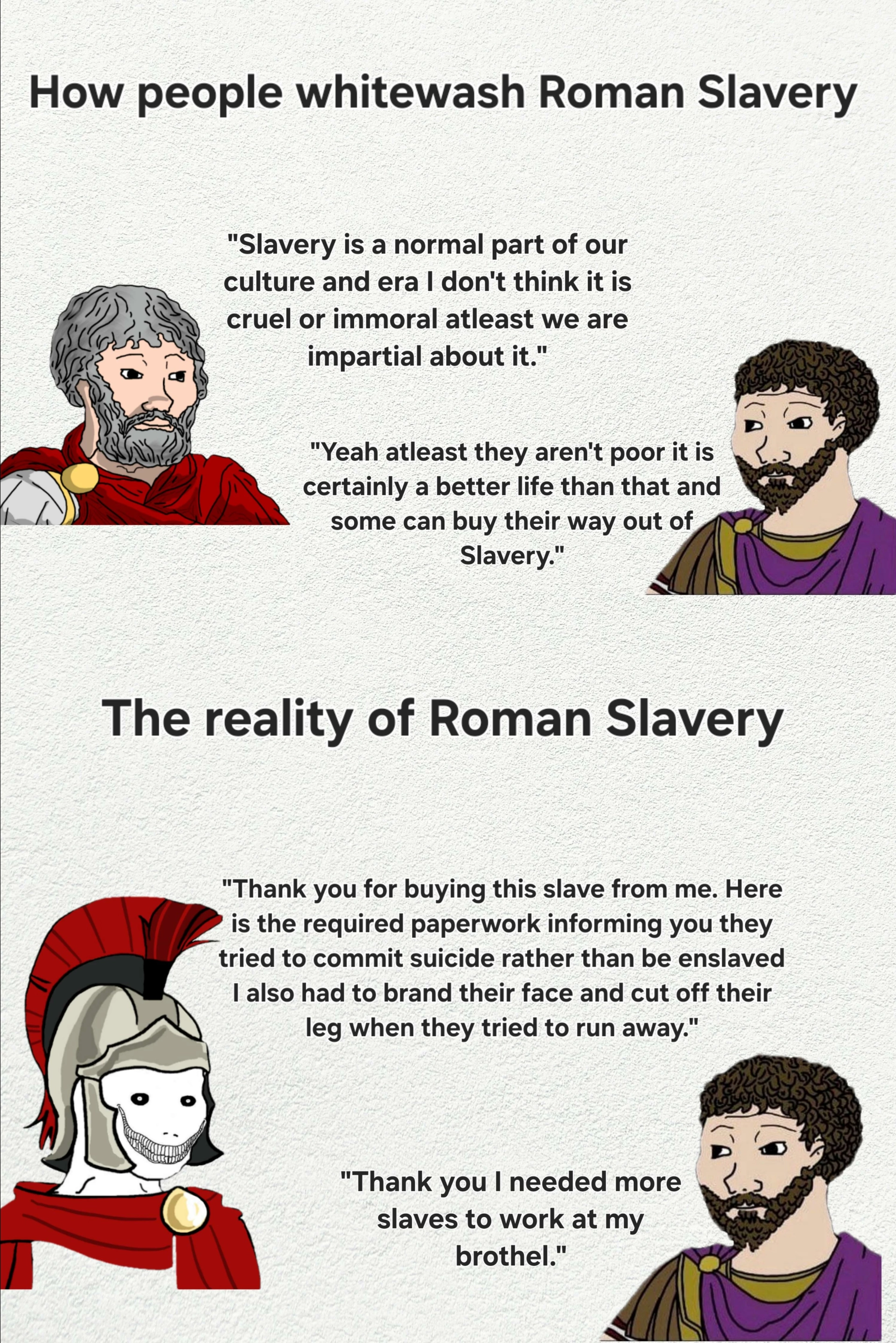
It is crazy how Whitewashed the practice of roman slavery has become
Context: Reports of mass suicide https://en.wikipedia.org/wiki/Mass_suicide r suicide https://en.wikipedia.org/wiki/Suicide y an individual to avoid enslavement or submission as a result of war are not rare in the Roman world.^(\[744\]) https://en.wikipedia.org/wiki/Slavery_in_ancient_Rome#cite_note-FOOTNOTEBradley,_''Slavery_and_Society_at_Rome''44,_111-788 n one incident, a group of captive Germanic women told Caracalla https://en.wikipedia.org/wiki/Caracalla hat they would rather be executed than enslaved. When he ordered them sold anyway, they committed suicide en masse, some of them first killing their children.^(\[745\]) https://en.wikipedia.org/wiki/Slavery_in_ancient_Rome#cite_note-FOOTNOTEBradley,_%22On_Captives_under_the_Principate%22314,_citing_Cassius_Dio_77.14.2.-789
Such an act could be considered honorable or rational in antiquity, and a slave might commit suicide for the same reasons a free person would, such as an agonizing health condition, religious fanaticism, or mental health crisis.^(\[746\]) https://en.wikipedia.org/wiki/Slavery_in_ancient_Rome#cite_note-FOOTNOTEBradley,_''Slavery_and_Society_at_Rome''122-790 ut suicide among the enslaved might also be the ultimate way to resist and escape the master's control or abuse. One of Cato https://en.wikipedia.org/wiki/Cato_the_Elder's slaves was so distraught after doing something he thought his master would disapprove of that he killed himself.^(\[747\]) https://en.wikipedia.org/wiki/Slavery_in_ancient_Rome#cite_note-FOOTNOTEBradley,_''Slavery_and_Society_at_Rome''111_,_citing_Plutarch,_''Cato_the_Elder''_10.5.-791 n inscription from Moguntiacum https://en.wikipedia.org/wiki/Moguntiacum ecords the killing of a freedman by one of his slaves, who then committed suicide by drowning himself in a river.^(\[748\]) https://en.wikipedia.org/wiki/Slavery_in_ancient_Rome#cite_note-FOOTNOTEBradley,_''Slavery_and_Society_at_Rome''111%E2%80%93112,_citing_''CIL''_13.7070.-792
Roman law recognized that slaves might be driven to suicidal despair. A suicide attempt was one of the pieces of information about a slave that had to be disclosed on a bill of sale, indicating that such attempts occurred often enough to be of concern. However, the law did not always regard slaves as criminally fugitive if they ran away in despair and attempted suicide. The jurist Paulus https://en.wikipedia.org/wiki/Julius_Paulus rote, "A slave acts to commit suicide when he seeks death out of wickedness or evil ways or because of some crime that he has committed, but not when he is able no longer to bear his bodily pain."^(\[749\]) https://en.wikipedia.org/wiki/Slavery_in_ancient_Rome#cite_note-FOOTNOTEBradley,_''Slavery_and_Society_at_Rome''112_,_citing_''Digest''_21.1.17.4_([[Vivianus_(jurist|Vivianus]]),_21.1.17.6_([Gnaeus_Arulenus_Caelius_Sabinus|Caelius]]),_and_21.1.43.4_([[Julius_Paulus|Paulus]]).-793 )
Fugitive slaves might be marked by letters tattooed on their forehead, called *stigmata* in Greek and Latin sources,[^(\[692\]) https://en.wikipedia.org/wiki/Slavery_in_ancient_Rome#cite_note-FOOTNOTEFuhrmann,_''Policing_the_Roman_Empire''29-733 practice most attested as a consequence of condemnation to hard labor https://en.wikipedia.org/wiki/Slavery_in_ancient_Rome#Hard_labor.^(\[693\ ]) https://en.wikipedia.org/wiki/Slavery_in_ancient_Rome#cite_note-734 he tattooing of slaves had been expressly banned in Hellenistic Egypt https://en.wikipedia.org/wiki/Hellenistic_Egypt xcept as part of a criminal sentence, when a forehead tattoo came with a beating.^(\[694\]) https://en.wikipedia.org/wiki/Slavery_in_ancient_Rome#cite_note-735 he Romans picked up slave tattooing from the Greeks, who in turn had acquired it from the Persians.^(\[695\]) https://en.wikipedia.org/wiki/Slavery_in_ancient_Rome#cite_note-736 ttic comedy https://en.wikipedia.org/wiki/Attic_comedy requently mentions slave *stigmata*, and the most notable passage in Latin literature comes in the *Satyricon* https://en.wikipedia.org/wiki/Satyricon hen Encolpius and Giton fake tattooing as an absurd form of disguise.^(\[696\]) https://en.wikipedia.org/wiki/Slavery_in_ancient_Rome#cite_note-737 attooing slaves with text to mark them as previous fugitives is most abundantly attested among the Greeks, and there is "no direct evidence for what was inscribed on runaways' foreheads in Rome",^(\[697\]) https://en.wikipedia.org/wiki/Slavery_in_ancient_Rome#cite_note-FOOTNOTEKamen,_%22A_Corpus_of_Inscriptions%22101-738 hough criminals generally were labeled with the name of their crime.^(\[698\]) https://en.wikipedia.org/wiki/Slavery_in_ancient_Rome#cite_note-739 iterature alludes to the practice, as when the epigrammatist Martial https://en.wikipedia.org/wiki/Martial atirizes a luxuriously attired freedman at the theater who keeps his inscribed forehead under wraps, and Libanius https://en.wikipedia.org/wiki/Libanius entions a slave growing out bangs https://en.wikipedia.org/wiki/Bangs_(hair ) o cover his stigmata.^(\[699\]) https://en.wikipedia.org/wiki/Slavery_in_ancient_Rome#cite_note-FOOTNOTEKamen,_%22A_Corpus_of_Inscriptions%22104,_citing_Martial,_2.29.9%E2%80%9310_and_Libanius_25.3.-740
In inscriptions from the Temple of Asclepius https://en.wikipedia.org/wiki/Sanctuary_of_Asclepius,_Epidaurus t Epidaurus https://en.wikipedia.org/wiki/Epidaurus , Greek slaves who had been tattooed ask the god to remove their markings, and in some cases thank him for doing so.^(\[700\]) https://en.wikipedia.org/wiki/Slavery_in_ancient_Rome#cite_note-FOOTNOTEKamen,_%22A_Corpus_of_Inscriptions%22106-741 ess miraculous means might also be sought, as various sources record medical procedures for removing stigmata, mostly herbal applications for which complete success was not guaranteed.^(\[701\]) https://en.wikipedia.org/wiki/Slavery_in_ancient_Rome#cite_note-742^(\[702\ ]) https://en.wikipedia.org/wiki/Slavery_in_ancient_Rome#cite_note-FOOTNOTEKamen,_%22A_Corpus_of_Inscriptions%22105%E2%80%93107-743
The evidence for Roman branding of slaves is less certain.^(\[703\]) https://en.wikipedia.org/wiki/Slavery_in_ancient_Rome#cite_note-744^(\[704\ ]) https://en.wikipedia.org/wiki/Slavery_in_ancient_Rome#cite_note-FOOTNOTEKamen,_%22A_Corpus_of_Inscriptions%22100-745 he methodical tortures to which slaves were subjected juridically included the application of hot metal plates or rods,^(\[705\]) https://en.wikipedia.org/wiki/Slavery_in_ancient_Rome#cite_note-746 hich would leave marks that could be seen as brands,^(\[706\]) https://en.wikipedia.org/wiki/Slavery_in_ancient_Rome#cite_note-FOOTNOTEKamen,_%22A_Corpus_of_Inscriptions%2295,_98-747 ince the branding of herd animals is known in the Roman world.^(\[707\]) https://en.wikipedia.org/wiki/Slavery_in_ancient_Rome#cite_note-748 he scars left by whipping were also "read" as inscribing slaves.^(\[708\]) https://en.wikipedia.org/wiki/Slavery_in_ancient_Rome#cite_note-FOOTNOTEKamen,_%22A_Corpus_of_Inscriptions%2296%E2%80%9397,_99-749
Slaves who played visible or public roles on behalf of a household, and female slaves in general, were not disfigured with markings.^(\[709\]) https://en.wikipedia.org/wiki/Slavery_in_ancient_Rome#cite_note-FOOTNOTEKamen,_%22A_Corpus_of_Inscriptions%2295-750 hat stigmatized slaves were those who had been marked as irredeemably criminal is indicated by their inclusion among the *dediticii* https://en.wikipedia.org/wiki/Dediticii , those who held no citizen rights even if manumitted.
Such acts of casual sadism^(\[676\]) https://en.wikipedia.org/wiki/Slavery_in_ancient_Rome#cite_note-717 re perhaps to be distinguished from the head of household's ancient right to pass sentence on a dependent for perceived wrongdoing, but the slaveholder's right to punish a slave was only weakly limited by law.^(\[615\]) https://en.wikipedia.org/wiki/Slavery_in_ancient_Rome#cite_note-FOOTNOTEParker,_%22Crucially_Funny_or_Tranio_on_the_Couch%22237-653 he censors https://en.wikipedia.org/wiki/Roman_censor ere a countervailing moral authority *(regimen morum)* if the *paterfamilias* exceeded community standards of cruelty, but the office was often left vacant or manipulated toward other ideological ends, and there is little or no evidence that the censors would rebuke others of their class for the abuse of slaves.^(\[677\]) https://en.wikipedia.org/wiki/Slavery_in_ancient_Rome#cite_note-FOOTNOTEWatson,_%22Roman_Slave_Law_and_Romanist_Ideology%22,_citing_the_Greek_historian_[[Dionysius_of_Halicarnassus|Dionysius]]_''Roman_Antiquities''_20.13_as_%22weak%22_evidence_of_censorial_powers_and_likely_not_well_informed.-718 nless the excessive cruelty had been blatantly public, there was no process for bringing it to the attention of the authorities—the slave boy targeted by Vedius was saved extrajudicially by the chance presence of an emperor willing to be offended,^(\[678\]) https://en.wikipedia.org/wiki/Slavery_in_ancient_Rome#cite_note-FOOTNOTEWatson,_''Roman_Slave_Law''55%E2%80%9356-719 he only person with the authority to stop what was allowed by law.^(\[679\]) https://en.wikipedia.org/wiki/Slavery_in_ancient_Rome#cite_note-720
When slaves did commit an actual crime, the penalties prescribed by law were far more severe than for free persons. For instance, the regular penalty for counterfeiting https://en.wikipedia.org/wiki/Counterfeiting as deportation and confiscation of property, but a slave was put to death.^(\[680\]) https://en.wikipedia.org/wiki/Slavery_in_ancient_Rome#cite_note-FOOTNOTEBradley,_%22Roman_Slavery_and_Roman_Law%22491%E2%80%93492-721 he liberty of a Roman citizen, by contrast, was defined by freedom from physical coercion and by the judicial right of appeal after receiving a capital sentence.^(\[681\]) https://en.wikipedia.org/wiki/Slavery_in_ancient_Rome#cite_note-722 his definition holds into the early Imperial era as a common understanding: in the Acts of the Apostles https://en.wikipedia.org/wiki/Acts_of_the_Apostles , when Paul https://en.wikipedia.org/wiki/Paul_the_Apostle sserts his rights as a Roman citizen to a centurion https://en.wikipedia.org/wiki/Centurion fter having been bound and threatened with flogging, the tribune https://en.wikipedia.org/wiki/Military_tribune ho has seized him acknowledges the error by backing off.^(\[682\]) https://en.wikipedia.org/wiki/Slavery_in_ancient_Rome#cite_note-723
In the later Imperial era, the status of "convict" versus "slave" often becomes a distinction without a practical difference,^(\[683\]) https://en.wikipedia.org/wiki/Slavery_in_ancient_Rome#cite_note-724 s free people of lower social status were increasingly subjected to more severe legal penalties once reserved for slaves.
Christian historiography claims that emperor Constantius Flavius Valerius Aurelius (272–337 CE) implemented new legislation that introduced amputation as punishment. Slaves caught trying to escape imprisonment either were killed, sentenced to hard labor in the mines, or subjected to the amputation of a leg \[8 https://pmc.ncbi.nlm.nih.gov/articles/PMC4160514/#CR8\ ]. The exact dates of these abuses are not known. Additionally, it is believed that the first punitive amputation of this era within the Byzantine territory took place during the reign of Isaurian, who made crucial reforms to the criminal provisions of Roman law, in order to replace the death penalty. Leo III revised the previous laws, introducing amputation as a substitute for the death penalty \[5 https://pmc.ncbi.nlm.nih.gov/articles/PMC4160514/#CR5\ ]. Despite implementing alternatives to the death penalty, executions continued to occur. Executions sometimes mutated into sadistic rituals, where representatives of the judiciary tortured the criminal, severing limbs and using knives of various shapes until the criminal died. Phocas, the Byzantine Emperor, introduced and applied particularly cruel methods of torture and punishment including forced blindness and amputation \[20 https://pmc.ncbi.nlm.nih.gov/articles/PMC4160514/#CR20\ ]. Even the Agricultural Law of the 7th and 8th centuries condoned amputation for merely stealing grapes or fruits from foreign ownership \[2 https://pmc.ncbi.nlm.nih.gov/articles/PMC4160514/#CR2\ ].
https://pmc.ncbi.nlm.nih.gov/articles/PMC4160514/
#history awaaTTwtUwTaTTswTLatmsLtTwfATeTawrABtIbo
Context: Reports of mass suicide https://en.wikipedia.org/wiki/Mass_suicide r suicide https://en.wikipedia.org/wiki/Suicide y an individual to avoid enslavement or submission as a result of war are not rare in the Roman world.^(\[744\]) https://en.wikipedia.org/wiki/Slavery_in_ancient_Rome#cite_note-FOOTNOTEBradley,_''Slavery_and_Society_at_Rome''44,_111-788 n one incident, a group of captive Germanic women told Caracalla https://en.wikipedia.org/wiki/Caracalla hat they would rather be executed than enslaved. When he ordered them sold anyway, they committed suicide en masse, some of them first killing their children.^(\[745\]) https://en.wikipedia.org/wiki/Slavery_in_ancient_Rome#cite_note-FOOTNOTEBradley,_%22On_Captives_under_the_Principate%22314,_citing_Cassius_Dio_77.14.2.-789
Such an act could be considered honorable or rational in antiquity, and a slave might commit suicide for the same reasons a free person would, such as an agonizing health condition, religious fanaticism, or mental health crisis.^(\[746\]) https://en.wikipedia.org/wiki/Slavery_in_ancient_Rome#cite_note-FOOTNOTEBradley,_''Slavery_and_Society_at_Rome''122-790 ut suicide among the enslaved might also be the ultimate way to resist and escape the master's control or abuse. One of Cato https://en.wikipedia.org/wiki/Cato_the_Elder's slaves was so distraught after doing something he thought his master would disapprove of that he killed himself.^(\[747\]) https://en.wikipedia.org/wiki/Slavery_in_ancient_Rome#cite_note-FOOTNOTEBradley,_''Slavery_and_Society_at_Rome''111_,_citing_Plutarch,_''Cato_the_Elder''_10.5.-791 n inscription from Moguntiacum https://en.wikipedia.org/wiki/Moguntiacum ecords the killing of a freedman by one of his slaves, who then committed suicide by drowning himself in a river.^(\[748\]) https://en.wikipedia.org/wiki/Slavery_in_ancient_Rome#cite_note-FOOTNOTEBradley,_''Slavery_and_Society_at_Rome''111%E2%80%93112,_citing_''CIL''_13.7070.-792
Roman law recognized that slaves might be driven to suicidal despair. A suicide attempt was one of the pieces of information about a slave that had to be disclosed on a bill of sale, indicating that such attempts occurred often enough to be of concern. However, the law did not always regard slaves as criminally fugitive if they ran away in despair and attempted suicide. The jurist Paulus https://en.wikipedia.org/wiki/Julius_Paulus rote, "A slave acts to commit suicide when he seeks death out of wickedness or evil ways or because of some crime that he has committed, but not when he is able no longer to bear his bodily pain."^(\[749\]) https://en.wikipedia.org/wiki/Slavery_in_ancient_Rome#cite_note-FOOTNOTEBradley,_''Slavery_and_Society_at_Rome''112_,_citing_''Digest''_21.1.17.4_([[Vivianus_(jurist|Vivianus]]),_21.1.17.6_([Gnaeus_Arulenus_Caelius_Sabinus|Caelius]]),_and_21.1.43.4_([[Julius_Paulus|Paulus]]).-793 )
Fugitive slaves might be marked by letters tattooed on their forehead, called *stigmata* in Greek and Latin sources,[^(\[692\]) https://en.wikipedia.org/wiki/Slavery_in_ancient_Rome#cite_note-FOOTNOTEFuhrmann,_''Policing_the_Roman_Empire''29-733 practice most attested as a consequence of condemnation to hard labor https://en.wikipedia.org/wiki/Slavery_in_ancient_Rome#Hard_labor.^(\[693\ ]) https://en.wikipedia.org/wiki/Slavery_in_ancient_Rome#cite_note-734 he tattooing of slaves had been expressly banned in Hellenistic Egypt https://en.wikipedia.org/wiki/Hellenistic_Egypt xcept as part of a criminal sentence, when a forehead tattoo came with a beating.^(\[694\]) https://en.wikipedia.org/wiki/Slavery_in_ancient_Rome#cite_note-735 he Romans picked up slave tattooing from the Greeks, who in turn had acquired it from the Persians.^(\[695\]) https://en.wikipedia.org/wiki/Slavery_in_ancient_Rome#cite_note-736 ttic comedy https://en.wikipedia.org/wiki/Attic_comedy requently mentions slave *stigmata*, and the most notable passage in Latin literature comes in the *Satyricon* https://en.wikipedia.org/wiki/Satyricon hen Encolpius and Giton fake tattooing as an absurd form of disguise.^(\[696\]) https://en.wikipedia.org/wiki/Slavery_in_ancient_Rome#cite_note-737 attooing slaves with text to mark them as previous fugitives is most abundantly attested among the Greeks, and there is "no direct evidence for what was inscribed on runaways' foreheads in Rome",^(\[697\]) https://en.wikipedia.org/wiki/Slavery_in_ancient_Rome#cite_note-FOOTNOTEKamen,_%22A_Corpus_of_Inscriptions%22101-738 hough criminals generally were labeled with the name of their crime.^(\[698\]) https://en.wikipedia.org/wiki/Slavery_in_ancient_Rome#cite_note-739 iterature alludes to the practice, as when the epigrammatist Martial https://en.wikipedia.org/wiki/Martial atirizes a luxuriously attired freedman at the theater who keeps his inscribed forehead under wraps, and Libanius https://en.wikipedia.org/wiki/Libanius entions a slave growing out bangs https://en.wikipedia.org/wiki/Bangs_(hair ) o cover his stigmata.^(\[699\]) https://en.wikipedia.org/wiki/Slavery_in_ancient_Rome#cite_note-FOOTNOTEKamen,_%22A_Corpus_of_Inscriptions%22104,_citing_Martial,_2.29.9%E2%80%9310_and_Libanius_25.3.-740
In inscriptions from the Temple of Asclepius https://en.wikipedia.org/wiki/Sanctuary_of_Asclepius,_Epidaurus t Epidaurus https://en.wikipedia.org/wiki/Epidaurus , Greek slaves who had been tattooed ask the god to remove their markings, and in some cases thank him for doing so.^(\[700\]) https://en.wikipedia.org/wiki/Slavery_in_ancient_Rome#cite_note-FOOTNOTEKamen,_%22A_Corpus_of_Inscriptions%22106-741 ess miraculous means might also be sought, as various sources record medical procedures for removing stigmata, mostly herbal applications for which complete success was not guaranteed.^(\[701\]) https://en.wikipedia.org/wiki/Slavery_in_ancient_Rome#cite_note-742^(\[702\ ]) https://en.wikipedia.org/wiki/Slavery_in_ancient_Rome#cite_note-FOOTNOTEKamen,_%22A_Corpus_of_Inscriptions%22105%E2%80%93107-743
The evidence for Roman branding of slaves is less certain.^(\[703\]) https://en.wikipedia.org/wiki/Slavery_in_ancient_Rome#cite_note-744^(\[704\ ]) https://en.wikipedia.org/wiki/Slavery_in_ancient_Rome#cite_note-FOOTNOTEKamen,_%22A_Corpus_of_Inscriptions%22100-745 he methodical tortures to which slaves were subjected juridically included the application of hot metal plates or rods,^(\[705\]) https://en.wikipedia.org/wiki/Slavery_in_ancient_Rome#cite_note-746 hich would leave marks that could be seen as brands,^(\[706\]) https://en.wikipedia.org/wiki/Slavery_in_ancient_Rome#cite_note-FOOTNOTEKamen,_%22A_Corpus_of_Inscriptions%2295,_98-747 ince the branding of herd animals is known in the Roman world.^(\[707\]) https://en.wikipedia.org/wiki/Slavery_in_ancient_Rome#cite_note-748 he scars left by whipping were also "read" as inscribing slaves.^(\[708\]) https://en.wikipedia.org/wiki/Slavery_in_ancient_Rome#cite_note-FOOTNOTEKamen,_%22A_Corpus_of_Inscriptions%2296%E2%80%9397,_99-749
Slaves who played visible or public roles on behalf of a household, and female slaves in general, were not disfigured with markings.^(\[709\]) https://en.wikipedia.org/wiki/Slavery_in_ancient_Rome#cite_note-FOOTNOTEKamen,_%22A_Corpus_of_Inscriptions%2295-750 hat stigmatized slaves were those who had been marked as irredeemably criminal is indicated by their inclusion among the *dediticii* https://en.wikipedia.org/wiki/Dediticii , those who held no citizen rights even if manumitted.
Such acts of casual sadism^(\[676\]) https://en.wikipedia.org/wiki/Slavery_in_ancient_Rome#cite_note-717 re perhaps to be distinguished from the head of household's ancient right to pass sentence on a dependent for perceived wrongdoing, but the slaveholder's right to punish a slave was only weakly limited by law.^(\[615\]) https://en.wikipedia.org/wiki/Slavery_in_ancient_Rome#cite_note-FOOTNOTEParker,_%22Crucially_Funny_or_Tranio_on_the_Couch%22237-653 he censors https://en.wikipedia.org/wiki/Roman_censor ere a countervailing moral authority *(regimen morum)* if the *paterfamilias* exceeded community standards of cruelty, but the office was often left vacant or manipulated toward other ideological ends, and there is little or no evidence that the censors would rebuke others of their class for the abuse of slaves.^(\[677\]) https://en.wikipedia.org/wiki/Slavery_in_ancient_Rome#cite_note-FOOTNOTEWatson,_%22Roman_Slave_Law_and_Romanist_Ideology%22,_citing_the_Greek_historian_[[Dionysius_of_Halicarnassus|Dionysius]]_''Roman_Antiquities''_20.13_as_%22weak%22_evidence_of_censorial_powers_and_likely_not_well_informed.-718 nless the excessive cruelty had been blatantly public, there was no process for bringing it to the attention of the authorities—the slave boy targeted by Vedius was saved extrajudicially by the chance presence of an emperor willing to be offended,^(\[678\]) https://en.wikipedia.org/wiki/Slavery_in_ancient_Rome#cite_note-FOOTNOTEWatson,_''Roman_Slave_Law''55%E2%80%9356-719 he only person with the authority to stop what was allowed by law.^(\[679\]) https://en.wikipedia.org/wiki/Slavery_in_ancient_Rome#cite_note-720
When slaves did commit an actual crime, the penalties prescribed by law were far more severe than for free persons. For instance, the regular penalty for counterfeiting https://en.wikipedia.org/wiki/Counterfeiting as deportation and confiscation of property, but a slave was put to death.^(\[680\]) https://en.wikipedia.org/wiki/Slavery_in_ancient_Rome#cite_note-FOOTNOTEBradley,_%22Roman_Slavery_and_Roman_Law%22491%E2%80%93492-721 he liberty of a Roman citizen, by contrast, was defined by freedom from physical coercion and by the judicial right of appeal after receiving a capital sentence.^(\[681\]) https://en.wikipedia.org/wiki/Slavery_in_ancient_Rome#cite_note-722 his definition holds into the early Imperial era as a common understanding: in the Acts of the Apostles https://en.wikipedia.org/wiki/Acts_of_the_Apostles , when Paul https://en.wikipedia.org/wiki/Paul_the_Apostle sserts his rights as a Roman citizen to a centurion https://en.wikipedia.org/wiki/Centurion fter having been bound and threatened with flogging, the tribune https://en.wikipedia.org/wiki/Military_tribune ho has seized him acknowledges the error by backing off.^(\[682\]) https://en.wikipedia.org/wiki/Slavery_in_ancient_Rome#cite_note-723
In the later Imperial era, the status of "convict" versus "slave" often becomes a distinction without a practical difference,^(\[683\]) https://en.wikipedia.org/wiki/Slavery_in_ancient_Rome#cite_note-724 s free people of lower social status were increasingly subjected to more severe legal penalties once reserved for slaves.
Christian historiography claims that emperor Constantius Flavius Valerius Aurelius (272–337 CE) implemented new legislation that introduced amputation as punishment. Slaves caught trying to escape imprisonment either were killed, sentenced to hard labor in the mines, or subjected to the amputation of a leg \[8 https://pmc.ncbi.nlm.nih.gov/articles/PMC4160514/#CR8\ ]. The exact dates of these abuses are not known. Additionally, it is believed that the first punitive amputation of this era within the Byzantine territory took place during the reign of Isaurian, who made crucial reforms to the criminal provisions of Roman law, in order to replace the death penalty. Leo III revised the previous laws, introducing amputation as a substitute for the death penalty \[5 https://pmc.ncbi.nlm.nih.gov/articles/PMC4160514/#CR5\ ]. Despite implementing alternatives to the death penalty, executions continued to occur. Executions sometimes mutated into sadistic rituals, where representatives of the judiciary tortured the criminal, severing limbs and using knives of various shapes until the criminal died. Phocas, the Byzantine Emperor, introduced and applied particularly cruel methods of torture and punishment including forced blindness and amputation \[20 https://pmc.ncbi.nlm.nih.gov/articles/PMC4160514/#CR20\ ]. Even the Agricultural Law of the 7th and 8th centuries condoned amputation for merely stealing grapes or fruits from foreign ownership \[2 https://pmc.ncbi.nlm.nih.gov/articles/PMC4160514/#CR2\ ].
https://pmc.ncbi.nlm.nih.gov/articles/PMC4160514/
#history awaaTTwtUwTaTTswTLatmsLtTwfATeTawrABtIbo


| 0 mlx | |
| 4 | |
| 0 |