0 reactions
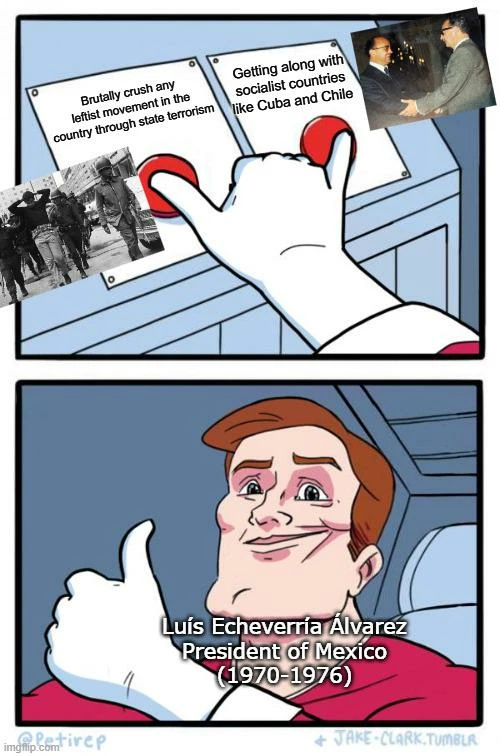
The duality of the Mexican president.
**Follow me through a brief tour in third-world politics during Cold War.**
>He visited a total of 36 countries and had strong ties with the communist and socialist governments of Cuba and Chile respectively. Echeverría visited Cuba in 1975. Also, Mexico provided political asylum to many political refugees from South American countries who fled their country's repressive military dictatorships; among them Hortensia Bussi, the widow of former Chilean President Salvador Allende. Moreover, he condemned Zionism and allowed the Palestine Liberation Organization to open an office in the capital.
https://en.wikipedia.org/wik https://en.wikipedia.org/wiki/Luis https://en.wikipedia.org/wiki/Luis_Echeverría#Foreign_policy
>On one hand, several leftist guerrilla groups appeared throughout the country (the most important being those led by Lucio Cabañas and Genaro Vázquez in Guerrero, as well as the urban guerrilla Liga Comunista 23 de Septiembre) in response to the government's authoritarianism and increasing social inequalities. The activities of these guerrilla groups mostly comprised kidnappings of prominent politicians and businessmen (two of the most famous cases included the kidnapping of José Guadalupe Zuno, who was Echeverría's father-in-law, and the failed kidnapping attempt of Eugenio Garza Sada, which ended in his death), bank robberies and occasional attacks on garrisons.
And on the other hand, the Government itself violently repressed political dissent. In addition to the notorious 1971 Corpus Christi massacre, the Army was accused of widespread human rights violations (including executions) during the fight against the guerrilla groups. The aforementioned guerrilla leaders Cabañas and Vázquez, both of whom officially died in clashes with the army, are widely suspected of actually having been extrajudicially executed by the armed forces.
https://en.wikipedia.org/wiki/Luis \_Echeverría#Di https://en.wikipedia.org/wiki/Luis https://en.wikipedia.org/wiki/Luis_Echeverría#Dirty_War_and_political_violence
#history
**Follow me through a brief tour in third-world politics during Cold War.**
>He visited a total of 36 countries and had strong ties with the communist and socialist governments of Cuba and Chile respectively. Echeverría visited Cuba in 1975. Also, Mexico provided political asylum to many political refugees from South American countries who fled their country's repressive military dictatorships; among them Hortensia Bussi, the widow of former Chilean President Salvador Allende. Moreover, he condemned Zionism and allowed the Palestine Liberation Organization to open an office in the capital.
https://en.wikipedia.org/wik https://en.wikipedia.org/wiki/Luis https://en.wikipedia.org/wiki/Luis_Echeverría#Foreign_policy
>On one hand, several leftist guerrilla groups appeared throughout the country (the most important being those led by Lucio Cabañas and Genaro Vázquez in Guerrero, as well as the urban guerrilla Liga Comunista 23 de Septiembre) in response to the government's authoritarianism and increasing social inequalities. The activities of these guerrilla groups mostly comprised kidnappings of prominent politicians and businessmen (two of the most famous cases included the kidnapping of José Guadalupe Zuno, who was Echeverría's father-in-law, and the failed kidnapping attempt of Eugenio Garza Sada, which ended in his death), bank robberies and occasional attacks on garrisons.
And on the other hand, the Government itself violently repressed political dissent. In addition to the notorious 1971 Corpus Christi massacre, the Army was accused of widespread human rights violations (including executions) during the fight against the guerrilla groups. The aforementioned guerrilla leaders Cabañas and Vázquez, both of whom officially died in clashes with the army, are widely suspected of actually having been extrajudicially executed by the armed forces.
https://en.wikipedia.org/wiki/Luis \_Echeverría#Di https://en.wikipedia.org/wiki/Luis https://en.wikipedia.org/wiki/Luis_Echeverría#Dirty_War_and_political_violence
#history


| 4,000 mlx | |
| 5 | |
| 0 |