Vive l'Empereur! Louis Napoleon, the nephew of Napoleon…
0 reactions
Vive l'Empereur!
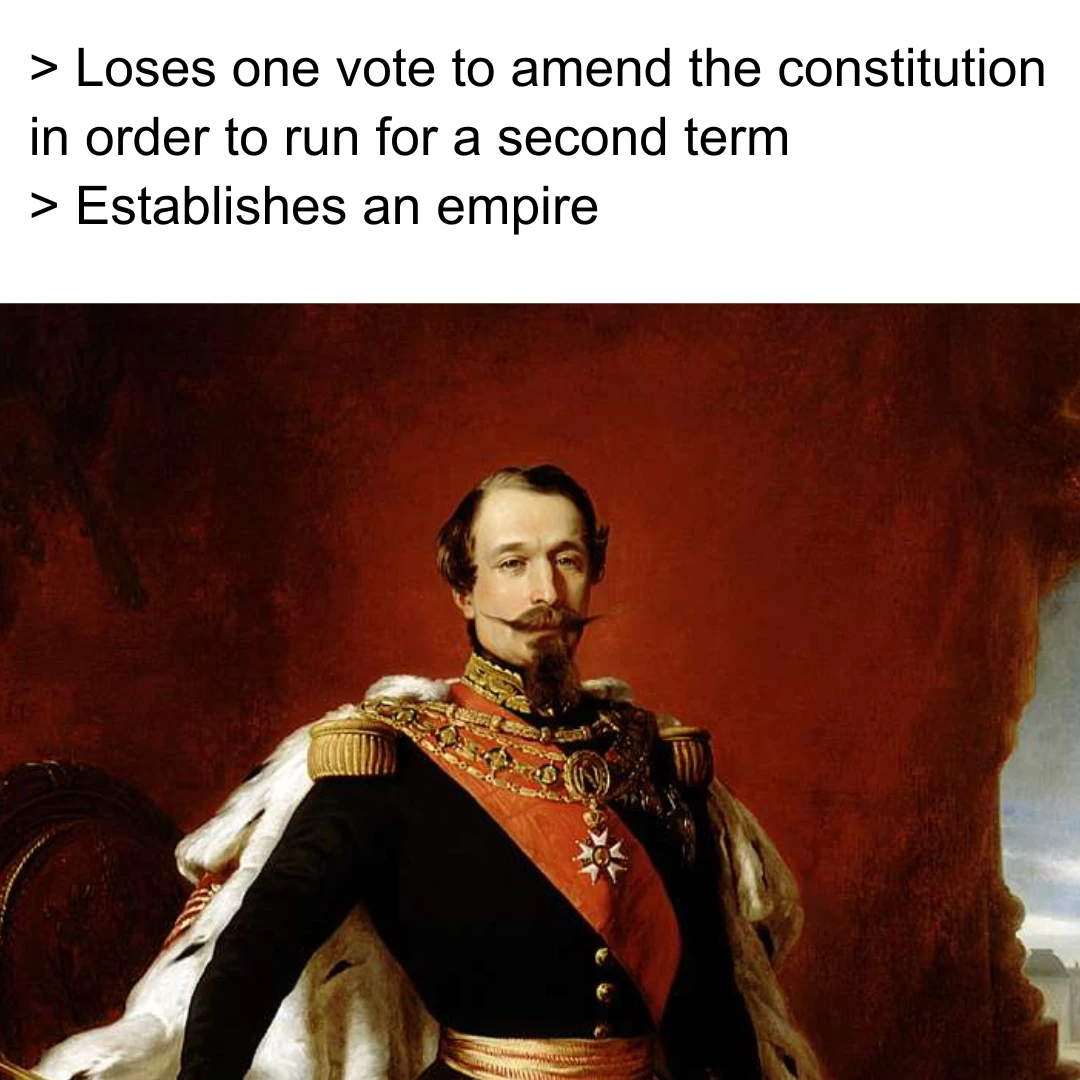
Louis Napoleon, the nephew of Napoleon III, was elected the first president of France in 1848. However, he had to step down at the end of his term in 1852 as the French Constitution of 1848 didn't allow consecutive presidential terms. Louis Napoleon sought a constitutional amendment to allow him to succeed himself, arguing that four years were not enough to fully implement his political and economic program. He toured the country and gained support from many of the regional governments and many within the Assembly. The vote in July 1851 was 446 to 278 in favor of changing the law and allowing him to run again, but this was short of the two-thirds majority needed to amend the constitution.
Louis Napoleon believed that he was supported by the people and he chose to retain power by other means. His half-brother Charles, duc de Morny, and a few close advisors quietly began to organize a coup d'état. On the night of 1–2 December, soldiers quietly occupied the national printing office, the Palais Bourbon, newspaper offices, and the strategic points in the city. In the morning, Parisians found posters around the city announcing the dissolution of the National Assembly, the restoration of universal suffrage, new elections, and a state of siege in Paris and the surrounding departments. Sixteen members of the National Assembly were arrested in their homes. When about 220 deputies of the moderate right gathered at the city hall of the 10th arrondissement, they were also arrested. On 3 December, writer Victor Hugo and a few other republicans tried to organize an opposition to the coup.
Louis Napoleon wished to demonstrate that his new government had a broad popular mandate, so on 20–21 December a national plebiscite was held asking if voters agreed to the coup. Mayors in many regions threatened to publish the names of any electors who refused to vote. When asked if they agreed to the coup, 7,439,216 voters said yes, 641,737 voted no, and 1.7 million voters abstained. The fairness and legality of the referendum was immediately questioned by Louis Napoleon's critics, but Louis Napoleon was convinced that he had been given a public mandate to rule.
The 1851 referendum gave Louis Napoleon a mandate to amend the constitution. Work began on the new document in 1852. It was officially prepared by a committee of eighty experts but was actually drafted by a small group of the Prince-President's inner circle. Under the new constitution, Louis Napoleon was automatically reelected as president. Under Article Two, the president could now serve an unlimited number of 10-year terms. He was given the absolute authority to declare war, sign treaties, form alliances and initiate laws. The Constitution re-established universal male suffrage, and also retained a National Assembly, albeit one with reduced authority.
An election was held for a new National Assembly on 29 February 1852. All resources of the government were used on behalf of the candidates backing the Prince-President. The new Assembly included a small number of opponents of Louis Napoleon.
Despite now holding all governing power in the nation, Louis Napoleon was not content with being an authoritarian president. The ink had barely dried on his new, severely authoritarian constitution when he set about restoring the empire. In response to officially inspired requests for the return of the empire, the Senate scheduled another referendum for 21–22 November 1852 on whether to make Napoleon emperor. After an implausible 97 percent voted in favour (7,824,129 votes for and 253,159 against, with two million abstentions), on 2 December 1852—exactly one year after the coup—the Second Republic was officially ended, replaced by the Second French Empire. Prince-President Louis Napoleon Bonaparte became Napoleon III, Emperor of the French. His regnal name treats Napoleon II, who never actually ruled, as a true Emperor (he had been briefly recognized as emperor from 22 June to 7 July 1815). The 1852 constitution was retained; it concentrated so much power in Napoleon's hands that the only substantive changes were to replace the word "president" with the word "emperor", and make the post hereditary.
#history
Louis Napoleon, the nephew of Napoleon III, was elected the first president of France in 1848. However, he had to step down at the end of his term in 1852 as the French Constitution of 1848 didn't allow consecutive presidential terms. Louis Napoleon sought a constitutional amendment to allow him to succeed himself, arguing that four years were not enough to fully implement his political and economic program. He toured the country and gained support from many of the regional governments and many within the Assembly. The vote in July 1851 was 446 to 278 in favor of changing the law and allowing him to run again, but this was short of the two-thirds majority needed to amend the constitution.
Louis Napoleon believed that he was supported by the people and he chose to retain power by other means. His half-brother Charles, duc de Morny, and a few close advisors quietly began to organize a coup d'état. On the night of 1–2 December, soldiers quietly occupied the national printing office, the Palais Bourbon, newspaper offices, and the strategic points in the city. In the morning, Parisians found posters around the city announcing the dissolution of the National Assembly, the restoration of universal suffrage, new elections, and a state of siege in Paris and the surrounding departments. Sixteen members of the National Assembly were arrested in their homes. When about 220 deputies of the moderate right gathered at the city hall of the 10th arrondissement, they were also arrested. On 3 December, writer Victor Hugo and a few other republicans tried to organize an opposition to the coup.
Louis Napoleon wished to demonstrate that his new government had a broad popular mandate, so on 20–21 December a national plebiscite was held asking if voters agreed to the coup. Mayors in many regions threatened to publish the names of any electors who refused to vote. When asked if they agreed to the coup, 7,439,216 voters said yes, 641,737 voted no, and 1.7 million voters abstained. The fairness and legality of the referendum was immediately questioned by Louis Napoleon's critics, but Louis Napoleon was convinced that he had been given a public mandate to rule.
The 1851 referendum gave Louis Napoleon a mandate to amend the constitution. Work began on the new document in 1852. It was officially prepared by a committee of eighty experts but was actually drafted by a small group of the Prince-President's inner circle. Under the new constitution, Louis Napoleon was automatically reelected as president. Under Article Two, the president could now serve an unlimited number of 10-year terms. He was given the absolute authority to declare war, sign treaties, form alliances and initiate laws. The Constitution re-established universal male suffrage, and also retained a National Assembly, albeit one with reduced authority.
An election was held for a new National Assembly on 29 February 1852. All resources of the government were used on behalf of the candidates backing the Prince-President. The new Assembly included a small number of opponents of Louis Napoleon.
Despite now holding all governing power in the nation, Louis Napoleon was not content with being an authoritarian president. The ink had barely dried on his new, severely authoritarian constitution when he set about restoring the empire. In response to officially inspired requests for the return of the empire, the Senate scheduled another referendum for 21–22 November 1852 on whether to make Napoleon emperor. After an implausible 97 percent voted in favour (7,824,129 votes for and 253,159 against, with two million abstentions), on 2 December 1852—exactly one year after the coup—the Second Republic was officially ended, replaced by the Second French Empire. Prince-President Louis Napoleon Bonaparte became Napoleon III, Emperor of the French. His regnal name treats Napoleon II, who never actually ruled, as a true Emperor (he had been briefly recognized as emperor from 22 June to 7 July 1815). The 1852 constitution was retained; it concentrated so much power in Napoleon's hands that the only substantive changes were to replace the word "president" with the word "emperor", and make the post hereditary.
#history


| 4,000 mlx | |
| 5 | |
| 0 |